Budgeting, Accounting and Reporting System (BARS)
Cash Basis
For Cities, Counties and Special Purpose Districts
Source: https://sao.wa.gov/bars-annual-filing/bars-cash-manual
Last updated on October 10, 2026
The BARS Manual has been updated for all the Fiscal Year 2025 accounting and reporting requirements. This update occurred on December 1, 2025.
The annual report for the fiscal year ended December 31, 2025, is required by Saturday, May 30, 2026 (RCW 43.09.230).
The Budgeting, Accounting and Reporting System (BARS) Manual directs accounting and reporting standards for local governments in accordance with RCW 43.09.200. Its purpose is to provide (1) uniform accounting and financial reporting to allow for meaningful use and comparison of financial data; (2) accounting and reporting instructions as a resource for local government managers; and (3) a consistent framework for financial reporting to intended users, including managers, governing bodies, granting and regulatory agencies, the state Legislature, and the general public.
The manual is maintained by the State Auditor's Office with input from the Local Government Advisory Committee. It is continuously reviewed to ensure prescription and instructions remain current and appropriate to meet the needs of intended users.
This manual is designated for all cash basis cities, counties and special purpose districts.
View the detailed Alerts and Changes tab for current year updates.
In need of technical assistance? Visit the Help Desk.
In accordance with the Americans with Disabilities Act, we will make this document available in alternative formats. For more information, please contact our Office at (564) 999-0950, TDD Relay at (800) 833-6388, or email our webmaster at webmaster@sao.wa.gov.
BARS Account Exports
In this section, governments can access a report providing information on the allowability of BARS codes in fund types as well as export a chart of accounts specific to a government type.
BARS Codes to Fund Type
BARS codes may be restricted for use in the annual report filing system. The following matrix “Codes to Funds” identifies which fund group(s) that each active BARS code may be reported in.
Download FY2025 Codes to Funds here. Codes are as of December 1, 2025.
Note: It is recommended to use this matrix in conjunction with the government specific BARS Account Export provided below.
BARS Account Export
Download a government specific BARS Chart of Accounts in the export box at the bottom of this page.
Your annual report requires seven digits for all account codes however, their display in the chart of accounts export varies. The expenditure or expense accounts are presented in the export without object codes. Object codes will need to be added to the BARS Code to complete the required seven digits for the annual report. Additional details about object codes are available in the BARS Manual 1.4, Object Codes. Reporting at the sub object level is not required.
How to use the BARS Account Export
Select a government type
The government type selection will limit the BARS accounts that are applicable to the selected government type. If all is selected, the export will include BARS accounts for all government types.
Select basis of accounting
The basis of accounting selection will limit the BARS accounts that are applicable to the basis of accounting selected (GAAP or Cash). If all is selected, the export will include all the BARS codes regardless of their applicability to a specific basis.
Select export type
The Excel option provides a spreadsheet which you can format.
The PDF is formatted to highlight the different categories of account codes and for printing. For display purposes, the account codes contain decimal points which should be excluded in your annual report.
Select a reporting level
Above and Prescribed option includes all the accounts, including the accounts in which other codes are rolled up into for category presentation. These above prescribed codes are not valid for reporting; however they provide detailed information on the category of the codes. This listing also provides the Prescribed accounts, which are the required accounts for annual report filing.
The Prescribed option includes only the accounts which are the valid BARS account codes for annual report filing.
1 Charts of Accounts
1.1.2 Account Structure
1.1.2.10 All BARS codes are required to be seven-digits for reporting purposes on the Schedule 01. Local governments may include additional digits within their internal account structure, such as fund numbers and added digits for tracking details. If a different system of numbers is used for internal accounting, it must contain equivalent detail throughout the budget, accounting, and reporting process.
See BARS 3.1.7, Fund Accounting and Fund Types for the structure of fund numbers, which are separate from the required structure of BARS codes.
1.1.2.20 The seven-digit BARS code structure has the following components:
First digit
3 (three) represents beginning balances, revenues, and other increases.
5 (five) represents ending balances, expenditures/expenses, and other decreases.
Second and third digits
Revenues – represents the source (origin or originating category) of revenues. These digits are always prescribed and required for reporting on the Schedule 01.
Expenditures – represents the different functions and activities for which the expenditures/other decreases are supporting.
Fourth and fifth digits
Revenues – represents further details for specific types of revenues within a particular source.
Expenditures – represents further details for specific elements and sub-elements of activities related to the particular function and activity.
Sixth and seventh digits
Revenues – these digits are generally not defined and are represented as zeros. When these digits are represented as zeros, they are available for customization by the local government. However, there are exceptions to this rule. The BARS codes within the 330 series prescribe all seven digits and cannot be customized. Local governments should be aware that as the BARS manual is updated, these digits may be assigned for specific purposes.
Expenditures – represents the object code, which identifies the specific type of items that support the activity or function. For additional information on object codes, please see BARS 1.4, Object Codes.
1.1.2.30 The tables below provide an overview of the major categories of BARS codes. For the complete listing of all BARS codes with their full definitions, go to BARS Account Export.
Beginning and Ending Cash and Investments
|
300 |
|
Beginning Cash and Investments |
|
|
308 |
Beginning Cash and Investments |
|
500 |
|
Ending Cash and Investments |
|
|
508 |
Ending Cash and Investments |
Major categories of revenues by source
|
310 |
|
Taxes |
|
|
311 |
Property Tax |
|
|
313 |
Retail Sales and Use Taxes |
|
|
316 |
Business and Occupation Taxes |
|
|
317 |
Excise Taxes in Lieu of Property Tax |
|
|
318 |
Other Taxes |
|
320 |
|
Licenses and Permits |
|
|
321 |
Business Licenses and Permits |
|
|
322 |
Non-Business Licenses and Permits |
|
330 |
|
Intergovernmental Revenues |
|
|
331 |
Federal Direct Awards |
|
|
332 |
Federal Other Award Revenues |
|
|
333 |
Federal Indirect Awards |
|
|
334 |
State Grants, Awards, and Other Contributions |
|
|
335-336 |
State Shared Revenues, Entitlements and Impact Payments |
|
|
337 |
Local Awards, Entitlements, Tribal Government Distributions, and Other Payments |
|
340 |
|
Charges for Goods and Services |
|
|
341 |
General Government |
|
|
342 |
Public Safety |
|
|
343 |
Utilities |
|
|
344 |
Transportation |
|
|
345 |
Natural and Economic Environment |
|
|
346 |
Social Services |
|
|
347 |
Culture and Recreation Fees |
|
|
348 |
Internal Service Funds Sales and Services |
|
350 |
|
Fines and Penalties |
|
|
351 |
Superior Court - Felony/Misdemeanor Penalties |
|
|
352 |
Civil Penalties |
|
|
353 |
Civil Infraction Penalties |
|
|
354 |
Civil Parking Infraction Penalties |
|
|
355 |
Criminal Traffic Misdemeanor Fines |
|
|
356 |
Criminal Non-Traffic Fines |
|
|
357 |
Criminal Costs |
|
|
359 |
Non-Court Fines and Penalties |
|
360 |
|
Miscellaneous Revenues |
|
|
361 |
Interest and Other Earnings |
|
|
362 |
Rents and Leases |
|
|
367 |
Contributions and Donations from Nongovernmental Sources |
|
|
368 |
Special Assessments |
|
|
369 |
Other Miscellaneous Revenues |
Other Increases and Financing Sources
|
380 |
|
Other Increases in Fund Resources |
|
|
381 |
Interfund Loan Receipts |
|
|
382 |
Deposits, Retainage and Other Collections |
|
|
385 |
Special or Extraordinary Items |
|
|
386 |
Court Remittances |
|
|
388 |
Other Increases in Fund Balance |
|
|
389 |
Custodial Activities |
|
390 |
|
Other Financing Sources |
|
|
391 |
Debt Issued |
|
|
392 |
Premiums on Bonds Issued |
|
|
393 |
Refunding Long-Term Debt Issued |
|
|
395 |
Disposition of Capital Assets |
|
|
397 |
Transfers-In |
|
|
398 |
Insurance Recoveries |
Major functions of expenditures
|
510 |
|
General Government |
|
|
511 |
Legislative Activities |
|
|
512 |
Judicial Activities |
|
|
513 |
Executive Activities |
|
|
514 |
Financial, Recording and Election Activities |
|
|
515 |
Legal Services |
|
|
517 |
Employee Benefit Programs |
|
|
518 |
Centralized/General Services |
|
|
519 |
Risk Management Services |
|
520 |
|
Public Safety |
|
|
521 |
Law Enforcement Activities |
|
|
522 |
Fire and Emergency Medical Activities |
|
|
523 |
Detention/Correction Activities |
|
|
524 |
Protective Inspection Services |
|
|
525 |
Disaster Services |
|
|
527 |
Juvenile Services |
|
|
528 |
Dispatch Services |
|
530 |
|
Utilities |
|
|
531 |
Storm Drainage Utilities |
|
|
532 |
Television/Cable/Internet Utilities |
|
|
533 |
Electric/Gas Utilities |
|
|
534 |
Water Utilities |
|
|
535 |
Sewer/Reclaimed Water Utilities |
|
|
536 |
Cemetery |
|
|
537 |
Solid Waste Utilities |
|
|
538 |
Combined Utilities |
|
|
539 |
Irrigation/Reclamation Utilities |
|
540 |
|
Transportation |
|
|
542 |
Roads/Streets Ordinary Maintenance |
|
|
543 |
Roads/Streets General Administration and Overhead |
|
|
544 |
Roads/Streets Operations |
|
|
545 |
Roads/Streets Extraordinary Operations |
|
|
546 |
Airports and Ports |
|
|
547 |
Transit, Railroads and Other Transportation Systems |
|
|
548 |
Public Works – Centralized Services |
|
550 |
|
Natural and Economic Environment |
|
|
551 |
Public Housing Services |
|
|
552 |
Employment Opportunity |
|
|
553 |
Conservation |
|
|
554 |
Environmental Services |
|
|
557 |
Community Services |
|
|
558 |
Community Planning and Economic Development |
|
|
559 |
Property Development |
|
560 |
|
Social Services |
|
|
561 |
Hospitals, Assisted Living and Convalescent Facilities |
|
|
562 |
Public Health Services |
|
|
563 |
Coroner/Medical Examiner |
|
|
564 |
Mental Health Services |
|
|
565 |
Welfare/Veterans Services/Services for Disabled/Homeless Services/Domestic Violence |
|
|
566 |
Chemical Dependency Services |
|
|
567 |
Children Services |
|
|
568 |
Developmental Disabilities Services |
|
|
569 |
Aging and Disability Services |
|
570 |
|
Culture and Recreation |
|
|
571 |
Educational and Recreational Activities |
|
|
572 |
Libraries |
|
|
573 |
Cultural and Community Events |
|
|
575 |
Cultural and Recreational Facilities |
|
|
576 |
Park Facilities |
Other Decreases and Financing Uses
|
580 |
|
Other Decreases in Fund Resources |
|
|
581 |
Interfund Loan Disbursements |
|
|
582 |
Deposits, Retainage and Other Remittances |
|
|
585 |
Special or Extraordinary Items |
|
|
588 |
Other Decreases in Fund Balance |
|
|
589 |
Custodial Activities |
|
590 |
|
Debt Expenditures, Capital Outlays, and Other Financing Uses |
|
|
591 |
Debt Repayment |
|
|
592 |
Interest and Other Debt Service Costs |
|
|
593 |
Advance Refunding Escrow |
|
|
594 |
Capital Expenditures |
|
|
595 |
Roads/Streets and Related Infrastructure: Improvements and New Construction Projects |
|
|
596 |
Issuance Discount on Long-Term Debt |
|
|
597 |
Transfers-Out |
|
|
599 |
Payments for Refunded Debt |
1 Charts of Accounts
1.4 Object Codes
00 Depreciation, Amortization, Other Decreases in Fund Resources and Transfers-Out
Use this category with the accounts 501, 581, 582, 585, 586, 588, 589, and 597.
10 Salaries and Wages
Use this object code for the gross amounts paid for personal services rendered by employees in accordance with the rates, hours, terms and conditions authorized by law or stated in employment contracts. This category also includes overtime, hazardous duty or other compensation construed to be salaries and wages. Governments may subdivide this account as necessary for detailed local purpose reporting (i.e., regular pay, overtime pay, sick pay (employee related), sick pay (non-employee related), vacation pay, shift differential, and other taxable compensation).
Personal services do not include fees and out-of-pocket expenditures for professional or consultant services performed on assignments. Such services are properly classified as object code 40.
20 Personnel Benefits
Use this object code for the employer’s share of benefits provided to employees, in addition to compensation, that are part of the conditions of current or past employment. Governments may subdivide this account as needed for detailed local purpose reporting (i.e., health/vision/dental insurance, unemployment compensation payments and/or premiums, Social Security, Medicare taxes, uniforms, pension, and workers' compensation).
Payments for pay-as-you-go health and welfare plans, or pension/OPEB plans would be coded to personnel benefits. Payments to fund either a self-insurance fund for health and welfare type benefits or a pension/OPEB fund would also be coded to personnel benefits, then subsequent payment from the self-insurance funds and non-fiduciary pension/OPEB funds for all claims would use object code 40 for the payments.
30 Supplies for Consumption and Resale
Use this object code for:
40 Services and Pass-Through Payments
Use this object code for professional and technical services which are provided by other governments (federal, state, local), other funds, or by private entities as well as for pass-through payments as described below.
Services include but aren’t limited to the following examples:
Pass-through payments include eligible intergovernmental payments, contributions and grants that the government has received from federal, state, or other local governments and are passed through to other entities.
60 Capital Outlays
Use this object code for expenditures related to the purchase or construction of assets considered capital according to the government’s capitalization threshold policy. This object code should be used only with accounts 594 and 595.
Include expenditures related to acquisition of, rights to, or additions to capital assets, including incidental costs such as legal, appraisal and brokerage fees, land preparation and demolishing buildings, fixtures and delivery costs. This category includes purchases and construction of major capital assets which are purchased or constructed by the external party. Assets constructed or fabricated by the municipality should be classified under other object codes; i.e., wages under object code 10, materials, small tools and minor equipment under object code 30, etc. Include:
70 Debt Service – Principal
Use this object code with codes 591, 593, 594 (cash basis only), 596 and 599. Include general obligation, revenue, special assessment bonds, long-term leases/SBITA, installment purchases, anticipation and other notes, anticipation warrants, contracts, intergovernmental loans, other debt, LOCAL program payments, etc.
80 Debt Service – Interest and Issuance Costs
Use this object code with codes 592, 593, 594 (cash basis only) and 599. Include interest on short and long-term external debt, interest on interfund debt, interests on debt to joint ventures and affiliates, LID assessments, interest on intergovernmental debt, leases, interest paid on overdue taxes (RCW 84.69.070), debt issuance and other debt service costs.
1 Charts of Accounts
1.2 Optional - General Ledger Accounts
1.2.10 The specific account numbers contained here are not prescribed, with an exception for selected liabilities accounts which are required to be reported on the Schedule of Liabilities (Schedule 09). Use of general ledger accounts in cash basis governments is optional. This general ledger has been carefully designed to meet several needs, generally the highest need being an accounting systems requirement for a full chart of accounts.
1.2.20 First, the accounts provide for identification of assets, deferred outflows, liabilities, deferred inflows and fund balance/net position (beginning and ending cash and investment balances for cash governments) that any local government fund might acquire. Throughout the general ledger, the fourth or fifth and subsequent digits have been left for local governments to use in establishing more detailed breakdowns where needed.
1.2.30 Second, the general ledger has been designed to permit logical summarization of the detailed accounts at various levels, such as rolling up cash and investment totals separately from liability totals.
1.2.40 Third, the comprehensiveness of the general ledger combined with the uniform summarization discussed above is designed to make the preparation balance sheets a simple matter of extracting the balances at the same level for all the funds of a government. The headings on the attached chart identify which digits to sort or summarize by for reporting purposes. The presentation of a balance sheet is structured in similar manner as the general ledger accounts as shown in the attached chart.
1.2.50 The following excel file provides the list of optional general ledger accounts. The “GL Accounts” tab provides account titles and their corresponding account number. The “GL Accts w Descriptions” tab provides account titles and their corresponding account number along with account descriptions.
Download the excel workbook here: General Ledger Accounts
2 Budgeting
2.4 Budget Compliance
2.4.1 Introduction
2.4.1.10 A budget is a legal document that forecasts the financial resources of a government and authorizes the spending of those resources for a fiscal period. At a minimum, local governments’ budget must meet the requirements of Washington state law and the State Auditor’s Office. The SAO does not prescribe how to budget or what a budget should look like. The adopted budget should be of sufficient detail to be meaningful and meet the intention of the law. The SAO considers budgets showing revenues and expenditures at the legal fund level to be the minimum acceptable level of detail.
2.4.1.20 Budgeting is more than just an activity to satisfy state law. It is a sophisticated process of strategic planning, communication and policy development resulting in a detailed plan of operations for allocating and monitoring the use of limited resources among various competing demands. Teaching how to budget is outside the scope of the BARS. However, there are many educational resources available to local governments, such as the Municipal Research and Services Center (mrsc.org) and the Government Finance Officers Association (gfoa.org).
2.4.1.30 Glossary of budgetary terms:
Annual/biennial appropriated budget – A fixed budget adopted for the government’s fiscal period. The appropriated budget was traditionally used to determine a government’s property tax levy, and a ceiling on expenditures was made absolute so that the expenditures of a government unit would not exceed its revenues. This budget was also historically a balanced budget, estimated revenues equaling appropriations. The appropriated budget is still used to set tax levies and some budget statutes still require balanced budgets, but it is more generally used to authorize a specific amount of expenditures regardless of whether estimated resources meet or exceed that amount. Appropriated budgets are required by statute in cities (Chapter 35.32A RCW, Chapter 35.33 RCW and Chapter 35A.33 RCW), counties (Chapter 36.40 RCW), and most other local governments in Washington State. These budgets are also called legal budgets, adopted budgets, or formal budgets. The appropriated budgets should be adopted by ordinance or resolution.
Appropriation – The legal spending level authorized by a budget ordinance or resolution. Spending should not exceed this level without prior approval of the governing body.
Capital improvement budget – Consists of two elements: the annual/biennial portion of capital projects and annual/biennial appropriations for the purchase, construction or replacement of major fixed assets in the current fiscal period.
Comprehensive budget – A government-wide budget that includes all resources the government expects and everything it intends to spend or encumber during a fiscal period. The comprehensive budget contains annual/biennial appropriated budgets, the annual/biennial portion of continuing appropriations such as the capital improvement projects, debt amortization schedules, and grant projects, flexible budgets and all non-budgeted funds.
Continuing appropriation – A fixed budget which authorizes expenditures for a fiscal period that differs from the government’s fiscal year, such as capital projects, debt issues, grant awards, and other service projects. These expenditures require an ordinance or resolution to authorize the project, establish the assessment roll, adopt the debt amortization schedule, or accept the grant award. Such ordinances or resolutions set an absolute maximum or ceiling on the expenditures, but the time period for incurring expenditures does not coincide with the government’s fiscal year; it may even cover several years. The major difference between annual/biennial appropriated budgets and continuing appropriations is that the latter do not lapse at fiscal period end; this implies that no legislative action is required to amend the annual/biennial portion of a continuing appropriation, unless the total authorized expenditures would exceed the entire appropriation.
Encumbrances – Commitments related to unperformed (executory) contracts for goods or services should be utilized to the extent necessary to assure effective budgetary control and to facilitate cash planning. Encumbrances outstanding at year end represent the estimated amount of expenditures ultimately to result if unperformed contracts in process are completed; they do not constitute expenditures or liabilities.
Final amended budget – The original budget adjusted by all reserves, transfers, allocations, supplemental appropriations, and other legally authorized legislative and executive changes applicable to the fiscal year, whenever signed into law or otherwise legally authorized.
Fixed budget – Those budgets which set an absolute maximum or ceiling on the expenditures of a particular fund, department, or other specific category. A fixed budget can be either an annual/biennial appropriated budget or a continuing appropriation. Fixed budgets must be adopted by ordinance or resolution, either for the government’s fiscal period or at the outset of a service project, debt issue, grant award, or capital project.
Flexible budgets – Are usually regarded as managerial tools, which do not set a ceiling on expenses or expenditures but establish a plan for them at various levels of service. They are especially appropriate for the day-to-day operations of a public utility where it is essential to plan fluctuations in the demand for services and where revenues will automatically increase with demand, so that a balanced budget does not depend on establishing a ceiling for expenses.
Operating budget – Presents the estimated expenditures and available resources necessary to provide the services for which the government was created. An operating budget will contain flexible budgets and fixed budgets; the fixed budgets will include annual/biennial appropriations for services and the annual/biennial portion of continuing appropriations for debt service and for service projects.
Original budget – The first complete appropriated budget. The original budget may be adjusted by reserves, transfers, allocations, supplemental appropriations, and other legally authorized legislative and executive changes before the beginning of the fiscal year. The original budget should also include actual appropriation amounts automatically carried over from prior years by law.
Working capital budget – Combines flexible and fixed budget elements in one document for enterprise and internal service funds. Current operations are flexibly budgeted based on the estimated level of services to be provided and long-range sources and uses of assets are controlled by annual/biennial appropriations and continuing appropriations.
2 Budgeting
2.4 Budget Compliance
2.4.3 Budget Adoption and Amendments
2.4.3.10 All taxing districts must file certified levies and budgets with the county per RCW 84.52.020. All taxing districts are required to hold a public hearing on the proposed levy and budget (excluding capital, enterprise, and special-assessment funds) and adopt their levy by ordinance or resolution per RCW 84.55.120.
2.4.3.20 Additional specific requirements for local governments that are required to expend within their budget are as follows:
2.4.3.30 Requirements for local governments that are not limited to expenditures within their budget are as follows:
Budget amendments
2.4.3.40 For governmental funds (except those types specifically identified above in 2.4.3.30), budgeted appropriations are legally binding. This means that the government cannot spend more than the amount budgeted. As new information becomes available throughout the year, the government can amend (increase) the budget through formal processes. Budget compliance is determined at the end of the fiscal period. Therefore, amendments may be done at any time during the fiscal period, but cannot be done after the fiscal period. If the entity adopts a biennial budget, amendments may be made at any time during the biennium. Regardless, budgetary authority must be in place before actual expenditures are made.
The following local governments have specific requirements for adoption of supplemental budgets:
2 Budgeting
2.4 Budget Compliance
2.4.2 Budget Process
2.4.2.10 The budgetary process encompasses a number of different activities and decisions over a period of several months. See the budget calendar below for cities and counties. Similar steps can be used to develop all types of budgets.
|
BUDGET CALENDAR |
|||
| Steps in Budget Preparation | Cities | Counties | |
|
1 |
BUDGET ESTIMATES Department heads are requested by clerk to prepare estimates of revenue and expenditures for the next fiscal year. |
On or before the second Monday of the fourth month prior to the beginning of the city's/town's next fiscal year (i.e., September). |
On or before the second Monday in July. |
|
RCW 35.33.031 (2nd, 3rd, towns, 1st class |
RCW 36.40.010 |
||
|
RCW 35.34.050 (Biennial Budgets) |
|||
|
RCW 35A.33.030 (Code Cities) |
|||
|
RCW 35A.34.050 (Code Cities - Biennial Budgets) |
|||
|
2 |
BUDGET ESTIMATES Estimates are to be filed with the city clerk/county auditor. |
On or before the fourth Monday in September. |
On or before the second Monday in August. |
|
RCW 35.33.031 (2nd, 3rd, towns, 1st class |
|||
|
RCW 35.34.050 (Biennial Budgets) |
RCW 36.40.010 |
||
|
RCW 35A.33.030 (Code Cities) |
|||
|
RCW 35A.34.050 (Code Cities - Biennial Budgets) |
|||
|
3 |
PROPOSED PRELIMINARY BUDGET Estimates are presented to the chief administrative officer for modification, revision, or additions. |
On or before the first business day in October. |
County auditor or chief financial officer shall prepare the county budget. |
|
RCW 35.33.051 (2nd, 3rd, towns, 1st class |
RCW 36.40.040 |
||
|
RCW 35.34.070 (Biennial Budgets) |
|||
|
RCW 35A.33.050 (Code Cities) |
|||
|
RCW 35A.34.070 (Code Cities - Biennial Budgets) |
|||
|
4 |
PRELIMINARY BUDGET Chief administrative officer provides the legislative body with: |
(a) Revenue estimates (setting of levies) due no later than the first Monday in October. |
(a) Revenue estimates are part of the preliminary budget process and due when preliminary budget is due. See next section. |
|
(a) Estimates of revenues (setting of levies), |
RCW 35.33.135 (2nd, 3rd, towns, 1st class |
||
|
RCW 35.34.230 (Biennial Budgets) |
|||
|
RCW 35A.33.135 (Code Cities) |
|||
|
RCW 35A.34.230 (Code Cities - Biennial Budgets) |
|||
|
(b) Clerk's proposed preliminary budget, and |
(b) Preliminary budget at least 60 days before the beginning of the next fiscal year and, |
(b) Preliminary budget submitted by the auditor to the Board of County Commissioners on or before the 1st Tuesday in September for adoption of the preliminary budget. |
|
|
(c) Copies of the preliminary budget are made available to the public. |
(c) Copies are made available to the public not later than six weeks before the beginning of the city's next fiscal period. |
(c) Copies of the preliminary budget are available to the public not later than two weeks immediately preceding the first Monday in October. |
|
|
RCW 35.33.055 (2nd, 3rd, towns, 1st class |
|||
|
RCW 35.34.080 (Biennial Budgets) |
|||
|
RCW 35A.33.052 (Code Cities) |
|||
|
RCW 35A.34.080 (Code Cities - Biennial Budgets) |
|||
|
5 |
NOTICE OF PUBLIC HEARING Clerk publishes notice of filing of preliminary budget with city clerk and publishes notice of public hearing on final budget once a week for two consecutive weeks. |
Published no later than the first two weeks in November. |
Notice shall be published once each week for two consecutive weeks immediately following adoption of the preliminary budget. |
|
RCW 35.33.061 (2nd, 3rd, towns, 1st class |
RCW 36.40.060 |
||
|
RCW 35.34.100 (Biennial Budgets) |
|||
|
RCW 35A.33.060 (Code Cities) |
|||
|
RCW 35A.34.100 (Code Cities - Biennial Budgets) |
|||
|
6 |
PUBLIC HEARING Budget hearing is held. |
On or before the first Monday of December, and may be continued from day to day but not later than the 25th day prior to the commencement of the new fiscal year. |
On the first Monday in October. |
|
RCW 35.33.071 (2nd, 3rd, towns, 1st class |
RCW 36.40.070 |
||
|
RCW 35.34.110 (Biennial Budgets) |
|||
|
RCW 35A.33.070 (Code Cities) |
|||
|
RCW 35A.34.110 (Code Cities - Biennial Budgets) |
|||
|
7 |
FINAL BUDGET Adoption of budget for next fiscal year. |
Following the conclusion of the hearing and prior to the beginning of the fiscal year, the legislative body shall by ordinance adopt the budget in its final form. |
At the conclusion of the budget hearing, the county legislative authority shall by resolution adopt the budget. |
|
A copy of the finalized budget must be sent to the Association of Washington Cities. |
A copy of the finalized budget must be sent to the State Auditor's Office. |
||
|
RCW 35.33.075 (2nd, 3rd, towns, 1st class |
RCW 36.40.080 |
||
|
RCW 35.34.120 (Biennial Budgets) |
|||
|
RCW 35A.33.075 (Code Cities) |
|||
|
RCW 35A.34.120 (Code Cities - Biennial Budgets) |
|||
Which funds need budgets?
2.4.2.20 Generally, all governmental funds including the general fund (also called the current expense fund) and special revenue funds of a local government must have annual/biennial appropriated budgets. Most debt service and capital project fund budget requirements are met by the continuing appropriation contained in the enabling legislation. These funds may not need annual/biennial appropriated budgets.
2.4.2.30 Expenses of proprietary, internal service and fiduciary funds are not considered to be appropriations and therefore are only subject to budgeting requirements as required by the government’s policy.
2.4.2.40 Fiduciary and permanent funds are subject to the trust agreement and their use is restricted by such.
2.4.2.50 Local governments may separately account for different aspects of a legal fund in several “sub-funds” on their general ledger for managerial purposes and roll-up these funds for financial reporting purposes. The minimum level of detail for budget purposes is the legal fund level.
2.4.2.60 Budgeted expenditures (or estimated expenses) should be limited to the amount of budgeted revenues plus the beginning fund balance. Governments are not authorized to appropriate (or estimate) more resources for expenditures than are available. Note that this requirement only applies at the legal fund level. Entities may budget a negative fund balance for departments, programs or sub-funds so long as the combined fund balance for the legal fund is positive.
What constitutes appropriations?
2.4.2.70 All final amounts budgeted as expenses, expenditures, transfers and other financing uses for a fund or department is the appropriation. The government cannot legally exceed this amount. Ending fund balance and nonrevenues (BARS 508 and 58X, if shown on the budget) would not be considered an appropriation. Only line items shown as expenditures (BARS 51X-57X and 59X) would be considered appropriations.
3 Accounting
3.1 Accounting Principles and Internal Control
3.1.10 Accounting Principles
3.1.10.10 The following principles are basic rules of accounting and financial reporting for cash basis cities, counties and special purpose districts.
3.1.10. 20 Common terminology and classification
A common terminology and classification should be used consistently throughout the budget, the accounts, and the financial reports of each fund. The notes to the financial statements should also include common terminology and classification.
3.1.10.30 Revenue, expenditure and transfer classifications
Governments should download the chart of accounts for the appropriate basis of accounting and government type each year by using the BARS Account Export.
Governmental and proprietary funds
Revenues should be classified by fund and by the sources indicated in the government specific chart of accounts.
Expenditures should be classified by fund and by the appropriate functional, capital, debt, or other uses indicated in the government specific chart of accounts.
Interfund transfers, proceeds from debt issuances and proceeds from capital asset disposition should be classified separately from fund revenues and expenditures as indicated in the government specific chart of accounts.
Fiduciary fund
Additions and deductions should be by fund and the sources and uses of resources as indicated in the government specific chart of accounts.
3.1.10.35 Reimbursements from external parties
Corrections of an error, receipt of a refund for an expenditure (example: returning a supply or cancelling a training class), or the receipt of a vendor discount/rebate awarded after the transaction is completed would qualify as reimbursement and as such, they should be treated in similar manner like interfund reimbursements, see BARS 3.9.4, Interfund Reimbursements. If a local government has an ongoing relationship with an external entity (e.g., phone company, etc.) the amounts of reimbursements most likely would be included in the upcoming bill, so no adjusting entry is required. If the reimbursement is related to the expenditure from the previous fiscal year and is immaterial, the amount of reimbursement should be recorded as revenue. If it is material, the government should record the reimbursement as an error correction, see BARS 3.1.10.70 below.
Examples of transactions that should not be accounted for as reimbursements include: state payments for public health services, expert witnesses, police salaries while attending criminal justice training; federal/state/local payments for the care and custody of prisoners and for election costs; local payments for data processing services, police/sheriff services, street maintenance, etc.; private payments for street repairs, culvert installations, weed control, demolition of dangerous property, subleases, etc.
3.1.10.40 Basis of accounting
Basis of accounting refers to when revenues and expenditures are recognized and reported in the financial statements.
Revenues are recognized only when cash is received, and expenditures are recognized when chargeable against the report year’s budget appropriations as required by state law. This generally results in revenues being recognized when delivered to the government or government’s agent and expenditures being recognized when paid. Warrants and checks are considered paid when issued. An exception to expenditure recognition would be during any open period after the close of the fiscal year when expenditures can be charged against the previous period for claims incurred in the previous period. Open periods are required by statute for cities (RCW 35.33.151) and RCW 35A.33.150) and allowed for counties (RCW 36.40.200). Special purpose districts which use the county or a city as their treasurer may use the same open period as their treasurer. If a special purpose district acts as its own treasurer, no open period is allowed by statute.
Revenues and expenditures should be reported at gross amounts by account and not netted against each other.
Revenues and expenditures should be recognized for all receipts and payments of a government’s resources, including those where the cash is handled by an agent (such as a bank, underwriter, escrow, etc.) on behalf of the government rather than handled directly by the local government. For example, debt proceeds wired directly to an escrow account, payments by the State Treasurer’s Office to vendors for items purchased with LOCAL resources, etc.
Interest earned on investments may be recognized at cost, amortized cost or fair value, in accordance with the government’s disclosed accounting policy.
In addition, revenue and expenditures should also be recognized when the government agrees to forgo receiving earned revenue in exchange for reduction of expenses (offsetting agreement) or receipt of an asset (e.g., acquiring an asset in exchange for reduced permit fees, etc.). The government should also recognize transactions in which cash may have been exchanged by third parties on behalf of the government (e.g., bond issuances and bond retirement transactions, loan advances deposited and held by a trustee). In such cases, the transactions are still reportable since the government experienced a transaction of economic or legal substance that would have resulted in cash inflows and outflows into the government’s accounts if the agreement was not in place or third party had not handled the transaction on behalf of the government. The transaction should be recorded as if the cash was received and expended in order to reflect the legal transaction.
This basis results in no reported assets other than cash and investments and no reported liabilities. For example, purchases of capital assets are expensed during the year of acquisition without any capitalization of capital assets or allocation of depreciation expense. However, liabilities should be reported on Schedule 09 and in the notes in financial statements.
3.1.10.50 Interim and annual financial reports
a. Appropriate interim financial statements and reports of operating results and other pertinent information should be prepared to facilitate management control of financial operations, legislative oversight, and, where necessary or desired, for external reporting purposes. (examples of required interim reports by RCW 35.33.141, RCW 35A.33.140 and RCW 36.40.210)
b. Annual reporting requirements are prescribed by the State Auditor’s Office. See BARS 4.1.5, Reporting Requirements and Filing Instructions for Cities and Counties or BARS 4.1.6, Reporting Requirements and Filing Instructions for Special Purpose Districts for details.
3.1.10.60 Accounting changes and error corrections - definitions
Accounting changes and error corrections occur in governments in three separate situations, as listed below.
Change in accounting principle:
This occurs when switching from one generally accepted accounting principle to another or adopting a new standard as required by the BARS Manual.
Change to or within the financial reporting entity:
a. A government opens or closes a fund and needs to move all related financial activity
b. A change in reporting at the fund level. For example:
1) A government reports a fiduciary fund and moves that activity to a fund of the primary government, or vice versa.
2) A special revenue fund no longer qualifies to be a special revenue fund and will be rolled into the general fund, or vice versa.
3) A proprietary fund that was reported separately and will now be reported as part of another proprietary fund.
Error correction:
An error occurs when any of the following are identified as of the previous financial statement date:
a. Mathematical mistake
b. Mistake in the application of accounting principles
c. Oversight or misuse of facts that existed at the time the financial statements were issued about conditions that existed as of the financial statement date is identified
d. Amounts that are refunded to the government (or fund) that are material from prior year financial activity
3.1.10.70 Accounting changes and error corrections - accounting and reporting
Accounting and reporting for each change and error correction category is discussed below. If an entity is required to submit notes, a note disclosure is required to be presented with each accounting change and/or error correction that occurs during the fiscal year (see Note X - Accounting Changes and Error Corrections).
Change in accounting principle:
Governments that implement or adopt a new accounting standard should record activity as if the accounting principle was in place as of the beginning of the fiscal year. BARS code 388.50.00 or 588.50.00 should be used to restate the beginning balance as of the beginning of the year.
Change to or within the financial reporting entity:
Governments that undergo a change to or within the reporting entity should record the activity as if the change occurred as of the beginning of the fiscal year. BARS code 388.40.00 or 588.40.00 should be used to adjust the beginning balance as of the beginning of the year.
For example, if a government has opened a new fund in the fiscal year, the change in the would reflect on the financial statement as if the fund had opened on first day of the fiscal year. All activity for the year would then be captured in the appropriate fund.
Error correction:
Governments required to correct an error should record the cumulative effect of the error in the fiscal year that the error is identified. BARS code 388.30.00 or 588.30.00 should be used to restate the beginning balance as of the beginning of the fiscal year.
For example, one fund incorrectly recognized an expenditure that should have been recognized by another fund which was identified in a subsequent fiscal year. As a result, the government is required to record an error correction to reflect the expenditure in the responsible fund in the fiscal year that the error was identified. In the fund that originally recognized the expenditure, the government should record the amount of the expenditure as a credit to BARS code 388.30.00 and should record the same amount in the fund that should have recognized the expenditure as a debit to BARS code 588.30.00
3 Accounting
3.1 Accounting Principles and Internal Controls
3.1.7 Fund Accounting and Fund Types
3.1.7.10 The following principles are basic rules of accounting and financial reporting for cash basis cities, counties and special purpose districts.
3.1.7.20 Accounting and reporting capabilities
A governmental accounting system must make it possible to determine and demonstrate compliance with finance related legal and contractual provisions.
3.1.7.30 Fund accounting systems
A governmental accounting system should be organized and operated on a fund basis. A fund is defined as a fiscal and accounting entity with a self-balancing set of accounts recording cash and other financial resources, together with all related expenditures and residual balances, and changes therein, which are segregated for the purpose of carrying on specific activities or attaining certain objectives in accordance with special regulations, restrictions, or limitations.
3.1.7.40 Types of funds
In fund financial statements, governments should report governmental, proprietary, and fiduciary funds to the extent that they have activities that meet the criteria for using these funds. Presented below is a system to classify all funds used by local government and the assignment of code numbers to identify each type of fund. A three-digit code is used: the first digit identifies the fund type, and the next two digits will be assigned by the government to identify each specific fund.
Since counties account for special purpose districts in their accounting systems as fiduciary funds, they often provide the districts with reports showing assigned fund codes 630-699. These codes refer to the fund from the county perspective. A district has to “reassign” the county code to the code appropriate to the fund type it is reporting (e.g., if the district’s general fund is coded in the county records as 663, the district in its annual report has to code this fund as 001).
For reporting purposes local governments are required to follow the fund structure described below. However, the local governments may create other funds for accounting or managerial purposes. When preparing external financial reports, those funds should be rolled to appropriate fund types as discussed at BARS 3.1.12, Managerial Funds.
Governmental funds
Code 000 - General (Current Expense) Fund – should be used to account for and report all financial resources not accounted for and reported in another fund. For reporting purposes, the local government can have only one general fund.
Although a local government has to report only one general fund in its external financial reports, the government can have multiple subfunds for its internal managerial purposes. These funds should follow guidance found at BARS 3.1.12, Managerial Funds.
Code 100 - Special Revenue Funds – may be used to account for and report the proceeds of specific revenue sources that are restricted or committed to expenditure for specific purposes other than debt service or capital projects. Restricted revenues are resources externally restricted by creditors, grantors, contributors or laws or regulations of other governments or restricted by law through constitutional provisions or enabling legislation. Committed revenues are resources with limitations imposed by the highest level of the government (e.g., board of commissioners, city council, etc.) through a formal action (resolution, ordinance) and where the limitations can be removed only by a similar action of the same governing body. Revenues do not include other financing sources (long-term debt, transfers, etc.).
The term proceeds of specific revenue sources establishes that one or more specific restricted or committed revenues should be foundation for a special revenue fund. They should be expected to continue to comprise a substantial portion of the inflows reported in the fund. It is recommended that at least 20 percent is a reasonable limit for restricted and committed revenues to create a foundation for a special revenue fund. Local governments need to consider factors such as past resource history, future resource expectations and unusual current year inflows such as debt proceeds in their analysis.
They may use the calculation below to determine whether an activity would qualify for reporting as a special revenue fund.
|
Substantial portion of inflows = |
(restricted revenues + committed revenues) |
|
total resources* reported in the fund |
*Total resources would include all revenues and other financing sources.
Other resources (investment earnings and transfers from other funds, etc.) also may be reported in the fund if these resources are restricted, committed, or assigned (intended) to the specific purpose of the fund.
Governments should discontinue reporting a special revenue fund, and instead report the fund’s remaining resources in the general fund, if the government no longer expects that a substantial portion of the inflows will derive from restricted or committed revenue sources.
All revenues must be recognized in the special revenue fund. If the resources are initially received in another fund, such as the general fund, and subsequently remitted to a special revenue fund, they should not be recognized as revenue in the fund initially receiving them. They should be recognized as revenue in the special revenue fund from which they will be expended.
Special revenue funds should not be used to account for resources held in trust for individuals, private organizations, or other governments.
The state statutes contain many requirements for special funds to account for different activities. The legally required funds do not always meet standards for external reporting. So, while the local governments are required to follow their legal requirements, they will have to make some adjustment to their fund structure for external financial reporting.
Code 200 - Debt Service Funds – may be used to account for and report financial resources that are restricted, committed, or assigned (intended) to expenditure for principal and interest. Debt service funds should be used to report resources if legally mandated. Financial resources that are being accumulated for principal and interest maturing in future years also should be reported in debt service funds. The debt service transactions for a special assessment for which the government is not obligated in any matter should be reported in a custodial fund. Also, if the government is authorized, or required to establish and maintain a special assessment bond reserve, guaranty, or sinking fund, it is required to use a debt service fund for this purpose.
Note: Debt service funds should not be used in proprietary funds (400 and 500). Use enterprise funds (400) or internal service (500) for debt payments related to utilities and other business type activities.
Code 300 - Capital Projects Funds – may be used to account for and report financial resources that are restricted, committed, or assigned (intended) for expenditure for capital outlays including the acquisition or construction of capital facilities or other capital assets. Capital outlays financed from general obligation bond proceeds should be accounted for through a capital projects fund. Capital project funds exclude those types of capital-related outflows financed by proprietary funds or for assets that will be held in trust for individuals, private organizations, or other governments (private-purpose trust funds).
Note: Capital project funds should not be used in proprietary funds (400 and 500). Use enterprise funds (400) or internal service (500) for capital payments related to utilities and other business type activities.
Code 700 - Permanent Funds – should be used to account for and report resources that are restricted to the extent that only earnings, and not principal, may be used for purposes that support the reporting government’s programs – that is for the benefit of the government or its citizens (public-purpose).
Permanent funds are required to have a nonspendable cash balance for the principal portion that cannot be spent. Any unspent interest remaining in the fund would be reported under one of the other cash balance classifications, such as restricted.
Generally, only the principal amounts, interest revenue, and transfers to the appropriate operating fund for interest revenue use should be reported in this fund. Note: if the allowable use of the interest earnings is related to operating expenses that are normally reported in another fund, the permanent fund should transfer the allowable amount to the appropriate operating fund.
Permanent funds do not include private-purpose trust funds which account for resources held in trust for individuals, private organizations, or other governments.
Proprietary funds
Code 400 - Enterprise Funds – may be used to report any activity for which a fee is charged to external users for goods or services. Enterprise funds are required for any activity whose principal revenue sources meet any of the following criteria:
These criteria should be applied in the context of the activity’s principal revenue source.
The term activity generally refers to programs and services. This term is not synonymous with fund. As a practical consequence, if an activity reported as a separate fund meets any of the three criteria, it should be an enterprise fund. Also, if a “multiple activity” fund (e.g., general fund) includes a significant activity whose principal revenue source meets any of these three criteria, the activity should be reclassified as an enterprise fund.
The determination of an activity’s principal revenue source is a matter of professional judgement. A good indicator of the activity’s significance may be comparing pledged revenues or fees and charges to total revenue. For example, consider a county auditor’s office that charges fees to provide a payroll service to various taxing districts. Even if the fee is meant to cover the cost of the service, the county auditor function as a whole is primarily supported with tax dollars from the general fund. It would be allowable in this case to leave the activity all within general fund.
Finding an appropriate fund type requires a careful analysis since there is not always a clear choice. For example, building permit fees may be accounted for in the general fund or a special revenue fund in certain circumstances, such as when they are partially supported by taxes. However, if there is a pricing policy to recover the cost of issuing those individual building permits, they should be reported in an enterprise fund.
Separate funds are not required for bond redemption, construction, reserves, or deposits, for any utility. If separated, use 400 series number. Separate funds are not required even though bond covenants may stipulate a bond reserve fund, bond construction fund, etc. The bond covenant use of the term fund is not the same as the use in governmental accounting. For bond covenants, fund means only a segregation or separate account, not a self-balancing set of accounts.
Local governments may separate operating, capital projects and debt functions of enterprise funds. However, when reporting such proprietary activities, all those functions should be rolled into one fund.
Code 500 - Internal Service Funds – may be used to report any activity that provides goods or services to other funds, departments or agencies of the government, or to other governments, on a cost-reimbursement basis. Internal service funds should be used only if the reporting government is the predominant participant in the activity. Otherwise, the activity should be reported in an enterprise fund. Cash basis special purpose districts (such as a fire or water district) should not use the internal service fund category. For more information on accounting for these funds see BARS 3.9.6, Internal Service Funds.
Note: When calculating the predominant participant, purchases from fiduciary funds would be considered part of the reporting government’s activity, but the BARS coding would still be to an external customer.
Fiduciary funds
In general, fiduciary funds are resources that are held by a government for the benefit of others.
To determine if an activity should be reported in a fiduciary custodial fund see BARS 3.1.11, Determining Fiduciary Activities to be Reported in Custodial Funds.
If activity is determined to be fiduciary, the funds should be reviewed for trust arrangements and equivalents. The three criteria for determining if a fiduciary activity is a trust are:
Code 600 - Fiduciary Funds – should be used to account for assets held by a government in a trustee capacity or as a custodian for individuals, private organizations, other governmental units, and/or other funds. These include (a) investment trust funds, (b) pension (and other employee benefit) trust funds, (c) private-purpose trust funds, (d) custodial funds and (e) external investment pool funds.
Code 600-609 - Investment Trust Funds – should be used to report fiduciary activities from the external portion of investment pools and individual investment accounts that are held in a trust or equivalent that meets the criteria above.
In addition to the trust criteria requirements above, all individual investment accounts are required to be reported in an Investment Trust Fund.
Code 610-619 - Pension (and Other Employee Benefit) Trust Funds – should be used to report fiduciary activities for pension plans and OPEB plans that are administered through qualifying trusts. Qualifying trusts are those in which:
If you are acting as administrator for someone else’s pension/OPEB plans, the plans still must meet the criteria above to be reported in a trust fund.
Code 620-629 - Private-Purpose Trust Funds – should be used to report all fiduciary activities that (a) are not required to be reported in pension (and other employee benefit) trust funds or investment trust funds, and (b) are held in a trust or equivalent that meets the criteria above.
Code 630-698 - Custodial Funds – should be used to report all fiduciary activities that are not required to be reported in pension (and other employee benefit) trust funds, investment trust funds or private purpose trust funds. The external portion of the investment pools that are not held in trust that meets criteria listed above should be reported in a separate external investment pool fund column under the custodial funds classification.
Note: The custodial funds are required to be used by business-type activities and enterprise funds, except when the resources will normally be held for less than ninety (90) days.
Code 699 - External Investment Pool Fund – The external portion of the investment pools that are not held in trust and meet criteria listed above. Although this is considered a custodial fund, it should be reported in a separate external investment pool fund column under the custodial funds classification.
3.1.7.50 Number of funds
Governments should establish and maintain those funds required by law and sound financial administration. Only the minimum number of funds consistent with legal and operating requirements should be established. Using numerous funds results in inflexibility, undue complexity, and inefficient financial administration.
Local governments should periodically undertake a comprehensive evaluation of their fund structure to ensure that individual funds that became superfluous are eliminated from accounting and reporting.
Elected officials should be educated to the fact that fiscal accountability may be achieved effectively and efficiently by use of department, program and other available account coding or the cautious use of managerial (internal) funds. See guidance at BARS 3.1.12, Managerial Funds for additional information regarding managerial funds.
3 Accounting
3.1 Accounting Principles and Internal Controls
3.1.11 Determining Fiduciary Activities to be Reported in Custodial Funds
3.1.11.10 Purpose
Due to the generally accepted accounting principles established by the Governmental Accounting Standards Board and Washington State law that requires the Office of the Washington State Audit to prescribe a uniform system of accounting for local governments, fiduciary activities implementation is required by all local governments. The accounting standards for these activities only provide a framework which could lead to incorrect implementation, therefore the Auditor’s Office has prescribed certain activities as custodial and therefore should be reported in a Fiduciary Custodial Fund. Additionally, the Auditor’s Office has prescribed certain activities that may appear custodial, but are ultimately not custodial and therefore would be reported in the appropriate governmental or proprietary fund.
Business Type Activities: If the resources are normally held for less than 90 days, then fiduciary reporting is not required for those resources.
3.1.11.20 Determination questions
1. Are the assets associated with the activity controlled by the government?
A government is considered to be controlling assets if either:
(a) The government holds the assets. An example of holding assets is when a government receipts money or has the money in the government’s bank account.
or
(b) The government has the ability to direct the use, exchange, or employment of the assets in a manner that provides benefits to the specified or intended recipients.
For purposes of this criteria a government uses an asset when it expends or consumes that asset for the benefit of individuals, organization, or other governments, outside of the government’s provision of services to them.
Restrictions from legal or other external restraints that stipulate the assets can be used only for a specific purpose do not negate a government's control of the assets. When a government appoints a designee to act on its behalf, the designee is performing the government's fiduciary duties and not assuming them. Thus, appointing a designee to act on its behalf does not alter the government's ability to direct the use, exchange, or employment of the assets.
Examples include:
The holding government is the treasurer for another government or acting as their bank.
The government is on the bank account such as construction accounts with contractors.
Any asset the government is holding for another government where the holding government is not using the asset for their own operations.
If "no", this is not a fiduciary custodial activity; if "yes", proceed.
2(a). Are the assets derived solely from the government's own-source revenues?
Own-source revenues are revenues that are generated by a government itself. They include exchange and exchange-like revenues (for example, water and sewer charges for service) and investment earnings. Derived tax revenues (such as leasehold taxes) and imposed nonexchange revenues (such as property taxes) are also included in own-source revenue.
Each component of a transaction must be separately evaluated.
Examples include:
When a local government leases office space the lease revenue is own-source revenue while the collected leasehold excise tax is not own-source revenue because that portion is imposed by the state under Chapter 82.29A RCW.
When a county or city imposes an impact fee those revenues are generated by that government and are own-source revenue even when those resources are required to be 100 percent remitted to other governments (such as to a school, fire or park district). The county’s or city’s ability to levy the fee by RCW means this revenue is own-source revenue.
If "yes", this is not a fiduciary custodial activity; if "no", proceed.
2(b). Are the assets associated with the activity from either government-mandated or voluntary nonexchange transactions?
Government-mandated nonexchange transactions, occur when a government provides resources to another government and requires the recipient government to use the resources for a specific purpose (for example, federal programs that state or local governments are mandated to perform or state programs that local governments are mandated to perform).
Examples include:
Washington State Department of Revenue’s requirement that all sales tax be remitted to the State for allocation and disbursement.
Washington State’s mandate on cities and counties to perform concealed permit processing.
Voluntary nonexchange transactions, result from legislative or contractual agreements, other than exchanges, entered into willingly by the parties to the agreement (for example, certain grants and private donations for government programs).
Examples include:
Administrative Office of the Courts mandated fees collected by cities and counties.
Washington State Department of Licensing functions that counties are contracted to perform.
Donations to a government for one of its programs would be voluntary nonexchange revenue and the answer would be "yes". However, a donation given to a government for the benefit of a third party would be answered "no" (this revenue classification does not apply because the resources are not governmental revenue)
If "no" (meaning not government-mandated or voluntary exchange transactions), proceed to step (3); if "yes" proceed to 2(c).
2(c). Are the assets from pass-through grants for which the government does not have administrative involvement or direct financial involvement?
A government has administrative involvement if it, for example (a) monitors secondary recipients for compliance with program-specific requirement, (b) determines eligible secondary recipients or projects, even if using grantor-established criteria, or (c) has the ability to exercise discretion in how the funds are allocated.
A government has direct financial involvement if it, for example, (a) finances some direct program costs because of grantor-imposed matching requirements, or (b) is liable for disallowed costs.
An example is:
A government does not have administrative involvement when a jail corrections officer approves inmate purchases ordered outside the corrections facility (to help ensure that contraband does not enter the facility). Keeping contraband out of the facility is a general goal of the government and not specific to overseeing the use of those funds.
If "no" (meaning the government has administrative or direct financial involvement), this is not a fiduciary activity; if "yes", proceed.
3. Are any one of the following three sets of criteria true? (all parts of the individual set must be met)
3(a). The assets are:
(a) administered through a trust in which the government itself is not a beneficiary,
(b) dedicated to providing benefits to recipients in accordance with the benefit terms, and
(c) legally protected from the creditors of the government.
If this set of criteria is true the assets should be reported in a fiduciary trust fund.
or
3(b). The assets are:
(a) for the benefit of individuals and
(b) the government does not have administrative involvement with the assets or direct financial involvement with the assets.
(c) In addition, the assets are not derived from the government's provision of goods and services to those individuals.
Provision of goods and services examples:
The government sells maps, umbrellas, utilities (water/sewer), etc.
The government provides services such as finger printing, background checks, etc.
Examples of when this set of criteria is true is inmate accounts for commissary purchases and patient accounts in certain medical facilities.
or
3(c). The assets are:
(a) for the benefit of organizations or other governments that are not part of the financial reporting entity and
(b) not derived from the government's provision of goods or services to those organization or other governments.
Examples include:
In evaluating each component of a transaction — collected leasehold excise tax is fiduciary because those specific dollars are for the benefit of the state and the tax is not derived from the collecting governments provision of goods or service to the state (the provision of services is to a third party).
When a government has a component unit that is considered part of the financial reporting entity, the component unit would not be reported in the fiduciary funds. The exception would be if the government was the acting fiscal agent, then the government would report the component unit in its custodial funds.
If "yes" to any one of the three sets of criteria, fiduciary reporting is applicable and activities should be reported in the custodial funds; if "no", this is not a fiduciary activity.
3.1.11.30 Prescribed custodial transactions
Below is a list of prescribed custodial fund activities, including the responses to the custodial criteria questions.
Leasehold tax and other state mandated taxes
Step 1 – Are the assets associated with the activity controlled by the government?
Yes, the collecting government receives the tax and is holding the monies in their bank account until the monies are remitted to the State.
Step 2(a) – Are the assets derived solely from the government's own-source revenues?
No, these taxes are levied by the State through RCWs therefore they are not solely from the reporting government’s own-source revenue.
Step 2(b) – Are the assets associated with the activity from either government-mandated or voluntary nonexchange transactions?
Yes, these monies are from derived government-mandated tax revenue.
Step 2(c) – Are the assets from pass-through grants for which the government does not have administrative involvement or direct financial involvement?
No, these monies are not from a grant and the reporting government does not have administrative or direct financial involvement.
Step 3(a) – Are the assets held in a trust or equivalent arrangement and the government itself is not a beneficiary?
No, these monies are not in a trust.
Step 3(b) – Are the assets for the benefit of individuals and the government does not have administrative involvement or direct financial involvement?
No, these monies are not for the benefit of individuals.
Step 3(c) – Are the assets for the benefit of organizations or other governments that are not part of the financial reporting entity? Are assets held for organizations or other governments not derived from the collecting government’s provision of goods or services to those organizations or other governments?
Yes, these monies are for the benefit of the State and the State is not part of the collecting government’s financial reporting entity. Yes, the collecting government did not provide a good or service to the State.
Conclusion: Leasehold tax and other state mandated taxes are fiduciary activities and should be reported in the custodial funds.
Department of Licensing accounts (counties only)
Step 1 – Does the government control the asset?
Yes, the collecting government’s name and tax identification number are on the bank account.
Step 2(a) – Are the assets derived solely from the government’s own-source revenue?
No, the State amounts are collected in addition to the local government’s revenues and are mandated by state law.
Step 2(b) – Are the assets derived from government-mandated or voluntary nonexchange transactions?
No, these monies are not from a government-mandated or nonexchange transaction.
Step 2(c) – Are the assets derived from a pass-through grant for which the government has administrative involvement or direct financial involvement?
No, these monies are not from a grant and the collecting government does not have administrative or direct financial involvement.
Step 3(a) – Are the assets held in a trust or equivalent arrangement and the government itself is not a beneficiary?
No, these monies are not in a trust.
Step 3(b) – Are the assets for the benefit of individuals and the government does not have administrative involvement or direct financial involvement?
No, these monies are not for the benefit of individuals.
Step 3(c) – Are the assets for the benefit of organizations or other governments that are not part of the financial reporting entity? Are assets held for organizations or other governments not derived from the collecting government’s provision of goods or services to those organizations or other governments?
Yes, these monies are for the benefit of the State and the State is not part of the collecting government’s financial reporting entity. Yes, the collecting government did not provide a good or service to the State Department of Licensing.
Conclusion: The portion of the licensing fees that are the State’s portion are fiduciary activities and should be reported in the custodial funds. The collecting government’s portion of these fees are the government’s own-source revenue and should be reported in the reporting government’s governmental or proprietary funds.
Permits and certificates fees (concealed pistol permits, birth certificates, etc.)
Step 1 – Does the government control the asset?
Yes, the collecting government receives the fees and is holding the monies in their bank account until the monies are remitted to the State.
Step 2(a) – Are the assets derived solely from the government’s own-source revenue?
No, the State amounts are collected in addition to the local government’s revenues and are mandated by state law.
Step 2(b) – Are the assets derived from government-mandated or voluntary nonexchange transactions?
No, these monies are not derived from a government-mandated or nonexchange transaction.
Step 2(c) – Are the assets derived from a pass-through grant for which the government has administrative involvement or direct financial involvement?
No, these monies are not from a grant and the reporting government does not have administrative or direct financial involvement.
Step 3(a) – Are the assets held in a trust or equivalent arrangement and the government itself is not a beneficiary?
No, these monies are not in a trust.
Step 3(b) – Are the assets for the benefit of individuals and the government does not have administrative involvement or direct financial involvement?
No, these monies are not for the benefit of individuals. While the citizen is receiving a certificate/permit from the city or county the citizen is not receiving a good or service from the government imposing the fee and issuing the permits and/or certificates (the State).
Step 3(c) – Are the assets for the benefit of organizations or other governments that are not part of the financial reporting entity? Are assets held for organizations or other governments not derived from the collecting government’s provision of goods or services to those organizations or other governments?
Yes, these monies are for the benefit of the State and the State is not part of the collecting government’s financial reporting entity. Yes, the collecting government did not provide a good or service to the State.
Conclusion: The portion of the permit/certificate fees that are the State’s portion are fiduciary activities and should be reported in the custodial funds. The collecting government’s portion of these fees are for the direct benefit of the collecting government and should be reported in the collecting government’s governmental or proprietary funds.
Flexible Savings Accounts and Health Savings Accounts (Government holds the monies for an administrator and reimburses based on administrator determination).
Step 1 – Does the government control the asset?
Yes, the collecting government is holding the monies for an administrator.
Step 2(a) – Are the assets derived solely from the government’s own-source revenue?
No, these deposits are from the employee’s revenues and not the government’s directly.
Step 2(b) – Are the assets derived from government-mandated or voluntary nonexchange transactions?
No, these monies are not government-mandated or voluntary nonexchange transaction.
Step 2(c) – Are the assets derived from a pass-through grant for which the government has administrative involvement or direct financial involvement?
No, these monies are not from a grant and the reporting government does not have administrative or direct financial involvement.
Step 3(a) – Are the assets held in a trust or equivalent arrangement and the government itself is not a beneficiary?
No, these monies are not in a trust.
Step 3(b) – Are the assets for the benefit of individuals and the government does not have administrative involvement or direct financial involvement?
Yes, these monies are for the benefit of employees under the IRS requirements.
Step 3(c) – Are the assets for the benefit of organizations or other governments that are not part of the financial reporting entity?
No, the administrator and the government have a contract that requires the government to collect the monies for the employees and reimburse for approved expenses.
Conclusion: Flexible Savings Accounts and Health Savings Accounts where the reporting government is holding the monies for the administrator of the plan and reimburses the employees based on direction from the administrator of the plan are fiduciary funds.
3.1.11.40 Prescribed non-custodial activities
Impact fees (cities & counties only)
Step 1 – Does the government control the asset?
Yes, the collecting government receives the fees and is holding the monies in their bank account until the monies are remitted to the school, fire, or park district.
Step 2(a) – Are the assets derived solely from the government’s own-source revenue?
Yes, these fees can only be levied by the collecting government per state law (RCW 82.02.050 - 82.02.110 and WAC 365-196-850).
Conclusion: Not a fiduciary activity. Under state law, only cities and counties can authorize and levy impact fees for school, fire, or park districts. Since the city or county is levying the impact fees these monies would be own-source revenue and reported in the governmental funds of the city or county.
Retainage and refundable deposits
Step 1 – Does the government control the asset?
Yes, the collecting government receives the fees and is holding the monies in their bank account until the contracting party meets their obligations.
Step 2(a) – Are the assets derived solely from the government’s own-source revenue?
Yes, although these deposits could be revenues for the collecting government, as revenue recognition is dependent on the contracting party meeting certain criteria in order for the collecting government to remit the retainage and/or deposit to the contracting party.
Conclusion: Not a fiduciary activity, since these monies are derived from the government’s own-source revenue. Therefore the retainage and refundable deposits should be reported in the government’s governmental or proprietary funds.
Payroll clearing accounts
Step 1 – Does the government control the asset?
Yes, the collecting government receives the fees and is holding the monies in their bank account until remittance to the mandating government (federal and/or state).
Step 2(a) – Are the assets derived solely from the government’s own-source revenue?
No, these deposits are from the employee’s revenues and not the government’s directly.
Step 2(b) – Are the assets derived from government-mandated or voluntary nonexchange transactions?
No, these monies are not government-mandated or voluntary nonexchange transaction.
Step 2(c) – Are the assets derived from a pass-through grant for which the government has administrative involvement or direct financial involvement?
No, these monies are not from a grant and the reporting government does not have administrative or direct financial involvement.
Step 3(a) – Are the assets held in a trust or equivalent arrangement and the government itself is not a beneficiary?
No, these monies are not in a trust.
Step 3(b) – Are the assets for the benefit of individuals and the government does not have administrative involvement or direct financial involvement?
No, these monies are not for the direct benefit of individuals. While the employee benefits from the employing government withholding and paying the employee’s portion of taxes and other payroll items, the employee’s government is obligated by law to withhold and pay the appropriate employee related payroll withholdings.
Step 3(c) – Are the assets for the benefit of organizations or other governments that are not part of the financial reporting entity?
No, the mandating authority (federal and/or state government) requires the employing government to collect and remit these monies and has the legal authority to enforce the liability on the employing government.
Conclusion: Not a fiduciary activity, since these monies are for the benefit of the collecting government and therefore these items should be reported on the financial statements of the collecting government.
Flexible Savings Accounts and Health Savings Accounts (Government holds the monies for an administrator and makes reimbursement decisions).
Step 1 – Does the government control the asset?
Yes, the collecting government is holding the monies for an administrator.
Step 2(a) – Are the assets derived solely from the government’s own-source revenue?
No, these deposits are from the employee’s revenues and not the government’s directly.
Step 2(b) – Are the assets derived from government-mandated or voluntary nonexchange transactions?
No, these monies are not government-mandated or voluntary nonexchange transaction.
Step 2(c) – Are the assets derived from a pass-through grant for which the government has administrative involvement or direct financial involvement?
No, these monies are not from a grant and the reporting government does not have administrative or direct financial involvement.
Step 3(a) – Are the assets held in a trust or equivalent arrangement and the government itself is not a beneficiary?
No, these monies are not in a trust.
Step 3(b) – Are the assets for the benefit of individuals and the government does not have administrative involvement or direct financial involvement?
No, while these monies are for the benefit of employees under the IRS requirements since the government is making reimbursement decisions there is administrative involvement.
Step 3(c) – Are the assets for the benefit of organizations or other governments that are not part of the financial reporting entity?
No, the administrator and the government have a contract that requires the government to collect the monies for the employees and reimburse for approved expenses.
Conclusion: Not a fiduciary activity, since these monies are under the administrative control of the government.
Court accounting
Cities and counties with their own court
1. Administrative Office of the Courts (AOC) mandated fees (BARS Codes 386/586)
Step 1 – Does the government control the asset?
Yes, the government is collecting the fines and fees and holding the monies in their bank account until remitting the monies to the State.
Step 2(a) – Are the assets derived solely from the government’s own-source revenue?
No, the AOC/state amounts are collected in addition to the local government’s revenue.
Step 2(b) – Are the assets derived from government-mandated or voluntary nonexchange transactions?
No, these monies are not a government-mandated or nonexchange transaction.
Step 2(c) – Are the assets derived from a pass-through grant for which the government has administrative involvement or direct financial involvement?
No, these monies are not from a grant and the reporting government does not have administrative or direct financial involvement.
Step 3(a) – Are the assets held in a trust or equivalent arrangement and the government itself is not a beneficiary?
No, these monies are not held in a qualifying trust.
Step 3(b) – Are the assets for the benefit of individuals and the government does not have administrative involvement or direct financial involvement?
No, these monies are not for the benefit of individuals.
Step 3(c) – Are the assets for the benefit of organizations or other governments that are not part of the financial reporting entity? Are assets held for organizations or other governments not derived from the collecting government’s provision of goods or services to those organizations or other governments?
Yes, these monies are for the benefit of the state and the state is not part of the collecting government’s financial reporting entity. Yes, these funds are for the state and the local government’s court is not providing a direct service to the state.
Conclusion: AOC fees are fiduciary activities and should be reported in the custodial funds.
2. Local government revenue fines and fees BARS Codes
Step 1 – Does the government control the asset?
Yes, the government is collecting the fines and fees and holding the monies in their bank account.
Step 2(a) – Are the assets derived solely from the government’s own-source revenue?
Yes, as an example, the city’s police department or the county’s sheriff department issued the tickets during the performance of their public safety function and the revenue is generated by the city/county for their own use.
Conclusion: Not a fiduciary activity, the local government’s fines and fees are the government’s own revenue.
3. State distributions to local government
Step 1 – Does the government control the asset?
No, the State controls the money and distributes the money.
Conclusion: Not a fiduciary activity, the monies are not reported by the city/county until the money is received by the city/county from the state and would be considered own-source revenue upon receipt.
Cities and counties that contract for court
1. Administrative Office of the Courts (AOC) mandated fees (BARS Codes 386/586)
Step 1 – Does the government control the asset?
Cities and counties that contract out for court services generally do not remit monies to the Administrative Office of the Courts (AOC). The court providing the service to the city/county generally remits the AOC monies for the contracting city/county. The city/county contracting for court services would therefore not report AOC fines and fees in their custodial funds.
2. Local government revenue fines and fees BARS Codes
Step 1 – Does the government control the asset?
No, the city or county does not control the asset, since the court the city contracted with holds the asset in their bank account.
Conclusion: Not a fiduciary activity, the monies are not the city/county until remitted from the court provided to the city/county.
3. Payment for court services
Step 1 – Does the government control the asset?
No, there is no asset. This is an expense for the city or county receiving the court services.
Conclusion: Not a fiduciary activity, this is a direct expense for the city/county receiving the court services and should be coded to BARS code 512.5P.PP.
Cash basis – providing court services
1. Administrative Office of the Court (AOC) mandated fees (386/586) – Please see above BARS 3.1.11.40.
2. Court provider’s collection/remittance of the fines and fees for the city/county receiving the court service
Step 1 – Does the government control the asset?
Yes, the court provider is collecting the fines and fees and holding the monies in their bank account.
Step 2(a) – Are the assets derived solely from the government’s own-source revenue?
No, these fines and fees are levied/ticketed by another government.
Step 2(b) – Are the assets derived from government-mandated or voluntary nonexchange transactions?
No, these monies are not a government-mandated or nonexchange transaction.
Step 2(c) – Are the assets derived from a pass-through grant for which the government has administrative involvement or direct financial involvement?
No, these monies are not from a grant and the collecting government does not have administrative or direct financial involvement.
Step 3(a) – Are the assets held in a trust or equivalent arrangement and the government itself is not a beneficiary?
No, these monies are not held in a qualifying trust.
Step 3(b) – Are the assets for the benefit of individuals and the government does not have administrative involvement or direct financial involvement?
No, these monies are not for the benefit of individuals.
Step 3(c) – Are the assets for the benefit of organizations or other governments that are not part of the financial reporting entity? Are assets held for organizations or other governments not derived from the collecting government’s provision of goods or services to those organizations or other governments?
Yes, these monies are for the benefit of the city or county and the city or county is not part of the collecting government’s financial reporting entity. No, the collecting government is providing a service (court) for a fee to another government.
Conclusion: Not a fiduciary activity, the fines and fees are collected by the court provider for the local government for a fee and would be reported in the collecting government’s financial reports under BARS codes 382.30 and 582.30.
3. Revenue for court services
Step 1 – Does the government control the asset?
Yes, the government is collecting the fee holding the monies in their bank account.
Step 2 – Are the assets derived solely from the government’s own-source revenue?
Yes, this is the court provider’s revenue for performing the court service for a fee.
Conclusion: Not a fiduciary activity, the revenues are the court providers own revenue and should be coded to BARS code 341.49.00.
3 Accounting
3.1 Accounting Principles and Internal Control
3.1.12 Managerial Funds
A managerial fund is a separate set of accounts that governments may elect to use to track an activity at a more detailed level than may be available in a reportable fund. Creating and using managerial funds is optional.
For discussion on the minimum number of funds necessary to be established (see BARS 3.1.7, Fund Accounting and Fund Types).
Clearing funds are not considered managerial funds. For more information on clearing funds, see BARS 3.8.6, Use of Payroll and Claims Funds.
3.1.12.10 Operating a managerial fund
A managerial fund functions as a sub-fund of a reportable fund of the government. The sub-fund is designed to track the financial transactions related to the activity in which the sub-fund was created. A managerial fund does not have any special or specific operating rules and should be operated like all other funds of the government (e.g. debits must equal credits within the managerial fund).
3.1.12.20 Intrafund activity
It is common for managerial funds to engage in financial transactions with their respective reportable fund. These types of transactions are called intrafund activity and include activities such as transferring or lending of cash. Transfer and lending are the most common type of intrafund activity in managerial fund use; however the government should evaluate other transactions between the funds to determine if eliminations of that activity should occur, see BARS 3.1.12.30 below.
To ensure accurate reporting, governments should have a process for tracking and identifying the intrafund activity.
3.1.12.30 Eliminating activity and financial reporting
For financial reporting purposes, governments should roll up all managerial funds into their respective reportable funds. Managerial funds should not be presented separately on the financial statements. While some accounting systems may support this roll up process, other systems may not have the necessary functionality. In these cases, governments can use an off-book consolidation spreadsheet to manually combine managerial fund activity with the reportable fund, ensuring accurate and complete financial reporting.
For example, in a government’s accounting system there is a ‘Grants 301’ fund tracked as a managerial fund of the ‘General 001’ reportable fund. In this case, an off-book consolidation spreadsheet is used to assist the government in rolling the Grants 301 fund into the General 001 fund, as seen below.
|
In accounting system |
Eliminations |
Reported |
|||
|
BARS Account |
BARS Name |
General 001 |
Grants 301 |
|
General 001 |
|
3083P00 |
Restricted - Beginning |
$ - |
$ 60,453.00 |
$ - |
$ 60,453.00 |
|
3085P00 |
Assigned - Beginning |
$ 22,693.00 |
$ - |
$ - |
$ 22,693.00 |
|
3111000 |
Property Tax |
$ 29,138.00 |
$ 15,000.00 |
$ - |
$ 44,138.00 |
|
3164100 |
Business and Occupation Taxes on Utilities |
$ 16,065.00 |
$ - |
$ - |
$ 16,065.00 |
|
3340423 |
State Award from Department of Commerce |
$ - |
$ 50,000.00 |
$ - |
$ 50,000.00 |
|
3611100 |
Investment Earnings |
$ 16.00 |
$ 4.00 |
$ - |
$ 20.00 |
|
3970000 |
Transfer in |
$ - |
$ 10,000.00 |
$ 10,000.00 |
$ - |
|
5142040 |
Financial Services |
$ 22,693.00 |
$ - |
$ - |
$ 22,693.00 |
|
5186340 |
General Grants, Financial Assistance and Other Distributions to Others |
$ - |
$ 44,251.00 |
$ - |
$ 44,251.00 |
|
5970000 |
Transfer out |
$ 10,000.00 |
$ - |
$ 10,000.00 |
$ - |
|
5085P00 |
Assigned - Ending |
$ 22,693.00 |
$ - |
$ - |
$ 22,693.00 |
|
5083P00 |
Restricted - Ending |
$ 12,526.00 |
$ 91,206.00 |
$ - |
$103,732.00 |
In this example, the government has consolidated (rolled up) all activity of the Grants 301 fund into the General 001 fund for financial reporting purposes. During this roll-up process in this example, the transfers in and transfers out were eliminated through the use of the eliminations column to prevent inflating the transfer activity in the financial statements.
Note: The roll-up of managerial funds does not constitute as a change in the reporting entity, as identified in BARS 3.1.10.60, Accounting Changes and Error Corrections, as long as the managerial fund has either consistently been consolidated into the reportable fund or the roll-up is occurring in a subsequent year following initial consolidation.
3.1.12.40 Moving a reported fund to a managerial fund
If a government determines that a previously reported fund on the financial statements will now operate as a managerial fund this would be reported as a change in reporting entity as identified in BARS 3.1.10.60, Accounting Changes and Error Corrections. This change must be disclosed and reported in the first year that the transition occurs.
A change in reporting entity should be reported as if the change occurred at the beginning of the fiscal year. To reflect a change in reporting entity, a government must adjust the beginning balance of the affected funds on the Schedule 01 using BARS codes 388.40.00 and 588.40.00. Additionally, all the reportable financial transactions in the managerial fund must be moved to the new reportable fund to ensure accurate and consistent financial reporting.
Note: Adjustments to consolidate managerial funds into the reportable funds are presented on the Schedule 01 only and should not be posted as transactions in the government’s accounting system to ensure both funds are still present in the government’s own systems.
This will require a government to perform a consolidation process. See an example of this process below.
|
|
|
In accounting system |
Reported funds |
||
|
BARS Account |
BARS Name |
General 001 |
Grants 301 |
General 001 |
Grants 301 |
|
3083P00 |
Restricted - Beginning |
$ - |
$ 60,453.00 |
$ - |
$ 60,453.00 |
|
3085P00 |
Assigned - Beginning |
$ 22,693.00 |
$ - |
$ 22,693.00 |
$ - |
|
3884000 |
Change to or within Reporting Entity |
$ - |
$ - |
$ 60,453.00 |
$ - |
|
3111000 |
Property Tax |
$ 29,138.00 |
$ 15,000.00 |
$ 44,138.00 |
$ - |
|
3164100 |
Business and Occupation Taxes on Utilities |
$ 16,065.00 |
$ - |
$ 16,065.00 |
$ - |
|
3340423 |
State Award from Department of Commerce |
$ - |
$ 50,000.00 |
$ 50,000.00 |
$ - |
|
3611100 |
Investment Earnings |
$ 16.00 |
$ 4.00 |
$ 20.00 |
$ - |
|
3970000 |
Transfer in |
$ - |
$ 10,000.00 |
$ - |
$ - |
|
5142040 |
Financial Services |
$ 22,693.00 |
$ - |
$ 22,693.00 |
$ - |
|
5186340 |
General Grants, Financial Assistance and Other Distributions to Others |
$ - |
$ 44,251.00 |
$ 44,251.00 |
$ - |
|
5970000 |
Transfer out |
$ 10,000.00 |
$ - |
$ - |
$ - |
|
5884000 |
Change to or within Reporting Entity |
$ - |
$ - |
$ - |
$ 60,453.00 |
|
5085P00 |
Assigned - Ending |
$ 22,693.00 |
$ - |
$ 22,693.00 |
$ - |
|
5083P00 |
Restricted - Ending |
$ 12,526.00 |
$ 91,206.00 |
$ 103,732.00 |
$ - |
In the initial year of transition, a fund reclassified as a managerial fund will still be reported on the financial statements. However, it will only display the beginning balance and the disclosure of the change in reporting entity, indicating where the beginning balances of the fund went. After the initial year, the fund is now considered a managerial fund and will follow the standard roll up process for reporting following the guidance in the section BARS 3.1.12.30 above.
3.1.12.50 Moving a managerial fund to a reported fund
If a government decides to begin reporting a fund – previously treated as a managerial fund and consolidated into another fund – as a standalone fund in the financial statements, this would constitute as a change in reporting entity as identified in BARS 3.1.10.60, Accounting Changes and Error Corrections, for the first year the decision is made. This change must be disclosed and reported in the first year that the transition occurs.
A change in reporting entity should be reported as if the change occurred at the beginning of the fiscal year. To reflect a change in reporting entity, a government must adjust the beginning balance of the affected funds on the Schedule 01 using BARS codes 388.40.00 and 588.40.00. Additionally, all the reportable financial activities that were reported in the initial managerial fund must now be moved to the new reported fund. This process is the reverse of the example shown in BARS 3.1.12.30, since the financial statements will now report both funds.
Note: Adjustments to separate a managerial fund from its reportable fund are presented on the Schedule 01 only. The government’s accounting system should continue to maintain the separate funds.
See an example of the separation of a managerial fund from its reportable fund below.
|
|
|
Rolled-up |
Reported Funds |
|
|
BARS Account |
BARS Name |
General 001 |
General 001 |
Grants 301 |
|
3083P00 |
Restricted - Beginning |
$ 60,453.00 |
$ 60,453.00 |
$ - |
|
3085P00 |
Assigned - Beginning |
$ 22,693.00 |
$ 22,693.00 |
$ - |
|
3884000 |
Change to or within Reporting Entity |
$ - |
$ - |
$ 60,453.00 |
|
3111000 |
Property Tax |
$ 44,138.00 |
$ 29,138.00 |
$ 15,000.00 |
|
3164100 |
Business and Occupation Taxes on Utilities |
$ 16,065.00 |
$ 16,065.00 |
$ - |
|
3340423 |
State Award from Department of Commerce |
$ 50,000.00 |
$ - |
$ 50,000.00 |
|
3611100 |
Investment Earnings |
$ 20.00 |
$ 16.00 |
$ 4.00 |
|
3970000* |
Transfer in |
$ - |
$ - |
$ 10,000.00 |
|
5142040 |
Financial Services |
$ 22,693.00 |
$ 22,693.00 |
$ - |
|
5186340 |
General Grants, Financial Assistance and Other Distributions to Others |
$ 44,251.00 |
$ - |
$ 44,251.00 |
|
5970000* |
Transfer out |
$ - |
$ 10,000.00 |
$ - |
|
5884000 |
Change to or within Reporting Entity |
$ - |
$ 60,453.00 |
$ - |
|
5085P00 |
Assigned - Ending |
$ 22,693.00 |
$ 22,693.00 |
$ - |
|
5083P00 |
Restricted - Ending |
$ 103,732.00 |
$ 12,526.00 |
$ 91,206.00 |
*Note: the transfer in and transfer out transactions between these funds would now be reported on financial statements since the funds no longer represent a managerial fund/reportable fund relationship.
3 Accounting
3.1 Accounting Principles and Internal Control
3.1.8 Beginning and Ending Cash and Investments Classifications
3.1.8.10 There are often limitations on how all or a portion of a government’s resources can be spent. Accordingly, the BARS manual requires beginning and ending cash and investments be classified as nonspendable, restricted, committed, assigned, or unassigned. These classifications indicate “the extent to which the government is bound to honor constraints on the specific purposes for which amounts in the fund can be spent.” The classifications reflect these limitations and inform management and financial statement users how much of the government’s resources are reserved for a specific purpose or use and how much is freely available for spending.
3.1.8.20 BARS accounts 3082100 and 5082100 define the beginning and ending nonspendable cash and investments as the amounts of cash and investments that according to laws or contracts cannot be spent (required to be maintained intact). This category applies to items like permanent endowments when the donor stipulates that the principal amount of the contribution must be preserved and invested and only the earnings can be used for governmental purposes.
This category can only be used in permanent (700) and trust (600-629) funds.
3.1.8.21 BARS accounts 3083100 and 5083100 define the beginning and ending restricted cash and investments as the amounts of cash and investments that is subject to externally enforceable legal restrictions (imposed by creditors, grantors, donors, other governments, most voter approved levies, etc.). The restrictions may also be imposed by law through constitutional provisions or enabling legislation. For more information on external restrictions please see BARS 3.1.8.40 below.
This category can be used in all fund types. Custodial funds must report beginning and ending cash and investment balances in this category.
3.1.8.22 BARS accounts 3084100 and 5084100 define the beginning and ending committed cash and investments as the amounts of cash and investments that is constrained by specific limitations that the government imposes upon itself at the highest level of decision making (normally the governing body) through the most binding formal action (e.g. resolution, ordinance, etc.) and that remains binding unless removed in the same manner. For more information on internal restrictions please see BARS 3.1.8.50 below.
This category can be used only in governmental and proprietary funds.
3.1.8.30 BARS accounts 3085100 and 5085100 define the beginning and ending assigned cash and investments as the amounts of cash and investments that reflects a government’s intended use of resources. These are amounts intended to be used by the government for specific purposes that are neither restricted nor committed. Intent can be expressed in one of two ways:
Any transfer of resources to funds other than the general fund represents an assignment since the transfer represents the intent for those resources to be used for a specific purpose.
The creation of a fund outside of the general fund is considered at least assigned, since the creation of a fund automatically sets aside the monies for a purpose.
By definition a special purpose district’s monies in any fund that is not the general fund are considered at least assigned since they are only able to use the monies for the purpose of their government.
3.1.8.31 BARS accounts 3089100 and 5089100 define the beginning and ending unassigned cash and investments as the amounts of cash and investments that are remaining after classifying amounts as nonspendable, restricted, committed, or assigned. Unassigned amounts are technically available for any purpose. The general fund is the only fund that can have a positive unassigned cash and investments balance since all other funds represent a specific purpose for their resources.
External restrictions
3.1.8.40 Any constraints on the purpose or use of resources imposed by an external party constitutes restricted classification. Any cash and investment balance subject to these restrictions must be reported as restricted. Generally the purpose of externally restricted revenue would need to be narrower than the purpose of the fund; unless the government has created a fund for this specific revenue. For example:
Unspent resources contributed by other governments in accordance with an interlocal agreement (contract) for future replacement of a building would be classified as restricted because they are subject to a specific external restriction.
Unspent operating assessments received by a government would not be classified as restricted even though it’s received from an external party. This could be classified as committed, assigned, or unassigned because such resources are not subject to specific restrictions but may be used for any allowable purpose of the government.
Any unspent taxes or other collections restricted by RCW for a specific purpose (e.g., hotel/motel tax, retainage collected or withheld, etc.)
All revenues generated by water sales can only be spent on water related activities and cannot be transferred to general fund to be spent for other governmental purposes. However these revenues can be spent for any water related activity and therefore would be either committed or assigned in the water fund.
Internal commitments
3.1.8.50 If the government’s highest level of authority (e.g., board of commissioners, city council, board of directors, board of supervisors, etc.) imposes specific restrictions on the use of resources through the most binding formal action (resolution or ordinance), the unspent portion at the year-end would be considered committed and may be reported as such.
A motion, plan or stated management intent regarding how resources will be used does not meet criteria for classifying balances as committed because the commitment has to occur at the highest level of authority through the most binding formal action. While commitments may be removed, it would take that same level of authority and level of formal action to do so. For example:
A cash balance in a capital project fund saved for future replacement of a building after verbal direction by city council members at a council meeting would not be classified as committed because the commitment was not established by the most binding formal action (resolution or ordinance).
3.1.8.60 Balances should be classified as committed when the government dedicates resources for a specific purpose, but not if only generic or functional limitations are imposed. For example:
A cash balance in a special revenue fund committed by commissioners for transportation purposes would not be classified as committed balance because the commitment “for transportation” is not specific enough to create limitations.
The limitation should be narrower than the governmental function or even activity. While resources designated for “public safety”, “park and recreation” or “public health” would not be considered committed; the designations for “new dispatch equipment”, “purchase of additional land to expand existing park”, or “cleaning the hazardous area XYZ” would be.
3.1.8.70 Budget documents approved by resolution or ordinance also do not meet criteria for classifying balances as committed because the budget only represents the government’s authorized spending during the period, rather than a constraint on remaining balances at year end. In other words, a budget deals with plans for anticipated revenues and expenditures – resources not yet collected and expenditures not yet incurred – whereas an internal commitment imposes a permanent constraint on currently existing financial resources.
Fund perspective
3.1.8.80 The classification of cash and investments does not reflect any government-wide limitations preventing resources of one fund being spent for purposes of another fund. In other words, any constraints based solely on the purpose of the fund itself would not require classification as restricted. Such constraints imposed by RCW 43.09.210 are both generic and already evident from the fund title, classification and description in the notes. For example:
All revenues generated by water sales can only be spent on water related activities and cannot be transferred to general fund to be spent for other governmental purposes. Within the water fund, unspent proceeds of bonds issued for capital improvement are restricted to this particular project (a specific, externally imposed restriction). In this case, the cash and investments balance classification will include restricted cash and investment for unspent proceeds of bonds and the appropriate committed or assigned balances for everything else that can be spent for any water purposes.
3.1.8.90 Also, resources with external restrictions and internal commitments are classified in either restricted or committed regardless of what fund they are reported in. The external restriction, internal commitments, and subsequent classification of restricted and committed remain tied to the resources no matter which fund they are reported in and if the resources are transferred to other funds. For example:
Unspent hotel/motel tax would be classified as restricted regardless of whether it is accounted for in the general fund, a special revenue fund, or a capital project fund because it is subject to a specific external restriction. The hotel/motel tax resources remains restricted until the resources are fully spent.
If the legislative body passed a resolution or ordinance to set aside (commit) a certain amount of money (from resources that are not restricted or committed) to be used only for a specific tourism purpose, the unspent amount of these monies would be reported as committed no matter which fund the resources are held.
The unassigned classification in the general fund does not mean resources are not subject to any limitations whatsoever. It means that there are no specific external restrictions or internal commitments that constrain spending that money for any allowable use and purpose of the government.
Emergency funds, savings accounts, and rainy day funds
3.1.8.100 Sometimes a legislative body sets aside an amount of money for the purpose of paying expenditures when there is a budgetary shortfall. Since these resources would be available for any purpose or use if needed, they should be classified as unassigned in the general fund unless the resolution stipulates a way that represents an actual constraint. Even if the resolution or ordinance stipulates that the money cannot be spent for any other circumstance, this limitation does not constitute commitment. Purpose refers to the object of spending or usage, rather than circumstances. That is, purpose limitations establish what the cash and investment balance can be spent for, not the circumstances under which the resources can be spent. The same concept applies to emergencies. An emergency is not the purpose of spending but a circumstance when the spending occurs.
3.1.8.110 Sometimes a legislative body creates a “reserve” fund that is a managerial fund in nature through resolution or ordinance to set money aside for a different purpose. These managerial funds (see BARS 3.1.12, Managerial Funds) are generally rolled-up into the general fund for reporting purposes. Creation of a fund and designation of cash and investment balances are two different issues. Merely creating fund to hold money destined for a specific purpose does not automatically classify the entire cash and investment balance as committed or assigned. A managerial fund of a proprietary fund would be rolled-up into its primary operating proprietary fund and therefore is created out of at least assigned cash and investment balances and would continue to be reported as such. The reserve fund may contain resources from many different sources and not all of them may be restricted or committed for the fund objective. Again, the purpose of the fund is separate from the constraints and limitations imposed on all resources designated for such a purpose.
When creating a new fund, please refer to BARS 3.1.7, Fund Accounting and Fund Types for proper fund type use and reporting.
3.1.8.120 An adopted minimum cash and investment balance policy would not meet the criteria to classify ending balances as committed. Such a policy only represents a target amount that the local government believes should be maintained to provide a reasonable level of assurance in the day-to day operations, and not a specific constraint on the purpose or use of any resources. For financial reporting purposes, such a policy may be disclosed, but would not affect classification of ending balances.
Flow of funds assumptions
3.1.8.130 The government may establish a policy for its intended order of use of classification balances when an expenditure is incurred in which restricted, committed, and assigned cash and investment balances can be used to pay the expenditure. In absence of an approved policy it is assumed that the government will use the most restricted cash and investment balance first.
Reporting a negative cash and investment classification balance
3.1.8.140 The classification of cash and investment balances as restricted and committed based on their respective allowable purposes will reduce the available ending cash and investment balances to be classified as assigned, and if in the general fund unassigned, in the fund in which the government is reporting. A government should not spend restricted or committed resources on any activity that does not support the requirement that led to the restricted or committed classification. Additionally, the government can only spend the available balance of restricted and committed resources that are on hand and in cash or investment deposits. Therefore reporting negative restricted or committed cash and investment balances is not allowed. The government must reduce assigned, and if in the general fund unassigned, cash and investment balances to account for payment of expenditures that would (or will) be paid from restricted or committed cash and investment balances that the government is expecting to receive as well as for expenditures paid by the available cash in the fund that were not attributed to the allowable purpose of the restricted or committed classifications.
The classifications of the available cash and investment balances to restricted and committed, as well as the evaluation of the use of available cash in the reported fund, could result in the reporting of a negative cash and investment unassigned balance, if the government has used restricted balances to pay expenses that were not related to the restricted or committed cash and investments that the government has received. The assignment of resources should not create a negative unassigned cash and investment balance, therefore a government should reduce the assigned cash and investment balance down to cover the negative unassigned cash and investment balance. The government is not allowed to report negative assigned cash and investment balances.
On the rare occasion that a government needs to report a negative cash and investment balance in any fund, that negative balance must be classified in the unassigned cash and investment category. This is the only time unassigned can be used outside of the general fund.
3.1. Accounting Principles and Internal Controls
3.1.9 Bank Reconciliations
3.1.9.5 Purpose
The purpose of a bank reconciliation is to compare cash and investment balances and activity (also known as a “proof of cash”) according to the bank to the government’s accounting records and reconcile or follow up on any differences.
Depending on the government’s organization, the bank reconciliation process may be done in stages or parts. For example, separate reconciliations may be done on different schedules, or by different people, for various government accounts, which are later aggregated as part of a global reconciliation.
Bank reconciliations are a necessary control to safeguard cash against fraud and losses, and to ensure the accuracy of accounting records. A reconciliation of cash activity is necessary to demonstrate that activity is valid and to safeguard against certain types of fraud. A global reconciliation is necessary to effectively compare and reconcile bank accounts to accounting records since individual bank accounts do not normally correspond exactly to individual accounts in the accounting records. It also demonstrates the completeness of the reconciliation by showing that all bank accounts and all cash accounts in the accounting records are able to be compared.
In this section, “cash” is inclusive of cash and investments. “Bank accounts” and “bank reconciliations” are likewise inclusive of investment accounts (such as certificates of deposit and bonds), zero-balance accounts (such as clearing accounts described in BARS 3.8.6, Use of Payroll and Claims Funds and transmittal accounts described in BARS 3.6.1, Cash Receipting) and accounts held by fiscal agents. For governments that use the County as their treasurer, bank reconciliations would refer to the reconciliation of the government’s accounting records to the county treasurer’s report.
3.1.9.10 Accounting
Accounting records typically track cash by fund and classification. This does not normally result in a one-for-one relationship between bank accounts and general ledger accounts. In absence of specific legal or contractual requirements, is it not necessary for governments to use separate bank accounts to segregate funds so long as accounting records separately track cash balances by fund in sufficient detail.
Money receipted by fiduciaries or third party vendors on behalf of the government should be considered a cash receipt for the government as described in BARS 3.6.1.60, Cash Receipting. If such deposits are remitted to the government, they may need to be identified as a deposit in transit on the bank reconciliation. If the government’s funds are receipted and held by others in a fiduciary capacity, the report from the fiscal agent may need to be treated similar to a bank or county treasurer account during the bank reconciliation process.
Imprest and petty cash funds should be recorded at their authorized amounts as described in BARS 3.8.7, Redeemed Warrants/Cancelled Checks. Since these accounts are subject to separate monthly controls, the authorized balance is typically used as a reconciling item between accounting records and bank accounts.
Funds should not have a negative cash balance in the accounting records. Any negative cash balance in the accounting records should be resolved with an interfund loan as described in BARS 3.9.1, Interfund Loans.
3.1.9.15 Controls
Governments must document a global bank reconciliation that includes reconciliation of both the ending balance of cash as well as cash activity at least monthly.
A global bank reconciliation consists of:
a. Timing differences between when a transaction is recorded in the accounting records and when it affects the bank account. For example, some of these reconciling items would include deposits in transit, outstanding items or open period items.
b. Bank activity that is not recorded in the accounting records. For example, some of these reconciling items would include transfers between bank accounts or transactions that are netted when recorded in the accounting records.
c. Reportable activity recorded in the accounting records that is not a receipt or deposit in the bank records. For example, some of these reconciling items would include interfund transfers, loans or taxes, internal service fund charges, or the difference between gross and net amounts from offsetting agreements.
Governments should consider more frequent reconciliations, such as daily reconciliations for accounts with a large amount of activity or that are at higher risk for fraud or invalid payments, such as the main checking account for a larger government.
SAO does not prescribe how governments might organize their bank accounts or the corresponding accounting records. However, the number and type of accounts, banking practices, organization of accounting records, and the methods, division and stages of reconciliation established by the government should not represent a barrier to effective control.
3 Accounting
3.1 Accounting Principles and Internal Control
3.1.3 Internal Control
Purpose and Definition of Internal Controls
3.1.3.10 Internal control refers to the means by which management runs its organization and achieves organizational objectives.
The Government Accountability Office (GAO) publishes Standards for Internal Control in the Federal Government, also known as the “Green Book,” which provides a comprehensive conceptual framework for designing, implementing and evaluating a government's system of internal control. The Green Book is not authoritative for Washington governments, but is the basis for this section of the BARS manual and represents a resource for local governments. The Green Book is compatible with similar guidance on internal control published by the Committee of Sponsoring Organizations of the Treadway Commission (COSO), and is referenced in professional auditing standards and Uniform Guidance for federal grants.
3.1.3.20 Internal control is a process designed to provide reasonable assurance regarding the achievement of objectives in the following categories:
3.1.3.30 A government's management and governing body are responsible for its performance, compliance and financial reporting. Therefore, the adequacy of internal controls is to provide reasonable assurance in achieving these objectives is also the responsibility of management, with oversight from the governing body. The governing body has ultimate responsibility for ensuring adequate controls to achieve objectives, even though primary responsibility has been delegated to management. Since management and the governing body are assumed to work in harmony, both parties are collectively referred to as “management” throughout the rest of this section.
The State Auditor's Office is not part of a local government's internal control system and cannot be a replacement or supplement to an adequate system of internal control. In accordance with Washington law, the State Auditor's Office also provides certain guidance, resources and educational materials. Such materials do not relieve management of their responsibility to evaluate the relevance of such information and decide whether and how to apply it in the context of their government. The role of the auditor is to provide independent accountability and assurance to the public and the government's stakeholders. However, this independence assurance, along with any recommendations provided by the auditor, also represents valuable feedback to management.
3.1.3.40 An effective system of internal control is composed of five interrelated components, as follows:
3.1.3.50 Internal control should be viewed as an integral or inherent part of the policies, systems and procedures management uses to operate and oversee the organization. This is not to say effective control will never require additional or incremental effort. Rather, controls exist to provide reasonable assurance about the achievement of objectives and so should be integrated into all the organization's fundamental business processes. Controls are normally most effective when built into the government's infrastructure rather than being treated as supplemental or separate processes. In the same way, implementation and monitoring of internal controls should not be viewed as a singular event, but rather a continuous or iterative process.
3.1.3.60 Since internal control is as fundamental as the objectives the controls relate to, the need for effective control is applicable to all organizations, regardless of size. While small entities may implement internal controls differently than larger ones, effective internal control is still both necessary and possible.
Determining what specific controls to implement
3.1.3.70 It is a management decision as to what specific controls to implement and how such controls are designed and operated.
3.1.3.80 There are many ways to attain effective internal control. Governments and their control needs vary considerably by statutory purpose, regulations, activities and programs, size, organizational structure, contractual and program structures, technology and information systems, expertise of staff and the policies of the governing body. In addition, there are often many different methods or combinations of methods that would result in effective internal control for any given situation. Thus, while all entities should have effective internal control, the specific controls in place may look very different from one government to another.
3.1.3.90 When choosing among different methods of achieving effective control, management often considers the costs and benefits of different control options.
3.1.3.100 The Washington State Auditor's Office does not require specific controls to be implemented by governments. Management is only required to ensure that whatever controls they choose to implement be adequate to provide reasonable assurance regarding compliance and financial reporting risks. The burden of demonstrating the adequacy of internal controls rests on management, since management is responsible both for the achievement of objectives and the determination of the design and operation of controls.
Controls over Compliance
3.1.3.110 This objective refers to compliance with laws, regulations, contracts, grant agreements and government policies, including the requirement to safeguard public resources against misappropriation, misuse and loss.
3.1.3.120 In meeting this objective, the government should have controls that accomplish the following key functions:
Controls over Financial Reporting
3.1.3.140 This objective refers to fair presentation of financial statements and required schedules in all material respects in accordance with the stated basis of accounting.
3.1.3.150 In meeting this objective, the government should have controls that accomplish the following key functions:
1. Identification of financial events – Controls should ensure financial events and transactions are properly identified and recorded.
2. Properly applying accounting standards – Controls should ensure correct criteria and methodology is applied when accounting for financial events. When the correct method of accounting for or reporting a transaction is unclear, the government should seek clarification by performing research, contracting for accounting assistance, or communicating with the State Auditor's Office or standard setting bodies.
3. Correctly accounting for all financial events – Controls should ensure that:
4. Preparation of the annual report – Controls should ensure that financial statements and required schedules are properly compiled and prepared from source accounting records. Controls should also ensure correct presentation of statements and schedules.
Limitations of Internal Control
3.1.3.170 No matter how well designed and operated, internal controls cannot provide absolute assurance that the government will achieve its objectives due to inherent limitations. These limitations include the following:
3.1.3.180 Although controls are not an absolute guarantee of success, effective internal controls are expected to consistently and reliably achieve objectives, year after year. However, even well-designed controls have a remote possibility of failure. This possibility increases with the number and primacy of external factors, as is often the case for performance objectives.
3.1.3.190 Ultimately, providing reasonable assurance of achieving compliance and financial reporting objectives is within the government's control and depends primarily on how well controls are designed and operated. Achievement of operational performance objectives also depends in large part on effective internal controls. By implementing effective controls a government can have reasonable assurance that it is doing all it can to meet its objectives.
3 Accounting
3.1 Accounting Principles and Internal Control
3.1.4 Original Supporting Documentation
3.1.4.10 Local governments are responsible for obtaining and ensuring the integrity and retention of the original vouchers, receipts, and other documents – regardless of physical form – necessary to isolate and prove the validity of every transaction relating to the receipt, use and disposition of public funds or property (RCW 43.09.200). This requirement extends to all accounting entries, including interfund transactions or allocations of overhead costs.
In addition, governments are required to comply with public records retention requirements (Chapter 40.14 RCW) and the Local Government Records Retention Schedule published by the Secretary of State in accordance with RCW 40.14.070.
Physical documentation
3.1.4.20 Physical documentation should be recognizable and legible. Internal controls should provide reasonable assurance of the accuracy, durability and availability of physical records.
Electronic documentation
3.1.4.30 Electronic supporting documentation for transactions is appropriate where safeguards exist to ensure that the documentation cannot be changed or altered and that the documentation is retained for as long as is necessary. In cases where source documents are initiated electronically and the local government’s accounting system does not have sufficient controls to ensure the integrity of the data, such electronic records should be printed, reviewed and signed by an appropriate person. The printed records would then be considered the official source document supporting the transaction.
Internal controls ensuring the integrity of data supporting public transactions should include policies and procedures ensuring the accuracy, durability and availability of the data. This would include, but is not limited to, establishing an audit trail and/or system for identification of changes made and users making subsequent modification to the source documents to ensure a proper chain of custody.
See Chapter 434-662 WAC for records retention regulations for electronic records.
Scanned documentation
3.1.4.40 Scanned original documents are acceptable to support the receipt, use and disposition of public funds given the above mentioned controls are in place to ensure their integrity, completeness and accuracy. The original imaged source records cannot be destroyed unless the local government has complied with the Secretary of State’s "Requirements for the Destruction of Non-Archival Paper Records after Imaging “Scanning and Tossing” document. This document can also be found on the Secretary of State’s Records website on the Records Management webpage. Alternatively, the original imaged source records may also be destroyed if the local government’s application requesting early destruction of records after electronic imaging has been approved by the Secretary of State. See Chapter 434-663 WAC.
Authorization of transactions
3.1.4.50 Local governments are responsible for ensuring transactions are properly authorized and have the appropriate type of signature approval. For audit purposes, log-in authentication is an acceptable means of limiting access or segregating duties with user account permissions, establishing accountability and chain of custody for records, and evidencing review or approval. For these controls to be effective, sufficient controls must be in place over user accounts, passwords, sessions, and audit trails or logs.
Physical signature
3.1.4.60 If there is a legal requirement for a signature on an electronic document (i.e. contract, etc.), it can have a digital signature. If a local government chooses to use a digital signature, they are responsible for complying with RCW 1.80.
Facsimile signature
3.1.4.70 Instruments of payments (i.e., check/warrant) can have a legal facsimile signature. A facsimile signature is a reproduction of a signature by engraving, imprinting, stamping or other means. If a local government chooses to use a facsimile signature, they are responsible for complying with Chapter 39.62 RCW.
Non-legal facsimile signature
3.1.4.80 Documents that do not require a legal signature can be authorized by a non-legal facsimile signature. A non-legal facsimile signature is a reproduction of a signature by engraving, imprinting, stamping, or other means.
Log-in identification
3.1.4.90 A number of accounting applications have been developed to use an individual’s log-in identification to authenticate an approval. This can be acceptable if there is no legal requirement for a written signature, if transaction records identify the user, and if there are sufficient user account controls in place to assign accountability for transactions to an individual.
3 Accounting
3.2 Assets
3.2.5 Compensating Balances
3.2.5.10 Some banks may require a government to maintain a predetermined average daily balance in noninterest bearing bank accounts to compensate the bank for handling the government’s bank services.
3.2.5.20 A government’s procurement of banking services will normally consider costs such as fees, minimum balance and compensating balance requirements compared to benefits such as interest rates, locations and services, along with other factors.
3.2.5.30 As part of their procurement of banking services, governments should consider whether the amount of foregone interest revenue is reasonable in relation to fees avoided in order to ensure the agreement does not represent a gift of public funds.
3 Accounting
3.2 Assets
3.2.9 County’s External Investment Pool
This guidance applies only to counties.
3.2.9.10 General accounting principles require the use of fiduciary funds to account and report assets held in a trustee or agency capacity for others. Custodial funds are used to account for situations where the government’s role is purely custodial. They are most commonly used by counties to account for taxes collected on behalf of special purpose districts. Trust funds are subject to a formal trust agreement or an agreement that is acting like a trust. Resources classified as trust or custodial funds cannot be used to support the government’s own programs.
3.2.9.20 In accordance with accounting principles, when counties provide investment services to other entities under RCW 36.29.020 whether through investment pool(s) or by individual investment accounts, the county is considered a sponsoring government and therefore has a fiduciary responsibility for those investments. A county is sponsoring an external investment pool when commingling (pooling) the monies of more than one legally separate entity that are not part of the same reporting entity as the sponsoring government, and invests, on the participant’s behalf. This includes investing in the Local Government Investment Pool when all the monies are held in the county’s name. When a County Treasurer invests any funds in its custody not required for immediate expenditure, whether or not at the request of a district, the County Treasurer is investing on behalf of the districts. The districts’ share in the risk of loss of those investments, so long as the County Treasurer has complied with the statutory requirements in making those investments, and said resources should be reported as an investment pool by the county. Per guidance from the Attorney General’s Office all counties operate a pool.
3.2.9.30 As such, all counties should report investments in either the investment trust fund or the custodial – external investment pool per the criteria located in BARS 3.1.7, Fund Accounting and Fund Types.
3.2.9.40 Reporting investments in both an investment trust fund or the custodial – external investment pool fund and custodial funds, will cause duplicative reporting of the same cash.
3 Accounting
3.2 Assets
3.2.1 Deposits and Investments
Investment Requirements
3.2.1.10 Each municipal corporation should, by action of its governing body, authorize investment of any moneys which are not required for immediate expense and which are in the custody of the county treasurer or other municipal corporation treasurer.
3.2.1.20 State law (primarily Chapter 39.59 RCW, along with Chapter 35.39 RCW for cities and Chapter 36.29 RCW for counties) limits the types of investments allowable for local governments. Limitations on eligible investments reflect preservation of capital and liquidity of funds as primary objectives for investment of public funds. In general, local governments may invest in reasonably safe investments, such as:
Absent statutes specifically authorizing a local government to make an investment in a certain investment type. For example, the following investments are generally not eligible for investment of public funds:
For a detailed description of eligible and non-eligible investments, along with policy considerations and suggested controls over investing activities, local governments should consult the Office of State Treasurer’s Guide to Public Funds Investing for Local Governments.
In addition to restrictions imposed by state law, investments of local governments may be further restricted by policy, contract or regulation. For example, debt covenants or arbitrage requirements may restrict investment of bond proceeds. Local governments should consult with bond counsel for guidance on such restrictions.
Deposit requirements
3.2.1.60 Except for funds deposited pursuant to a fiscal agency contract with the state fiscal agent or its correspondent bank, no public funds should be deposited in demand or investment deposits except in a public depositary located in this state or as otherwise expressly permitted by statute (RCW 39.58.080).
3.2.1.70 WAC 389-12-020(3) allows public depositaries to arrange for the investment of public funds in certificates of deposit issued by one or more federally insured financial institutions wherever located on behalf of a treasurer provided the funds are initially invested in an authorized Washington public depositary.
3.2.1.80 The total deposits of public funds by any treasurer in any one public depositary may not exceed that depositary’s net worth. If a public depositary’s net worth is reduced, a treasurer may allow public funds on deposit in excess of the reduced net worth to remain until maturity as long as the depositary provides collateral equal to one hundred percent of the excess deposits (RCW 39.58.130). Net worth for public depositaries may be adjusted by the Public Deposit Protection Commission (PDPC) to reflect the depositaries proportional net worth position in Washington State.
3.2.1.90 A financial institution receives designation as a public depositary from the PDPC. This designation is readily verified, either from the financial institution (via a letter of authority from the PDPC) or directly from the PDPC. A quarterly list of each public depositary and its net worth is published on the Washington State Treasurer’s website at www.tre.wa.gov.
3.2.1.100 Washington state and federally chartered credit unions may also accept public deposits within limitations set forth in RCW 39.58.240. State law allows up to two hundred fifty thousand dollars on deposit for any one depositor of public funds in any one credit union. A quarterly list of each approved credit union and its public deposit balances is also available on the Washington State Treasurer’s website.
Accounting for Deposits and Investments
Deposit and investment amounts are both reported together in BARS account 308 (beginning cash and investments) and BARS account 508 (ending cash and investment).
Except for investments held in an investment pool that reports the pooled investments at fair value, all deposits and investments must be reported at either face value or amortized cost. Face value is the stated value of the investment by the issuer. Amortized cost is the value equal to the acquisition cost less the value of principal repayments and the adjustment for the discounts or premiums received at the time of purchase. Governments should establish a policy on when investments should be reported at amortized cost, face value, or fair value. This policy should be disclosed in the Note X - Deposits and Investment.
If accounted for at amortized cost, the purchase of an investment at a premium or discount would require an entry to the Investment Income BARS Code 361.10.00 to account for the premium or discount on the purchase of the investment.
Amortized Cost Example:
Investment in a bond with a face value of $1,000. The government purchases the investment for $950. The cash and investment balance should remain at $1,000. Accounting entry would be as follows:
Investment purchase (cash and investment account) $1,000
Cash $950
Investment income 361.10.00 50
The bond investment receives annual principal repayments and interest payments. For example, the first payment is $100 of principal plus $10 of interest. Accounting entry would be as follows:
Cash (principal and interest payment amount) $110
Investment maturity (cash and investment account) $100
Investment income 361.10.00 10
Accounting for investments in an investment pool that reports at fair value:
Fair value is the estimated price at which an investment would be bought or sold as of the reporting date. Fair value adjustments are performed at least annually at the financial statement reporting date. The investment would recognize unrealized gains or losses on the investment in the 361.10.00 Investment Earnings BARS code. Unrealized gains and losses on investments would only occur with investments held in investment pools reporting at fair value.
3 Accounting
3.2 Assets
3.2.4 Money Held For and By Others (formally Money Held in Trust)
Deposits Held for Customers
3.2.4.10 Governments may require deposits from customers. For example:
These deposits should not be reported in fiduciary funds, they should be reported in the fund where the operational activity is reported in using BARS codes 382.10 and 582.10.
3.2.4.20 Governments should enact policies addressing investment and disposition of interest on deposits by considering legal and contractual requirements and public policy. Governments are encouraged to disclose such policies in applications and official documents related to deposits to ensure a clear mutual understanding of such policies with depositors.
Deposits Held for the Government
3.2.4.30 When a government deposits money into an escrow account, the amount should continue to be recorded as cash on the financial statements, specifically cash held with a fiscal agent. The movement of the money does not represent a financial statement transaction, so should not be reported as an expenditure.
For example, if a government utilizes separate cash accounts in their general ledger, when the government places $50,000 into an escrow account for a down payment towards land the following transactions would be recorded to recognize the movement of the cash. Note: if a government does not utilize separate cash accounts in their general ledger, the following transaction would not be recorded.
|
Cash held with fiscal agent |
$50,000 |
|
|
Cash |
|
$50,000 |
At the time the escrow money is paid out to the owner of the land, the expenditure is recorded.
For example, when the government finalizes the land purchase and uses the $50,000 escrow cash towards the purchase of land, the following transaction would be recorded.
|
Capital expenditure |
$50,000 |
|
|
Cash held with fiscal agent |
|
$50,000 |
Investment of superior court trust funds
3.2.4.50 Pursuant to RCW 36.48.090, whenever the clerk of the superior court has money held in trust for any litigant or for any purpose, they should be deposited in a separate fund designated Clerk Trust Fund. This money should not be commingled with any public funds. The clerk is subject to the same investment limitations as the county treasurer (RCW 36.29.020).
Note: Clerk Trust Funds do not meet the definition of an accounting trust and should not be reported in the fiduciary trusts or any other fiduciary fund. These funds are different from money collected for the Administrative Office of the Courts and the money held awaiting judgement which should be reported as custodial funds (see BARS 3.1.11, Determining Fiduciary Activities to be Reported in Custodial Funds).
Superior court trust funds interest income
3.2.4.60 If the Clerk Trust Fund principal is $2,000 or more, and a litigant in the matter has filed a written request that the Clerk invest the funds held in trust, the interest income accrued from the date of filing should be held in trust and paid to the beneficiary upon termination of the trust.
All litigants not represented by an attorney and who have $2,000 dollars or more being held by a superior court clerk should receive written notice of the provision for receiving interest income on the funds.
The clerk should assess a five percent investment service fee on income earned on behalf of beneficiaries. This service fee should be placed in the county current expense fund to be used by the county for general county purposes.
Unless provided otherwise, interest earned on trust investments should be forwarded to the county treasurer as current expense fund revenue. See BARS 3.2.3, Sweeping Interest and Investment Returns into General Fund.
Investment interest earnings (BARS code 361.10.00) and investment service fees (BARS code 341.42.00) remitted to the county current expense fund should be coded to the revenue account. Moneys to be paid to the county treasurer should be remitted each month together with other remittances.
Superior court accounting requirements
3.2.4.100 Interest paid to litigants may need to be reported to the Internal Revenue Service. Governments should contact the IRS Federal, State and Local Government Division if tax advice is needed.
3.2.4.110 Guidelines for tracking deposits and investments are located at BARS 3.2.1, Deposits and Investments.
3.2.4.120 All money reported under this section will be reported on the government’s financial statements and included in the bank reconciliations following the guidance located at BARS 3.1.9, Bank Reconciliations.
3 Accounting
3.2 Assets
3.2.7 Special Assessments
3.2.7.10 Introduction
Some capital improvements or services provided by local governments are intended primarily to benefit a particular property owner or group of property owners rather than the general citizenry. The costs of providing the capital improvements or services are charged either partially or totally to the property owners who receive the benefit. There are two types of assessments: operating/service assessments and capital assessments.
3.2.7.20 Operating/Service Assessments
Operating/service assessments are for operating activities and do not result in the purchase or construction of capital assets (e.g., street cleaning or snow plowing). The revenues and expenditures should be recorded in the fund that best reflects the nature of the transactions.
3.2.7.40 Capital Assessment
Capital assessments enhance the utility, accessibility, or aesthetic value of the affected properties and generally result in improvements or additions to the government’s general capital assets. The project expenditures should be recorded in the fund that best reflects the nature of the transactions. Assessment projects that are an integral part of the government’s enterprise activities should be recognized in the enterprise fund.
3.2.7.50 Special Assessment Debt
Special assessment debt for which the government is obligated in some manner, should be reported on the Schedule of Liabilities (Schedule 09).
The phrase obligated in some manner is defined very broadly and includes all situations other than those in which (a) the government is prohibited (by constitution, charter, statute, ordinance, or contract) from assuming the debt in the event of default by the property owner or (b) the government is not legally liable for assuming the debt and makes no statement, or gives no indication, that it will, or may, honor the debt in the event of default. It would be very rare, if ever, that special assessment debt should not meet these criteria.
3.2.7.60 Debt Service
If the special assessment is related to governmental fund activities, the long-term debt service transactions may be recorded in a debt service fund. Any debt service that is an obligation of an enterprise fund or expected to be repaid from an enterprise fund revenue should be reported in the enterprise fund. Short-term debt service expenditures should be recognized in the fund recording the associated debt.
3.2.7.70 Capital Expenditures
The capital expenditures should be recorded in the fund that the special assessment is related to (for example, the general fund, a capital project fund, or enterprise fund).
3.2.7.80 Budgeting
Capital improvements funded by special assessments should be budgeted on a project basis. Although improvement district statutes vary, they normally require formal adoption of an assessment roll. The LID formation ordinance is an adequate budget for the life of the LID. The amount of the assessment roll is determined by the estimated costs of construction and debt service, which are approved by the same action. If construction costs exceed estimates, legislative approval is normally required. That approval should be recorded as a budget modification.
3.2.7.90 References
|
|
Authority to Establish and Assess for |
RCW Reference |
|---|---|---|
|
Cities and Towns |
LID & ULID |
|
|
Counties/County Roads |
CRID |
Chapter 36.88 RCW |
|
Fire Districts |
LID & ULID |
Chapter 52.20 RCW |
|
Port Districts |
LID & ULID |
Chapter 53.08 RCW |
|
Irrigation Districts |
LID & ULID |
|
|
Irrigation Districts |
O&M |
|
|
Park and Recreation Districts |
LID |
|
|
Water/Sewer Districts |
ULID |
Chapter 57.16 RCW |
|
Counties Sewerage, Water and Drainage System |
LID & ULID |
|
|
Flood Control Zone Districts |
LID & ULID |
|
|
Flood Control Districts |
O&M |
|
|
Diking Districts |
O&M |
|
|
Drainage Districts |
O&M |
|
|
Diking, Drainage and Sewage Improve. Dist. |
O&M |
RCW 85.08.410, RCW 85.08.420, RCW 85.08.480, Chapter 85.16 RCW |
|
Public Utility Districts |
ULID |
3 Accounting
3.2 Assets
3.2.3 Sweeping Interest and Investment Returns into General Fund
This guidance applies only to cities and counties.
3.2.3.10 Based on the current economic environment in which they operate, local governments are actively looking for ways to generate additional unrestricted revenues, so often there are questions regarding the transfer of interest income associated with certain revenues to the general fund and/or other funds.
3.2.3.20 The answers to these questions may be “Yes: or “No”, based on the statutory language that authorized the imposition of taxes and levies or the distribution of fees and taxes by the state. These answers are also affected by the type of entity receiving the revenue.
Counties
3.2.3.30 County legislative authorities have the power to direct the investment of county funds, and when they do so, the interest earned stays with the original fund. If the legislative authority does not provide this direction RCW 36.29.020 allows a county treasurer to allocate the interest and other income earned on the investment of a county’s own funds into county general fund.
3.2.3.40 As discussed in the AGO 2010 No. 10, the three statutes listed below are examples of a specific legislative intent which overrides the general authorization granted counties in RCW 36.29.020.
3.2.3.50 Again, the statutes listed above are not meant to provide an exhaustive list of all revenues where the allocation of interest is restricted. It is the county’s responsibility to carefully review the statutory language governing a particular revenue source to determine restrictions related to interest and other investment income.
Cities
3.2.3.60 Cities may transfer interest income to their general fund if the transfer is in compliance with RCW 35.39.034 (non-code cities) or RCW 35A.40.050 (code cities).
3 Accounting
3.3 Capital Assets
3.3.8 Capital Assets Management
3.3.8.10 Definitions
Accountability means the obligation to demonstrate good management of or control over those matters for which the government is responsible.
Capital assets are real and personal property used in operations, that are at or above the capitalization threshold and in which the government intends to use or keep for more than one year. Capital assets include land and land rights; buildings, fixtures, and furniture; infrastructure assets, intangible assets (such right-to-use lease, SBITA and PPP assets, right-of-way easements, patents, etc.), equipment, machinery, vehicles, and tools.
Capital assets management system is the set of written policies and procedures used to control a government's capital assets and demonstrate accountability. Public officials have several broad responsibilities with respect to capital assets such as tracking assets for accountability purposes; maintaining records for insurance purposes; ensuring assets are safeguarded from loss, waste, damage, or neglect; for compliance purposes such as when purchased with federal funds; and long-term capital budgeting and planning.
Capitalize means to report an expenditure for real and personal property or intangible assets as a capital outlay. These expenditure transactions are coded to 594 and 595 account codes.
Capitalization threshold is a dollar amount set in a formal policy defining when an item with more than one or more years of usefulness will be classified as a capital asset.
Impairment is the significant and unexpected decrease in the service capacity of a capital asset that is expected to remain in service. Reporting impairment may qualify as an extraordinary or special item [1]. If the impairment does not meet the definition of extraordinary or special item any compensation received for the impairment should be reported under BARS code 395.20.
Physical inventory is a procedure where the existence of assets on the inventory list is confirmed by physically observing the assets at their location in the field.
Small and attractive assets are assets that last longer than one year, but do not qualify as capital assets. They are less than the capitalization threshold and may be susceptible to theft or misuse.
3.3.8.20 Reporting capital asset transactions
Cash basis accounting only reports inflows and outflows of cash therefore, the financial reporting requirements for capital assets are limited. When a capital asset is purchased, the entire expenditure is recognized in the period as capital outlay when the cash outflow occurs. Because the entire asset cost is reported when it was purchased, the reporting of depreciation accounts is not appropriate.
The determination of when a purchased item is classified as a capital asset and reported as a capital outlay, is dependent upon the capitalization threshold established in the policy of the government. Each government should establish a formal policy that addresses capitalization thresholds.
When constructing an asset, expenses should start being recorded as a capital outlay when the government knows that the project is going to occur, and record only costs that are directly attributable to a specific asset. Exclude costs related to studies to determine feasibility of the project or the best location for the asset or project. Other costs such as engineering, architectural and other ancillary fees related to acquiring, or putting in service, a specific asset or piece of property should be capitalized. Costs clearly related to the acquisition or construction of capital assets that are shared across more than one capital project should be capitalized. These costs should be allocated to the individual projects.
In the event that a cash basis government receives an asset and no cash is exchanged (donations, contributions, or similar type exchange), there is not a reportable financial transaction. Exceptions to this are discussed in BARS 3.1.10.40, Accounting Principles. This does not remove the responsibility of the government from its stewardship of public resources. Entities must have policies and procedures in place to track, demonstrate accountability and ensure security of their capital assets.
3.3.8.30 General tracking requirements
Specific capital asset tracking requirements are disclosed below, BARS 3.3.8.60. In addition, the federal government has issued property management requirements that may apply to governments that receive federal financial assistance. Title 2 of the Code of Federal Regulations (CFR) sections 200.310-316 outlines specific requirements related to real property, equipment, supplies and intangible property purchased with federal award funds. Note that these requirements involve broad stewardship responsibilities and specific accounting records.
The duty to make certain that public property is adequately protected and that its use is properly managed is one of the fundamental responsibilities of government officials. Local governments with capital assets should develop policies and procedures for management of these public resources. At a minimum, the policies should be reviewed and approved by the governing body. Once a policy is adopted, it should be periodically reviewed and updated to ensure it meets the needs of the local government.
The following are items the government must consider when developing policies for tracking and safeguarding their capital assets.
Local governments that are recipients of federal grants should ensure capital asset thresholds will allow the government to meet federal requirements in the 2 CFR §200.313 related to tracking assets purchased with federal funds. Note the April 22, 2024 revisions to the Uniform Guidance increased in the capitalization threshold from $5,000 to $10,000. The revisions to the administrative requirements and cost principles are effective to new federal awards executed by a federal agency on or after October 1, 2024.
3.3.8.50 Small and attractive assets
These are assets that are below the government’s capitalization threshold for reporting purposes and last longer than a year but may be susceptible to theft or misuse. Each government should perform an assessment to identify those assets that are particularly at risk or that otherwise need to be tracked for operational purposes.
Governments should implement specific measures to track and control these assets to minimize identified risks, as appropriate for the nature of the assets, value of the assets, and risks. Controls may range from basic measures such as policies, tagging, assigned custody, restricted access or other physical controls - to limited systems such as check-out systems or reserve inventories (where only items not in use are tracked) – to comprehensive tracking and inventory controls such as that is done for capital assets (compete tracking lists, periodic physical inventories, see below for more information). Governments should also consider the cost/benefit of tracking certain types of assets and the resources it has available when establishing control measures, as compared to the risks involved.
3.3.8.60 Capital asset tracking system
When a government has capital assets it must establish and maintain a tracking system for them. It may be maintained using either a computerized or manual system.
The tracking system must adhere to the formal asset policies approved by the governing body.
It must include following information, as applicable:
1) Inventory list containing capital assets owned by the government.
2) Individual information record for each capital asset:
3) A reconciliation of the capital assets list and individual supporting asset records at least once per year to ensure the information is complete and accurate.
4) Adequate internal controls over additions and deletions to the capital asset tracking system to ensure the capital asset tracking system is kept up-to-date and accurately reflects all activity.
5) A method to track changes in custody and assigned responsibility for the assets.
6) Performance of a physical inventory, at reasonable intervals, as established by the government's policy.
3.3.8.70 Uniform guidance - property management
Capital assets purchased with federal funds are subject to federal property standards. The federal requirements are found in the Uniform Administrative Requirements, Cost Principles, and Audit Requirements of Federal Awards (Uniform Guidance - 2 CFR §§200.310-316). They apply whether the assets are purchased in whole or in part with federal resources and are in addition to the accountability requirement prescribed by our office. The federal rules are in effect during the time the asset is owned by the government until official disposition has occurred. Also, government should be aware some federal agencies may publish deviations from the Uniform Guidance due to statutory requirements. Note the April 22, 2024 revisions to the Uniform Guidance increased in the capitalization threshold from $5,000 to $10,000. The revisions to the administrative requirements and cost principles are effective to new federal awards executed by a federal agency on or after October 1, 2024.
3.3.8.80 Improvements, repairs and maintenance
Costs related to an existing asset need to be carefully evaluated as they are incurred to determine whether they should be expensed or capitalized. This evaluation will depend on the nature of the cost as well as the government’s policy.
Routine repair and maintenance costs should be reported to normal, functional expenditure BARS codes. For example, expenditures incurred to repair a piece of equipment that was damaged during shipment should be expensed.
Costs that represent betterments, such as those that increase service capacity or efficiency should be reported as capital expenditure using the BARS 594 or 595 codes. For example, an increase in service capacity is a road that is widened to include another lane. An example of an increase in efficiency might be the ability to raise the speed limit of a road due to the addition of entrance or exit ramps. To the extent that a project is partially a betterment, the amount of the betterment should be estimated and capitalized.
Costs that extend useful life should also be capitalized. For example, a road that is fully depreciated undergoes significant reconstruction. The costs of the reconstruction should be capitalized.
3.3.8.90 Leased asset improvements/leasehold improvements
Costs related to improvements to an asset where the government has a long term lease agreement should be evaluated to determine if the costs should be expensed or capitalized. This evaluation will be dependent on the nature of the costs and the applicable contracts or agreements.
A government who is leasing the asset has a leasehold improvement when modifications are made to leased property to better suit the government’s specific needs. If the modifications are at or above the government’s capitalization threshold and will be utilized for more than one year, the expenditures should be coded to 594 and 595 account codes.
3.3.8.100 Jointly acquired or constructed assets
Governments may jointly acquire or construct an asset, however only one government may own and report the asset. Determining when to report a capital outlay expenditure, a cash basis government would need to determine who owns the asset and what the outlay is supporting. The contracts and agreements supporting the acquisition or construction of the asset should assist in this determination. A capital outlay should only be reported if the outlay meets the capital asset requirements as discussed throughout this section.
Footnote
[1] Special items result from significant transactions or other events within the control of management that are either unusual in nature or infrequent in occurrence. Extraordinary items are both unusual in nature and infrequent in occurrence.
3 Accounting
3.4 Liabilities
3.4.6 Arbitrage Rebates
Overview
3.4.6.10 Any local government may engage in arbitrage by borrowing funds at one interest rate and investing those same funds at a higher rate. The primary reason for arbitrage is that the rates of interest paid on tax exempt debt normally are lower than those paid on taxable securities and it is possible for local governments to profit from this disparity in interest by temporarily reinvesting the proceeds of lower interest tax exempt borrowings in higher yielding taxable securities. The proceeds from those transactions are called arbitrage earnings.
3.4.6.20 When governments reinvest tax-exempt proceeds at a higher, taxable yield, the excess earnings must be remitted to the federal government as arbitrage rebate. There are some important exceptions to this general rule. These special situations are known as safe harbors (e.g., small issuer safe harbor, six-month expenditure safe harbor, eighteen-month expenditure safe harbor, twenty-four month expenditure safe harbor).
3.4.6.30 If a government fails to qualify for one of the safe harbors, it must calculate and rebate arbitrage earnings to the federal government. The tax code requires that arbitrage amounts be calculated and remitted every five years and upon maturity of the debt. For accounting and reporting, the calculation should be performed annually to determine whether a liability needs to be reported on the Schedule of Liabilities (Schedule 09), even if payment is not made to the federal government.
Financial accounting and reporting for arbitrage
3.4.6.40 Rebatable arbitrage should not be recognized in cash basis financial statements as an expenditure until the rebatable amounts are actually paid to the federal government.
3.4.6.50 Each year a liability may be reported on the Schedule 09 with an appropriate increase or decrease as the government calculates the arbitrage rebate annually with a full reduction of this liability in the year of payment. When calculating the amount of the liability, it should be remembered that excess earnings of one year may be offset totally or in part by lesser earnings in a subsequent year. Therefore, the ending liability amount reported on the Schedule 09 for the year should be only the current years calculated amount of the estimated future payment to the federal government.
3.4.6.60 When the arbitrage rebate is paid to the federal government, the reduction of cash and recognition of an expenditure would be reported in the appropriate fund.
592PP80 Expenditures – Arbitrage Rebate Tax $1,000
111.10 Cash $1,000
(To record the payment of arbitrage rebate.)
3 Accounting
3.4 Liabilities
3.4.23 Compensated Absences
3.4.23.10 Compensated Absences are defined as leave for which employees may receive cash payments when the leave is used for time off, other cash payments like unused leave paid upon termination of employment and non-cash settlements like conversion to defined benefit post-employment benefits.
Termination of employment refers to the end of an employee’s active service no matter the reason. This category would include estimated leave paid at separation, retirement, or death.
3.4.23.20 There are two types of leave that are included in the liability calculation:
3.4.23.30 Leave that has not been used should be included in the liability calculation if the following criteria is met:
The leave is attributable to services already rendered (the employee earned the hours over the course of employment)
The leave accumulates (carries over from one fiscal year to another)
There is a greater than 50 percent likelihood that the leave will be used for time off or otherwise paid in cash or settled through noncash means.
3.4.23.35 To determine if leave is more likely than not to be paid, governments should review their compensated absence policy and historical information on leave usage.
3.4.23.40 Additionally, governments should verify if they have specific criteria for paying unused leave balances for specific events at the end of employment (for example: the government only pays at retirement or there are additional benefits due to death in the line of duty, etc.). When this scenario has been identified then the government would only calculate the unused balance based on the likelihood of that payment.
3.4.23.50 Leave that is dependent upon occurrence of a sporadic event that affects a relatively small proportion of employees should not be estimated or recognized until that leave commences, including any scheduled leave that carries over the fiscal year-end. Some examples would be:
Military leave
Bereavement leave
Jury duty
Parental leave
3.4.23.60 Unlimited leave policies are excluded until commencement except for leave that has been used, but not yet paid.
3.4.23.70 Governments should calculate each leave type separately (sick, vacation, PTO, etc.) and may further separate leave types based on other factors such as employee type, length of employment, bargaining agreements, scaled payout agreements, etc. These groupings must be maintained throughout the calculation of the compensated absence liability and should be applied consistently over reporting years.
3.4.23.80 The calculated compensated absence liability should include any salary related payments related to the leave balances included in the calculation. Salary related payments are additional costs that are directly and incrementally associated with the payment. Directly associated is defined as amounts of the payment that depend on the amount of salary being paid. Incrementally associated with is defined as payments that the government will make in addition to the payment of the salary. Examples of salary related payments include:
Payroll taxes
Health savings accounts (HSAs), flexible spending accounts (FSAs), etc.
Nonsponsored defined contribution retirement plans
3.4.23.90 Department of Retirement Systems plan contributions would not be included in salary related payments.
3.4.23.100 Components of the Calculation of the Compensated Absence Liability -
3.4.23.110 Leave that has been used, but not paid should be calculated at exact hours taken and the pay rate in which those hours will be settled plus any salary related payments.
3.4.23.120 Leave that has not been used should be calculated based on the government’s compensated absence policy. Note: This calculation should not exceed the year-end accrued leave balances.
3.4.23.130 Common leave policies - examples
3.4.23.131 If the government’s compensated absence policy is to payout 100% of leave balances.
Take the accrued leave balance and calculate the liability amount using the pay rate at fiscal year-end including salary related payments.
3.4.23.132 If the government’s compensated absence policy is to not payout any leave balances at termination of employment.
Estimate the leave usage that will be used in a future period by the employee or group of employees.
Verify that the estimated usage is not over the accrued leave balance.
Using the hours calculated in Step 1, calculate the liability amount using the pay rate at fiscal year-end including salary related payments.
3.4.23.133 If the government’s compensated absence policy includes payment due to termination of employment at current pay rate and less than 100% of the accrued hours.
Estimate the leave usage that will be used in a future period by the employee or group of employees.
Subtract the estimated calculated hours in Step 1 from the accrued leave balance. Note: If the estimate usage is equal to or greater than the accrued leave balance then only use the accrued leave balance and skip to Step 4.
Use the remaining balance in Step 2 to calculate the termination amount per policy. Include any reductions in hours in this calculation (for example, policy states that 25% of the leave balance is paid).
Using the hours calculated in Step 1 and Step 3, calculate the liability amount using the pay rate at fiscal year-end including salary related payments.
Add the amounts calculated in Step 4 together.
3.4.23.134 If the government’s compensated absence policy includes payment due to termination of employment paid at a different pay rate and 100% of the hours.
Estimate the leave usage that will be used in a future period by the employee or group of employees.
Subtract the estimated calculated hours in Step 1 from the accrued leave balance. Note: If the estimate usage is equal to or greater than the accrued leave balance then only use the accrued leave balance and skip to Step 4.
Use the remaining balance in Step 2 to calculate the termination amount per policy.
Using the hours calculated in Step 1 and Step 3 calculate the liability amount using the pay rate that the hours will be settled at, including salary related payments:
a. Termination pay: policy states that the balance will be paid at 25% of the current pay rate
b. Usage pay: the current pay rate for leave expected to be used in a future period.
Add the amounts calculated in Step 4 together.
3.4.23.135 If the government’s compensated absence policy includes payment due to termination of employment paid at current pay rate with a cap of hours paid.
Estimate the leave usage that will be used in a future period by the employee or group of employees.
Subtract the estimated calculated hours in Step 1 from the accrued leave balance. Note: If the estimate usage is equal to or greater than the accrued leave balance then only use the accrued leave balance and skip to Step 5.
Use the remaining balance in Step 2 to calculate the termination amount per policy.
Review the termination amount and any amount over the cap should be adjusted to the cap.
Using the hours calculated in Step 1 and Step 3, with any adjustment from Step 4, calculate the liability amount using the pay rate at fiscal year-end including salary related payments.
Add the amounts calculated in Step 5 together.
3.4.23.140 These calculations must be done for each leave type. The amounts calculated should be added together and reported on the Schedule of Liabilities (Schedule 09) under liability code 259.12 and disclosed at Note X – Long-Term Liabilities.
3 Accounting
3.4 Liabilities
3.4.18 Environmental and Certain Asset Retirement Liabilities
3.4.18.10 Many of governments’ activities have a direct impact on environment and, in some cases, they may contaminate it or create potential for contamination. State and federal laws may require significant remediation work necessary to restore a property or properly dispose of hazardous materials, such as, removing underground fuel storage tanks, cleanup and removal of sewage lagoon, etc. or work to eliminate a potential adverse impact, such as decommissioning wells, proper disposal of radioactive materials, etc. These situations may result in environmental liabilities and certain asset retirement liabilities which are reportable on the Schedule 09 and in various note disclosures.
3.4.18.20 Pollution remediation may be unplanned and results from accidents, improper use of an asset (e.g., oil spill, etc.) or might be inherent for the type of assets used (e.g., x-ray machines, etc.). In some cases contamination occurred in the past on government owned property that the municipality may now be obligated to clean up. Pollution remediation liabilities include obligations to pay for activities for pre-cleanup (such as site assessment), clean-up (neutralization, containment, or removal), oversight or enforcement of laws, and post remediation monitoring related to contamination.
3.4.18.30 Certain Asset Retirement liabilities are an obligation which is legally enforceable, associated with the retirement of a tangible capital asset. Legally enforceable refers to some legal requirement by a third party such as due to federal, state, or local laws or regulations; a legally binding contract with a third party, or issuance of a court judgement. Due to these legally enforceable liabilities, other parties could compel the government to fulfill an asset retirement obligation, leaving the government with little or no discretion to avoid the obligation.
3.4.18.40 The government must disclose environmental liabilities; see sample note disclosure. If the amount of environmental liabilities can be reasonably estimated and it’s probable that the government will be obligated to pay it, the amount should be reported on the Schedule 09 (ID No. 263.93). The government can use current costs to perform the required work, or present value of future costs. The federal (e.g., EPA, FERC, etc.) and state agencies (e.g., Department of Ecology, Department of Natural Resources, Department of Health, etc.) provide resources to help governments’ determining possible future cost of related remediation. This estimate must be revisited at least on an annual basis to adjust the liability for inflation or deflation and to evaluate whether there has been a significant change in the estimated costs associated with the liability.
3.4.18.45 The government must disclose an asset retirement liability once the retirement of the asset is reasonably certain; see sample note disclosure. Indicators of certainty would be a date stated in a contract, governing board approval to decommission or otherwise retire the asset, a legal judgement with a stated timeframe for retirement, etc. The amount should be reported on the Schedule 09 (ID No. 263.93).
The asset retirement liability is the estimated current cost of what it would take to meet the legal obligation – taking in all available evidence at a reasonable cost. The current cost should include all legally required costs to be incurred, as if this liability were to be taken care of at the end of the reporting period. This estimate must be revisited at least annually, to adjust the asset retirement liability for inflation or deflation and to evaluate whether there has been a significant change in the estimated costs associated with the liability.
3.4.18.50 The most common indicators of a governments’ environmental and asset retirement liabilities are:
3.4.18.60 The above requirements do not apply to landfills which are discussed in BARS 3.4.10, Solid Waste Utilities: Closure and Postclosure Cost Accounting.
3 Accounting
3.4 Liabilities
3.4.7 Intergovernmental and Forgivable Loans
3.4.7.1 Intergovernmental loans
In general, any loans to other governments will be scrutinized for permanent diversion of funds. However, loans to other governments may occur in lieu of a transfer or contribution when activity is related to a public or proprietary purpose of the government. For example, since provision of affordable housing is a public purpose of a city, a city could lend money to a housing authority in support of an affordable housing project within the city’s boundaries. Alternatively, the city could lend money to the authority on favorable terms, or with a partial or full forgiveness clause.
RCW 39.59.040 allows for investment in certain registered warrants with monies available for investment. However, to be considered an investment, governments must meet all the requirements in RCW 39.59.040, otherwise registered warrants will be considered an intergovernmental loan. Also, a direct loan or investment with the intent to donate will be scrutinized for a permanent diversion of funds.
Lender accounting for intergovernmental loans
Loan issued:
|
518.63.40 Financial Assistance and Other Distributions |
$100,000 |
|
|
Cash |
|
$100,000 |
Loan repaid:
|
Cash |
$102,000 |
|
|
337.00.00 Local Grants and Other Payments |
|
$100,000 |
|
361.40.00 Other Interest |
|
$2,000 |
Recipient Accounting for Intergovernmental Loans
Loan issued:
|
Cash |
$100,000 |
|
|
391.80.00 Intergovernmental Loans |
|
$100,000 |
Loan repaid:
|
591.XX.70 Debt Service Principal |
$100,000 |
|
|
592.XX.80 Debt Service Interest |
$2,000 |
|
|
Cash |
|
$102,000 |
This should also be reported as a liability on the recipient’s Schedule of Liabilities (Schedule 09).
3.4.7.2 Intergovernmental loans as a fiscal agent
Lending of funds between a primary government and the fiduciary funds is considered an intergovernmental loan.
If a government acts as a fiscal agent for another government or organization, then allowing a negative cash balance is effectively lending to that other organization. Additionally, the issuance of registered interest-bearing warrants as described in BARS 3.8.6.30, Use of Payroll and Claims Funds are considered intergovernmental loans.
The governing body of the primary government may authorize a policy for handling negative cash balances administratively that provides for appropriate terms and interest in its role as fiscal agent.
However, if negative cash balances are significant or persist beyond 60 days in substance, then procedures described in BARS 3.4.7.1 (above) should be followed.
3.4.7.3 Forgivable loans
A loan with a forgiveness clause is a contract that contains provisions for the loan to be forgiven if certain criteria is met. For example, a lender may provide a loan to a government to construct a building and allow for forgiveness of the loan if the building is used for low-income housing for 40 years. Most loans with forgiveness clauses do not require any payments for a specified time, but some can require regular payments or interest-only payments. Transactions should be reported as loans if a note payable or loan contract is outstanding, even if the lender does not require payments and the loan contains a forgiveness clause that the government expects to eventually meet.
Loans with forgiveness clauses should be accounted for as debt proceeds when received. Terms of these transactions need to be presented in the notes to the financial statements. The disclosures should include the assets acquired with the resources, conditions to be met for the transaction to become a grant, what circumstances require repayment, and the amount to be repaid (e.g., interest, appreciated value, etc.). When a government has satisfied the criteria for the loan to be forgiven, grant revenue can be recognized along with a loan repayment.
A recoverable grant is a contract where the grantor can require repayment if the government fails to fulfill the requirements. Some recoverable grant contracts also require return of the appreciation in value of the asset as well as the original funding amount. Recoverable grants are non-exchange transactions and should be reported as revenue when the eligibility requirements are met. If the government has received a recoverable grant, the conditions for recoverability must be disclosed in the notes to the financial statements. The items requiring disclosure include: the asset the grantor has an interest in, the amount the grantor can require to be returned, and the conditions that trigger return of the grantor interest.
Lender Accounting for Forgivable Loans
Loan issued:
|
518.63.40 Financial Assistance and Other Distributions |
$100,000 |
|
|
Cash |
|
$100,000 |
Loan forgiven:
|
Functional Expense |
$100,000 |
|
|
337.00.00 Local Grants and Other Payments |
|
$100,000 |
When the loan is forgiven, the lending government is forgoing a revenue stream in exchange for the recipient providing the services specified in the contract. As noted in BARS 3.1.7.40, Basis of Accounting, when a government forgoes a revenue stream in exchange for a reduction in expenses, the government must still record the revenue and expense.
The revenue will always be BARS Code 337.00.00 for Local Grants and Other Payments because the government is forgoing a repayment of the debt. The expense depends on what service was provided by the recipient government.
For example, if a City loans $100,000 to a Housing Authority to set up a low-income housing program. The loan will be forgiven if the Housing Authority provides renter assistance service for 3 years. Once the loan is forgiven, the City will record an expense to BARS Code 551.00.00 Public Housing Services.
Recipient Accounting for Forgivable Loans
Loan issued:
|
Cash |
$100,000 |
|
|
391.XX.00 Loan Proceeds |
|
$100,000 |
Loan forgiven:
|
591.XX.70 Debt Service Principal |
$100,000 |
|
|
33X.XX.00 Grant Proceeds |
|
$100,000 |
3.4.7.4 Revolving Loans
Some federal agencies award local governments funding to be used for a revolving loan program (such as HUD). In a revolving loan program, the local government receives funding from the awarding agency. They use the award funding to give loans to individuals, organizations, or business for a specific purpose. Those individuals, organizations, and businesses repay the loans and the local government uses those receipts to create new loans.
Grants received from awarding agency:
|
Cash |
$100,000 |
|
|
33X.XX.00 Grant Revenue |
|
$100,000 |
The exact grant code will depend on which agency awarded the funding and whether it was a direct or indirect award. This entry also results in restricted ending cash and investments.
Loans are created:
|
518.63.40 Financial Assistance and Other Distributions |
$5,000 |
|
|
Cash |
|
$5,000 |
The full amount of the grant revenue continues to be reported as restricted cash and investments.
Receive payments on loans:
|
Cash |
$1,000 |
|
|
337.00.00 Local Grants and Other Payments |
|
$900 |
|
361.40.00 Other Interest |
|
$100 |
The receipt of this interest revenue increases the restricted ending cash and investments because in most cases, the federal awarding agency requires you to use the interest income for a specific purpose (such as continuing to support the revolving loan program).
Other expenditures:
|
5XX.XX.X0 Expenditure/Expense |
$2,000 |
|
|
Cash |
|
$2,000 |
If the award agency approves for the funds to be used on a project or spent for something besides making loans, the local government would record an expenditure. There is no specific BARS code for the expense as it depends on the specific function of government that the activity is related to.
3.4.7.5 Working Advances from the Department of Social and Health Services (DSHS)
This guidance applies only to counties and Area Agencies on Aging (AAA).
The DSHS provides working advances to local governments in conjunction with aging, mental health, developmental disabilities and alcohol and drug rehabilitation programs. Working advances are provided in order to alleviate the cash flow problems associated with the time lag between the governments' expenditures and reimbursements from the DSHS.
Working advances should be treated as debt and reported on the Schedule of Liabilities (Schedule 09).
The receipt of a working advance should be recorded as follows:
|
Cash |
$50,000 |
|
|
391.80.00 Intergovernmental Loans |
|
$50,000 |
3 Accounting
3.4 Liabilities
3.4.5 Issuance of Duplicate Instruments [1]
3.4.5.10 Before a duplicate instrument is issued, the issuing officer should require the person making application for its issue to file in his/her office a written affidavit specifically alleging on oath that he/she is the proper owner, payee, or legal representative of such owner or payee of the original instrument, giving the date of issue, the number, amount, and for what services or claim or purpose the original instrument or series of instruments of which it is a part was issued, and that the same has been lost or destroyed, and has not been paid or received by him/her.
3.4.5.20 The following is a sample for use by all political subdivisions.
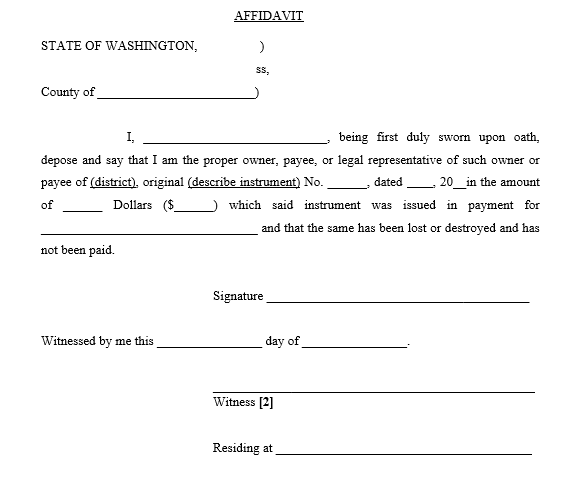
Footnotes
[1] Lost or destroyed evidence of indebtedness issued by local governments: RCWs 39.72.010, 39.72.020
Lost or destroyed evidence of indebtedness issued by state or state agencies: RCWs 43.08.064, 43.08.066, 43.08.068
[2] City/county/district may require the affidavit to be signed by a notary public.
3 Accounting
3.4 Liabilities
3.4.1 Leases and Installment Purchases
3.4.1.10 Lease definition
A contract that conveys control of the right to use another entity’s nonfinancial asset (the underlying asset) as specified in the contract for a period of time in an exchange or exchange-like
transaction.
3.4.1.20 Exclusions
The following items are not considered leases. For lessees that means these would not be reported on the Schedule of Liabilities (Schedule 09) as lease liabilities.
3.4.1.30 Summary of BARS codes
| 34P.PP | Lessors – For lease payments received if leasing is the primary operation of the fund. |
| 362.00 | Lessors – For lease payments received that are not the primary operation of the fund. |
| 591.PP.70 | Lessee – Lease/rental payments (ownership of asset is not transferred at the end of the contract) |
| 594.PP.70 | Installment purchase payments – Ownership of asset is transferred at the end of the contract |
3.4.1.40 Lessor accounting
Lessors only need to report the cash payments received for lease payments on the Schedule 01. Since lessors are receiving payments, there is no liability to report on the Schedule 09. To receipt payments, use either BARS Code 34P.PP or 362.00. If leasing is the primary operation/function of the fund that the payment is being receipted into, then use BARS Code 34P.PP which is a Charge for Services code. The “P” stands for prescribed numbers that are related to the function of the leasing activity. Review the chart of accounts to identify the applicable function and determine the full BARS Code. An example of when to use the 34P.PP code would be a port whose primary operation is leasing buildings.
If leasing is not the primary operation/function of the fund that the payment is being receipted into, then use BARS Code 362.00. An example of when to use BARS Code 362.00 is when a city or county is receipting lease payments into the general fund.
Lessors will use the revenue codes above for both short-term and long-term leases.
3.4.1.50 Lessee accounting and reporting
At the start of the lease, lessees will not report any inflows or outflows on the Schedule 01. Lessees will record actual lease payments made to the lessor on the Schedule 01 using BARS Code 591.PP.70.
Short term lease payments should be coded to normal, functional BARS expenditure codes. For example, if a government has a short-term lease for a copier that is used by the water utility fund, the lease expense would be coded to BARS 534.00.40.
Lessees are also required to include a note disclosure about their lease activity in the Notes to the Financial Statements. See template note at Note X – Leases (Lessees).
3.4.1.51 Variable and other non-lease payments
Variable payments should be excluded from the lease liability calculation. Variable payments are those that depend on future performance of the lessee or usage of the underlying asset. For example, a car lease may also include a charge per mile. The payment amount would vary depending on how many miles were driven, so the per mile charge would be excluded from the lease liability. Another type of variable payment would be charging a percentage of the lessee’s revenues.
However, if the variable payment is fixed in substance, it should be included in the calculations. For example, if a lessee is required to remit the greater of 10% of their sales or $5,000 each month, then the $5,000 payment is fixed in substance because the lessee will always be required to pay at least $5,000.
Some contracts include additional fees or taxes. Only the portion of the payment that is related to the right to use the asset should be included in the lease liability calculation. For example, if a copier lease also includes maintenance and sales tax, those are non-lease payments and should be excluded from the lease liability.
BARS Code 591 should only be used for the lease payments that are related to the right to use the asset. The variable and non-lease payments should be coded to regular, functional BARS expense codes.
3.4.1.52 Lease rate increases
Some contracts include clauses to increase the rates over time. There are two types of rate increases, known rate increases and variable rate increases. An example of a variable rate increase is an increase based on the Consumer Price Index (CPI) where the amount of the increase will vary depending on the CPI. An example of a known rate increase is a flat 3% annual increase where the increase amount is known and can be calculated for each period.
If the contract includes a variable rate increase, that rate increase should be ignored for purposes of calculating the liability on the Schedule of Liabilities, since the increase amount is unknown at the time of calculation.
For example, there is a 5-year lease that charges $500 per month for the first year and in each subsequent year the rent will be increased based on the CPI. The lease liability would be $30,000, which is $500 multiplied by 60 months (5 years). Since we do not know what the CPI increase will be in the future, the CPI increase is not factored into our calculation.
When making the monthly payment, only the original $500 used to calculate the liability should be coded to BARS 591.XX.70. For example, if the lease payment increased to $550 in the second year, the payment would be split into two different BARS codes: $500 would be charged to BARS 591.XX.70 and the remaining $50 would be charged to a functional BARS expense code.
Conversely, if a lease payment increases based on a flat rate, that should be factored into the liability. For example, there is a 5-year lease that charges $500 per month for the first year and each subsequent year the rent will be increased by 3%. The lease liability is $31,855 as shown below:
| Monthly rate (increased by 3% each year) | Months | Annual lease payments |
| $500 | 12 | $6,000 |
| $515 | 12 | $6,180 |
| $530 | 12 | $6,365 |
| $546 | 12 | $6,556 |
| $563 | 12 | $6,753 |
| Total beginning lease liability | $31,855 | |
This increase is factored into the total liability because it is known and can be accurately calculated at the beginning of the lease.
3.4.21.43 Prepaid Leases
Some contracts require payment for all years of the contract upfront. When the entire term of the contract is paid at the beginning, this is a prepaid lease. For example, a government enters a lease contract for 5 years at a price of $10,000 per year. The government pays $50,000 for all 5 years at the beginning of the contract, so this is a prepaid lease. Prepaid leases are not reported on the Schedule of Liabilities since the government does not owe the lessor any additional payments.
3.4.1.55 Lessee Schedule 09 reporting
Lessees will report a lease liability on the Schedule 09 measured at the total amount of future lease payments. See Schedule 09 reporting instructions.
In the year of implementation, any existing leases should report a beginning balance on the Schedule 09. The beginning balance reported should be the total amount of lease payments that were remaining as of the beginning of the year. In subsequent years, the beginning balance should match the prior year ending balance.
Any leases that are entered into during the year will be reported as an addition on the Schedule 09. The addition will be the total amount of future lease payments.
Reductions are the amount the lease liability is reduced during the year, which is typically the amount of lease payments made.
If the lease liability is remeasured for any of the items listed in Section 3.4.1.70, the change in the lease liability should be reported as either an addition or reduction on the Schedule 09.
3.4.1.60 Lease term
To calculate the total amount of future lease payments for the schedule 09, you need to know how many payments you are expecting to make which depends on the lease term. Here is what should be included in the lease term:
In situations where contracts automatically renew, not canceling is the same as choosing to extend the contract. As above, future renewals are not part of the lease term if both parties have the right to not renew (i.e. cannot be forced into continuing the contract).
Determining whether a lease option is reasonably certain of being exercised or not requires professional judgement and should take into consideration the specific facts and circumstances at your government. Examples of items to consider in this analysis:
3.4.1.70 Remeasuring the lease liability
The lease liability reported on the Schedule 09 must be remeasured (recalculated) if any of the following happen:
3.4.1.80 Installment purchases (formerly called capital leases)
Leases that transferred ownership of the asset to the lessee were previously called capital leases. These are now called installment purchases. If a lease has a purchase option or bargain purchase option, you will need to determine whether that option will be exercised or not. If you determine the purchase option will not be exercised, treat the contract like a lease. If you determine that the purchase option will be exercised, treat the contract like a financed purchase.
3.4.1.85 Installment purchase accounting
You will add a liability to the Schedule 09 (Schedule of Liabilities) for the total amount of future payments, including the cost of any purchase options. At the start of the contract you do not record any inflows or outflows on your Schedule 01. You will record payments made on your Schedule 01 using BARS Code 594.PP.70. Some installment purchase contracts will include an interest charge. In that case, interest expenditure should be coded to BARS 592.XX.80.
If your government previously determined they would not exercise the purchase option, but then later do exercise it, you should start treating the contract as an installment purchase at the time the decision is made. That means you should start coding your remaining lease payments to BARS 594.PP.70. However, you should not go back and change the BARS codes of any of your previous payments.
3 Accounting
3.4 Liabilities
3.4.11 LOCAL Program Financing
3.4.11.10 Local governments have an efficient financing option provided by the State Treasurer – the LOCAL program – that allows them to pool funding needs into large offerings of securities issued by the State Treasurer in order to take advantage of favorable market conditions.
3.4.11.20 Washington governments may use the LOCAL program to purchase equipment or real estate – everything from radios and computer systems to fire or police cars to building improvements or other construction.
3.4.11.30 Accounting
The State Treasurer issues debt on behalf of the local government. The State Treasurer holds LOCAL program proceeds and makes direct payments to vendors to and from the government’s specially designated LGIP account. Although proceeds are received and payments made by the State Treasurer, the government must account for and report both the debt issuance and capital asset purchase made on its behalf.
3.4.11.40 The debt issuance transaction must be reported as soon as the debt is issued and the resources placed in the Local Governments Investment Pool (LGIP), or other bank account. The date reimbursement requests are submitted to the State Treasurer is not the date the liability has been incurred.
Debt proceeds should be reported in the fund that will be using the proceeds. As with other debt, a local government may use a debt service fund to account for the debt payments.
3.4.11.50 Journal entries
Journal entry for debt issuance:
Cash $XXX
596.XX.70 Issuance Discount on Long-Term Debt (if applicable) $XX
592.XX.80 Interest and Other Debt Service Costs (for issuance costs) $XX
391.90.00 Other Debt Proceeds $XXX
392.00.00 Premiums on Bonds Issued (if applicable) $XX
Journal entry for capital asset purchase:
594.XX.60 Capital Expenditures $XXX
Cash $XXX
Journal entry for debt repayment:
591.XX.70 Debt Repayment (principal) $XX
592.XX.80 Interest and Other Service Costs $XX
Cash $XX
3.4.11.80 Reporting
LOCAL program proceeds must be reported as long-term debt and included in the Schedule 09, Schedule of Liabilities using Debt ID 263.96 LOCAL program financing. Only the face value of the debt should be reported on the Schedule 09. Do not include any premiums or discounts on the Schedule 09.
Debt incurred under this program may be considered either voted or non-voted and it should be included in the calculation of the local government’s debt limitation (see 3.10.5 Compliance – Limitation of Indebtedness).
3 Accounting
3.4 Liabilities
3.4.16 Other Postemployment Benefits (OPEB)
3.4.16.10 Introduction
OPEB refers to benefits, other than pensions, that are paid in the period after employment. OPEB includes:
OPEB includes the direct payment of benefits (e.g., LEOFF 1 medical benefits) and also explicit and implicit rate subsidies (e.g., the state’s PEBB plan).
The explicit rate is the rate participating employers pay as part of the monthly premiums that subsidizes the retiree monthly premiums. This subsidy reduces the monthly premiums paid by the retiree. The explicit rate is applied to each active employee of the government; therefore, it doesn't matter how many retirees the government may have. The explicit rate is set for the pool as a whole and all participating employers share in the cost.
An implicit rate subsidy is also referred to as a “blended premium rate.” It is caused by the inclusion of retirees in the same cost pool as active employees. As a result, retirees have the same premium rates as active employees and the rates for active employees implicitly subsidize the rates for retirees. This implicit subsidy is OPEB – even if retirees pay 100 percent of their premiums.
OPEB does not include termination benefits or termination payments for compensated absences.
3.4.16.20 Examples of OPEB benefits
Some common examples of OPEB benefits include:
If you are uncertain about whether or not an arrangement qualifies as OPEB, please contact the SAO HelpDesk.
3.4.16.30 Defined Benefit OPEB vs. defined contribution OPEB:
Defined benefit plans are those for which the benefits the employee will receive at or after separation from employment are defined by the benefit terms. OPEB may be stated as:
See the sample OPEB note disclosure for cash-basis local governments at Note X – OPEB.
Defined contribution plans have terms that:
Defined contribution OPEB plans do not result in a liability to be reported on the Schedule of Liabilities. If the government contributes to the OPEB Plan, it must be disclosed in the Notes to the Financial Statements. See requirements at Note X – OPEB.
If the government does not contribute to the plan (i.e. only employees contribute), no disclosures are required. The government may elect to disclose the plan in the notes but must clearly state that it does not contribute.
3.4.16.40 Defined benefit reporting requirements
Unlike pension plans, most OPEB plans in the state are not centrally administered and there is no single actuarial valuation like the DRS PEFI for the state’s pension plans. The only way to determine an OPEB liability is through an individual employer actuarial valuation or by using the Alternative Measurement Method if you have less than 100 participants in your plan.
If you are a participating employer in the PEBB plan or provide OPEB benefits to LEOFF 1 retirees, you may use the on-line calculation tools provided by the Office of the State Actuary (OPEB Tools) to calculate your OPEB liability. These tools are designed only for PEBB or LEOFF 1 employers with less than 100 plan members, which includes all active employees and retirees participating in the plan (excludes spouses and dependents).
Note: If your entity provides PEBB benefits and has 100 or more plan members, OSA has created a specialized tool for you to estimate your liability. To obtain this tool, please contact the SAO HelpDesk.
Defined benefit plans result in liabilities that must be reported on the BARS 4.8.3, Liabilities (Schedule 09).
If you provide OPEB through another plan (e.g. LEOFF 2) or contract with an actuary for your own valuation, the liability amount should be determined based on an actuarial valuation done by a qualified actuary using Actuarial Standards of Practice, including a roll-forward from an actuarial valuation done in the previous year.
Reminder – Even though accounting and reporting standards require you to get a valuation only every two years, you must still roll-forward the valuation to the updated measurement date in the off years.
3.4.16.50 Qualifying trust vs. non- qualifying-trust
Depending upon how individual local governments have established their OPEB plans, they may or may not meet the criteria of a trust described below. Local governments that have these plans should carefully review all legislation establishing and modifying the plans and consult with their legal counsel regarding the status of the plans.
Pay-as-you-go funding is not a qualifying trust.
Plans that meet the trust criteria should report a net OPEB liability on the Schedule of Liabilities. If the plan has a net OPEB asset, that will not be reported on the Schedule of Liabilities and will only be disclosed in the Notes to the Financial Statements. If the plan is administered through a qualifying trust, then the government is holding monies on behalf of someone else. Therefore, the government should report a fiduciary OPEB trust fund (reported on the C5 Statement).
Plans that do not meet the trust criteria should report a total OPEB liability on the Schedule of Liabilities. These plans cannot be reported as a OPEB trust fiduciary fund. Instead, it should be reported as a managerial fund that is rolled into the general fund for financial statement reporting. For additional guidance on managerial fund roll-ups, see BARS 3.1.12, Managerial Funds.
Both trusted and non-trusted defined benefit plans should be disclosed in the notes, see Note X – OPEB.
3.4.16.51 Accounting for tax revenues for OPEB and fiduciary trust funds
Some governments receive taxes to help fund OPEB costs. These taxes are levied by the government, not the OPEB plans. Since these are revenues of the government, they must be reported as a revenue in the governmental funds. To move these monies to the fiduciary trust fund, they would then report an expenditure in the governmental fund and then report an addition in the fiduciary trust fund.
For example, a government receipts $50,000 in an ad valorem property tax that will ultimately be used in their fiduciary trust fund to pay OPEB benefits. They would make the following journal entries:
Initial receipt of tax money:
|
General Fund – Cash |
$50,000 |
|
|
311.10.00 General Fund – Property Tax |
$50,000 |
Move tax money out of General Fund:
|
517.20.20 General Fund – Expenditure |
$50,000 |
|
|
General Fund – Cash |
$50,000 |
Move tax money into Fiduciary Trust Fund:
|
Fiduciary Trust Fund – Cash |
$50,000 |
|
|
389.40.00 Fiduciary Trust Fund – Additions |
$50,000 |
3 Accounting
3.4 Liabilities
3.4.13 Pension Liabilities
3.4.13.10 Introduction
Cash basis local governments are required to calculate their pension liabilities and assets. This section provides guidance for accounting and reporting these liabilities and assets.
BARS 3.4.13.20 through BARS 3.4.13.50 focus on local governments participating in the State of Washington cost-sharing, multiple-employer pension plans administered by the Department of Retirement Systems (e.g. PERS 1, PERS 2/3, TRS 1, TRS 2/3, SERS 2/3, PSERS 2, LEOFF 1, LEOFF 2). BARS 3.4.13.60 and BARS 3.4.13.70 focus on other types of pension plans.
Management’s responsibilities
This guidance is intended to assist local governments in the application of the pension reporting requirements. Local governments must apply their own professional judgment to determine if this guidance is appropriate for their facts and circumstances and must draw their own conclusions about the proper reporting. Government’s management is solely responsible for the content of the financial statements. Each local government is responsible for evaluating the information used to recognize and disclose pension amounts in its financial statements. Preparers must understand the underlying accounting and reporting concepts for pensions and retain adequate supporting documentation for all amounts reported.
Steps and procedures to calculate the proportionate share of collective pension amounts
3.4.13.20 Step 1 – Get your data
Much of the financial data necessary to report pension liabilities and assets will be obtained from the State Department of Retirement Systems (DRS) at www.drs.wa.gov.
Download the Participating Employer Financial Information (PEFI) report from the Employers section of the website. This report is published annually as of June 30.
This report includes the Employer Allocation Schedules and the Schedules of Collective Pension Amounts for each pension plan.
Employer Allocation Schedules: Each separate plan presents a schedule of employer allocations. The schedules are sorted by allocation percentage, largest to smallest, and you will need to search each schedule for your local government’s name. Note that the PERS 1 and TRS 1 schedules have separate sections for both the regular allocation and the Plan 1 UAAL allocation. You will need both allocation percentages. If you have more than one DRS ORG ID number, add the percentages together.
What is the Plan 1 UAAL?
Under RCW 41.45.060, part of the contributions for PERS 2/3, SERS 2/3, PSERS 2, and TRS 2/3 fund the UAAL’s for PERS 1 and TRS 1.
Employers have a responsibility to exercise due care in financial reporting and to verify and recalculate amounts specific to them. Use the DRS Employer Reporting Application (ERA) contribution reconciliation, or some other reliable method, to verify the reasonableness of contributions used in the calculation of your proportionate share.
Schedule of Collective Pension Amounts: The PEFI also includes the schedules of collective pension amounts for each plan. Employers will use the collective pension amounts and apply their proportionate share (discussed above) to determine their own share of pension liabilities (or assets). The use of this schedule is discussed further below.
3.4.13.30 Step 2 – Calculate your numbers
The Schedules of Collective Pension Amounts for each plan are published near the back of the DRS report.
For each plan in which you participate, multiply the amounts in these schedules by your unique allocation percentage to calculate your entity’s share of each plan’s pension liability (or asset).
See Cash Pension Worksheet (found on the BARS Reporting Templates page) for calculations. The calculated numbers will represent your government’s pension liability and pension assets at year-end. Only the total pension liability amount is reported on the government’s Schedule of Liabilities (Schedule 09). Pension assets are only reported in the Notes to the Financial Statements. Do not net pension liabilities with pension assets.
3.4.13.40 LEOFF – Special funding situation
LEOFF Plans 1 and 2 include a special funding situation in which the State has a legal obligation to make contributions directly to the Plans.
LEOFF Plan 1 is fully funded and there have been no contributions since 2000 and the State continues to make the contributions on behalf of the individual employers to the LEOFF Plan 2.
3.4.13.50 Reporting
Pension liabilities are reported on Schedule 09 under I.D. No. 264.30 – Pension Liabilities. Pension assets are reported only in the notes. For note disclosures see Note X - Pension Plans.
3.4.13.60 Local government pension plans – defined benefit vs. defined contribution plans
Defined benefit pensions are those for which the income or other benefits that the employee will receive at or after separation from employment are defined by the benefit terms. The pensions may be stated as:
Examples of local government defined benefit plans include pre-LEOFF police and firefighter plans that were established under the following RCWs:
Defined contribution plans are those that:
Defined contribution plans do not require an actuarial valuation and do not require a liability to be reported on the Schedule of Liabilities.
If a government contributes to a defined contribution plan, including pension plans administered by non-government entities (such as union sponsored plans), the governments must include the plan in their note disclosures, see Note X - Pension Plans.
If a government does not contribute to the pension plan (only employees make contributions) governments are not required to include the plan in their pension note disclosures.
3.4.13.70 Qualifying Trust vs. non-qualifying trust
Depending upon how individual local governments have established their pension plans (including pre-LEOFF I police and firefighter plans), they may or may not meet the criteria of a trust described below. Local governments that have these plans should carefully review all legislation establishing and modifying the plans and consult with their legal counsel regarding the status of the plans.
Pay-as-you-go funding is not a qualifying trust.
Plans that meet the trust criteria should report a net pension liability on the Schedule of Liabilities. If the plan has a net pension asset, that will not be reported on the Schedule of Liabilities and will only be disclosed in the Notes to the Financial Statements. These governments should have an actuarial valuation to determine the net pension liability (asset) amount. If the plan is administered through a qualifying trust, then the government is holding monies on behalf of someone else. Therefore, the government should report a fiduciary pension trust fund (reported on the C5 Statement).
Plans that do not meet the trust criteria should report a total pension liability on the Schedule of Liabilities. These governments should have an actuarial valuation to determine the total pension liability amount. These plans cannot be reported as a pension trust fiduciary fund. Instead, it should be reported as a managerial fund that is rolled into the general fund for financial statement reporting. For additional guidance on managerial fund roll-ups, see BARS 3.1.12, Managerial Funds.
Both trusted and non-trusted defined benefit plans should be disclosed in the notes, see Note X - Pension Plans.
3.4.13.71 Accounting for tax revenue for pensions and fiduciary trust funds
Some governments receive taxes to help fund pension costs, such as the Fire Insurance Premium Tax (BARS 336.06.91) or an ad valorem property tax for pensions. These taxes are levied by the government, not the pension plans. Since these are revenues of the government, they must be reported as a revenue in the governmental funds. To move these monies to the fiduciary trust fund, they would then report an expenditure in the governmental fund and then report an addition in the fiduciary trust fund.
For example, a government receipts $50,000 in Fire Insurance Premium Tax that will ultimately be used in their fiduciary trust fund to pay pension benefits. They would make the following journal entries:
Initial receipt of tax money
|
General Fund – Cash |
$50,000 |
|
|
336.06.91 General Fund – Fire Insurance Premium Tax |
|
$50,000 |
Move tax money out of General Fund
|
517.20.20 General Fund – Expenditure |
$50,000 |
|
|
General Fund – Cash |
|
$50,000 |
Move tax money into Fiduciary Trust Fund
|
Fiduciary Trust Fund – Cash |
$50,000 |
|
|
389.40.00 Fiduciary Trust Fund – Additions |
|
$50,000 |
3 Accounting
3.4 Liabilities
3.4.22 Public-Private and Public-Public Partnerships (PPP)
3.4.22.10 Public-Private and Public-Public Partnership (PPP) Definition
A Public-Private and Public-Public Partnership (PPP) is an arrangement in which a government (the transferor) contracts with an operator to provide public services by conveying control of the right to operate or use a nonfinancial asset, such as infrastructure or other capital asset (the underlying PPP asset), for a period of time in an exchange or exchange-like transaction. You may also know these as Service Concession Arrangements; however, the accounting is the same.
3.4.22.20 Transferor Accounting and Reporting
Transferors will report revenue as it is receipted. Transferors do not report any liabilities on the Schedule of Liabilities.
To receipt payments, use either BARS Code 34P.PP or 362.00. If the PPP activity is related to the primary operation/function of the fund that the payment is being receipted into, then use BARS Code 34P.PP which is a Charge for Services code.
The “P” stands for prescribed numbers that are related to the function of the activity. Review the chart of accounts to identify the applicable function and determine the full BARS Code.
If the PPP activity is not related to the primary operation/function of the fund that the payment is being receipted into, then use BARS Code 362.00.
3.4.22.30 Operator Accounting and Reporting
At the start of the PPP, operators will not report any inflows or outflows on the Schedule 01. Operators will record actual payments made to the transferor on the Schedule 01 using BARS Code 591.PP.70.
The “P” stands for prescribed numbers that are related to the function of government the PPP is supporting. Review the chart of accounts for your government to identify the applicable function and determine the full BARS Code.
Operators are also required to include a note disclosure about their PPP activity in the Notes to the Financial Statements. See template note at Note X – PPP (Operator).
3.4.22.30 Variable and other non-PPP payments
Variable payments should be excluded from the PPP liability calculation. Variable payments are those that depend on future performance of the government, usage of the underlying asset, or number of users.
However, if the variable payment is fixed in substance, it should be included in the calculations. For example, if an operator is required to remit the greater of 10% of their sales or $5,000 each month, then the $5,000 payment is fixed in substance because the operator will always be required to pay at least $5,000.
Some contracts include additional fees or taxes. Only the portion of the payment that is related to the right to use the underlying PPP asset should be included in the liability calculation. For example, if a PPP contract also includes maintenance and sales tax, those are non-PPP payments and should be excluded from the liability.
BARS Code 591 should only be used for the PPP payments that are related to the right to use the underlying PPP asset. The variable and non-PPP payments should be coded to regular, functional BARS expense codes.
3.4.1.52 Contract rate increases
Some contracts include clauses to increase the rates over time. There are two types of rate increases, known rate increases and variable rate increases. An example of a variable rate increase is an increase based on the Consumer Price Index (CPI) where the amount of the increase will vary depending on the CPI. An example of a known rate increase is a flat 3% annual increase where the increase amount is known and can be calculated for each period.
If the contract includes a variable rate increase, that rate increase should be ignored for purposes of calculating the liability on the Schedule 09, since the increase amount is unknown at the time of calculation.
For example, there is a 5-year PPP contract that charges $500 per month for the first year and each subsequent year the payment will be reevaluated and increased based on the CPI. The PPP liability is $30,000, which is $500 multiplied by 60 months (5 years). Since we do not know what the CPI increase will be for each subsequent year, the CPI increase is not factored into our calculation.
When making the monthly payment, only the original $500 used to calculate the liability should be coded to BARS 591.XX.70. For example, if the PPP payment increased to $550 in the second year, the payment would be split into two different BARS codes: $500 would be charged to BARS 591.XX.70 and the remaining $50 would be charged to a functional BARS expense code.
Conversely, if a PPP payment increases based on a flat rate, that should be factored into the liability. For example, there is a 5-year PPP contract that charges $500 per month for the first year and each subsequent year the payment will be increased by 3%. The PPP liability is $31,855 as shown below:
|
Monthly rate (increased by 3% each year) |
Months |
Annual payments |
|
$ 500 |
12 |
$ 6,000 |
|
$ 515 |
12 |
$ 6,180 |
|
$ 530 |
12 |
$ 6,365 |
|
$ 546 |
12 |
$ 6,556 |
|
$ 563 |
12 |
$ 6,753 |
|
Total beginning PPP liability |
$ 31,855 |
|
This increase is factored into the total liability because it is known and can be accurately calculated at the beginning of the PPP contract.
3.4.22.50 Schedule of Liabilities (Schedule 09) Reporting
Operators will report a PPP liability on the Schedule 09 measured at the total amount of future payments. See Schedule 09 reporting instructions.
In the year of implementation, any existing PPPs should report a beginning balance on the Schedule 09. The beginning balance reported should be the total amount of payments that were remaining as of the beginning of the year. In subsequent years, the beginning balance should match the prior year ending balance.
Any new PPP contracts that are entered into during the year will be reported as an addition on the Schedule 09. The addition will be the total amount of future payments.
Reductions are the amount the PPP liability is reduced during the year, which is typically the amount of payments made.
If the PPP liability is remeasured for any of the items listed in Section 3.4.22.70, the change in the PPP liability should be reported as either an addition or reduction on the Schedule 09.
3.4.22.60 PPP Term
To calculate the total amount of future PPP payments for the Schedule 09, governments need to know how many payments will be made, which depends on the PPP term. Here is what should be included in the PPP term:
The period during which the operator has a non-cancelable right to use the underlying PPP asset
plus periods covered by the operator’s or transferor’s option to extend the PPP (if reasonably certain the option will be exercised)
and periods covered by the operator’s or transferor’s option to terminate the PPP (if reasonably certain the option will not be exercised)
PPP term excludes periods for which both the operator and transferor each have the option to terminate or both parties must agree to extend.
Determining whether an extension or termination option is reasonably certain of being exercised requires professional judgement and should take into consideration the specific facts and circumstances at your government. Examples of items to consider in this analysis:
A significant economic incentive, such as contractual terms and conditions for the optional periods that are favorable compared with current market rates.
A significant economic disincentive, such as costs to terminate the PPP and sign a new PPP arrangement (for example, negotiation costs, relocation costs, abandonment of significant underlying PPP asset improvements, costs associated with returning the underlying PPP assets in a contractually specified condition or to a contractually specified location, or a substantial cancellation penalty).
The history of exercising options to extend or terminate.
The extent to which the underlying PPP asset is essential to the provision of government services.
3.4.22.70 Remeasuring the PPP Liability
The PPP liability reported on the Schedule 09 must be remeasured (recalculated) if any of the following happen:
Change in PPP term
The PPP term might change if the government was previously not going to exercise an extension option, but then later determines it will extend the PPP contract (or vice versa). In that case, the PPP liability must be recalculated to include the additional payments related to extending the PPP term.
Contingency for variable payments is resolved.
If the PPP payments were variable and later all of the remaining PPP payments become known (no longer variable), then the liability must be recalculated using the known amounts.
3 Accounting
3.4 Liabilities
3.4.14 Refunding Debt
3.4.14.10 Any government in the state of Washington may extinguish (pay off) debt prior to the debt maturity date. This may be done with existing resources or by issuing new debt, which is referred to as a “refunding.” Refunding is authorized by Chapter 39.53 RCW also known as the Refunding Bond Act.
3.4.14.20 Refunding bonds may be issued to immediately repay old debt or may be issued now to repay debt in the future when it matures or becomes callable, which is referred to as an “advance refunding.”
Usually refunding is done to take advantage of lower interest rates or to modify debt service requirements. Often the proceeds from the sale of new debt with a lower interest rate are used to pay off old debt with a higher interest rate. While there are costs associated with issuing bonds, refunding results in a net cost savings when the present value of savings from lower interest payments on the refunding debt plus any income from temporary investment of refunding debt proceeds pending redemption of debt to be refunded are greater than the present value of the fees, sales discounts, redemption premiums and other costs of refunding.
3.4.14.30 The following definitions apply to the terms used here:
3.4.14.40 Advance refunding may be either a legal or an in-substance defeasance.
3.4.14.50 A legal defeasance occurs when debt is legally satisfied based on certain provisions in the debt instrument, even though the debt is not actually paid. A legal defeasance is rare in the government environment and generally occurs only when an amount sufficient to pay both principal and interest at the time of deposit is placed in an irrevocable trust with an independent escrow agent. A government is released from its legal status as the primary obligor on outstanding indebtedness after an escrow account is established, leaving the government only contingently liable.
3.4.14.60 An in-substance defeasance debt occurs when debt is considered to be extinguished for financial reporting purposes even though a government has not met legal requirements for a defeasance and so legally remains the primary obligor on the indebtedness. The proceeds from the sale of refunding (new) debt together with any other funds the entity may set aside for payment of refunded debt must be irrevocably placed with an escrow agent in a trust. The escrow agent invests the proceeds so that the cash realized from the maturing investments together with interest earned will meet the debt service requirements of the refunded (old) debt and redeem the balance of the old debt when it becomes callable or matures. Cash or other assets used for refunding must qualify as “essentially risk-free as to amount, timing and collection of principal and interest” and they must provide cash flows that are sufficient and timed to match the scheduled interest and principal payments on the debt that is being extinguished. Also, the chance of the government being required to make any additional future payments must be remote.
3.4.14.70 Generally, the requirement for “essentially risk-free” securities may be accomplished through the purchase of U.S. government securities, securities guaranteed by the U.S. government, or U.S. government backed securities.
3.4.14.80 The government does not budget or report any refunded (old) debt. However, the government is responsible for verifying the amounts reported by the trustee. The amount of the old debt should be disclosed in a note to financial statements.
3.4.14.90 Since cash basis statements reflect only the financial resource flows related to the refunding transaction, they do not report a gain or loss on an advance refunding resulting in defeasance.
3.4.14.100 The provisions of the Refunding Bond Act (Chapter 39.53 RCW) satisfy the criteria for in-substance defeasance, except for the requirement to place cash and assets in an irrevocable escrow. If the irrevocable trust fund is not established, both the refunded (old) and the refunding (new) debt must be recorded and reported on the government’s Schedule of Liabilities (Schedule 09).
Often the refunding is coordinated by the underwriter and the money from the issuance of the new debt is directly forwarded to the escrow account. Regardless how the money is physically handled, the city/county/district is a party to and responsible for the transaction and therefore should account for and report the transaction on their financial statements. The omission of this transaction from accounting or reporting will be most likely a material error.
The following example illustrates the BARS coding and reporting of the regular and refunding transactions.
Transaction 1: The government issues Series A Bond with a $5,000,000 face value at a premium of $200,000 and with $30,000 in issuance costs. The government receives $5,170,000 in cash:
|
Cash |
$5,170,000 |
|
|
592.PP.80 Debt Service Interest |
$30,000 |
|
|
391.PP.00 Loan Proceeds |
|
$5,000,000 |
|
392.00.00 Premiums on Bonds Issued |
|
$200,000 |
Transaction 2: The government issues Series B Bond with a $2,000,000 face value at a discount of $100,000 and with $10,000 in issuance costs. The government receives $1,890,000 in cash:
|
Cash |
$1,890,000 |
|
|
592.PP.80 Debt Service Interest |
$10,000 |
|
|
596.PP.70 Issuance Discount on Long-Term Debt |
$100,000 |
|
|
391.PP.00 Loan Proceeds |
|
$2,000,000 |
Transaction 3: The government makes payments on the Series A & B bonds:
|
591.PP.70 Debt Service Principal |
$195,000 |
|
|
592.PP.80 Debt Service Interest |
$200,000 |
|
|
Cash |
|
$395,000 |
|
591.PP.70 Debt Service Principal |
$80,000 |
|
|
592.PP.80 Debt Service Interest |
$70,000 |
|
|
Cash |
|
$150,000 |
Transaction 4a: Refunding with no additional payment to escrow
Years later the government issues Series C Refunding Bond with a face value of $1,500,000 at a premium of $100,000 with $50,000 in issuance costs to refund the Series B bond. At the time of the refunding Bond B’s outstanding principal balance was $1,450,000 and there was accrued interest of $100,000:
|
599.PP.70 Payments for Refunded Debt – Principal |
$1,450,000 |
|
|
599.PP.80 Payments for Refunded Debt – Interest |
$100,000 |
|
|
592.PP.80 Debt Service Interest |
$50,000 |
|
|
393.00.00 Refunding Long-Term Debt Issued |
|
$1,500,000 |
|
392.00.00 Premiums on Bonds Issued |
|
$100,000 |
Transaction 4b: Refunding with additional payment to escrow
Years later the government issues Series C Refunding Bond with a face value of $1,425,000 at a premium of $100,000 with $50,000 in issuance costs to refund the Series B bond. At the time of the refunding Bond B’s outstanding principal balance was $1,450,000 and there was accrued interest of $100,000. The City needs to contribute $75,000 in addition to the proceeds from the Series C Refunding Bonds:
|
599.PP.70 Payments for Refunded Debt – Principal |
$1,375,000 |
|
|
593.PP.70 Advance Refunding Escrow |
$75,000 |
|
|
599.PP.80 Payments for Refunding Debt - Interest |
$100,000 |
|
|
592.PP.80 Debt Service - Interest |
$50,000 |
|
|
393.00.00 Refunding Long-Term Debt Issued |
|
$1,425,000 |
|
392.00.00 Premiums on Bonds Issued |
|
$100,000 |
|
Cash |
|
$75,000 |
Note: Normally the government would report $1,450,000 to BARS 599.PP.70 for the payoff of the old debt’s principal as shown in transaction 4a. However the payment to escrow of $75,000 needs to be recorded to BARS account 593.PP.70. Both of these accounts use object code 70 Debt Service principal. Therefore when the government records the Advance Refunding Escrow of $75,000, they are recording a partial payment of the principal, so we need to reduce the 599.PP.70 account by $75,000. In the end the total principal payment is still $1,450,000 ($1,375,000 + $75,000).

3 Accounting
3.4 Liabilities
3.4.10 Solid Waste Utilities: Closure and Postclosure Cost
This guidance applies only to cities and counties.
3.4.10.10 The Department of Ecology (Ecology) mandates solid waste landfill closure standards in Washington Administrative Code (WAC) 173-304-467, WAC 173-351-600 and WAC 173-350-400 subsection 8. The standards prescribe specific closure and post-closure procedures and their funding. While these standards apply to a landfill’s closure, they are associated with its operation and represent a liability to be recognized during its operation.
3.4.10.20 Ecology requires each owner or operator to prepare written closure and post-closure cost estimates as part of the facility closure and post-closure plan. This plan is to be reviewed annually and adjusted for cost changes, including inflation. This liability should be reported on the Schedule of Liabilities (Schedule 09) using I.D. number 263.22. The liability balance should be updated annually. Governments should also disclose this liability in the Notes to the Financial Statements, Note X – Environmental and Certain Asset Retirement Liabilities.
3.4.10.30 Each owner or operator is also required to either establish a reserve account or provide another form of financial assurance that, over the life of the facility, funds will be adequate to cover the costs of closing the facility and performing post-closure activities in accordance with state and federal regulations (RCW 70A.205.165). Ecology rules require that reserve accounts be set aside as restricted assets. These requirements apply to all landfill disposal facilities.
3 Accounting
3.4 Liabilities
3.4.21 Subscription Based Information Technology Arrangement (SBITA)
3.4.21.10 Definition
A Subscription Based Information Technology Arrangement (SBITA) is a contract that conveys control of the right to use another party’s (a SBITA vendor’s) IT software, alone or in combination with tangible capital assets (the underlying IT assets), as specified in the contract for a period of time in an exchange or exchange-like transaction.
3.4.21.20 Exclusions
The following items should not follow SBITA accounting and reporting guidance:
3.4.21.30 Perpetual License versus Subscription
Perpetual license arrangements are indefinite, whereas SBITAs are for a finite period of time. With a perpetual license, the software is directly downloaded onto the government’s computer or servers. After the software is paid for, the government will never lose access to the software (it can be accessed perpetually).
A subscription contract requires a monthly or annual fee to continue to access the software. If the subscription fee is not paid, the government will lose access to the software. A subscription contract with indefinite renewal periods, is not the same as a perpetual license.
One way to determine whether it is a perpetual license or a subscription bases contract is to ask: “Can I still log in and access the IT software after the engagement term ends?” If the answer is “no,” it is not a perpetual license, and the contract should be further evaluated to determine if it meets the definition of a SBITA.
3.4.21.40 Accounting and Reporting
At the start of the subscription, governments will not report any inflows or outflows on the Schedule 01. Governments will record actual subscription payments made to the SBITA on the Schedule 01 using BARS Code 591.PP.70.
The “P” stands for prescribed numbers that are related to the function of government the SBITA is supporting. Review the chart of accounts for your government to identify the applicable function and determine the full BARS Code. For example, if a government has a water utility fund and has a SBITA for software that calculates the customer water bills, the principal payment would be coded to BARS 591.34.70.
Short-term subscription payments should be coded to normal, functional BARS expenditure codes. For example, if a government has a short-term SBITA for software used by the water utility fund, the subscription expense would be coded to BARS 534.00.40.
Governments are also required to include a note disclosure about their SBITA activity in the Notes to the Financial Statements. See template note at Note X – SBITA.
3.4.21.41 Variable and other non-SBITA payments
Variable payments should be excluded from the subscription liability calculation. Variable payments are those that depend on future performance of the government, usage of the underlying asset, or number of users. For example, a contract may require an additional $50 per user. The payment amount would vary depending on how many employees had user accounts, so that portion of the payment would be excluded from the subscription liability.
However, if the variable payment is fixed in substance, it should be included in the liability calculation. For example, if a payment is $50 per user, and the contract locks the government into paying for at least 10 user licenses, then the $500 payment is fixed in substance because the government will always be required to pay at least $500.
Some contracts include additional fees or taxes. Only the portion of the payment that is related to the right to use the asset should be included in the subscription liability calculation. For example, if a subscription contract also includes technical support and sales tax, those are non-SBITA payments and should be excluded from the subscription liability.
BARS Code 591 should only be used for the subscription payments that are related to the right to use the software. The variable and non-SBITA payments should be coded to regular, functional BARS expense codes.
3.4.21.42 Subscription rate increases
Some contracts include clauses to increase the rates over time. There are two types of rate increases, known rate increases and variable rate increases. An example of a variable rate increase is an increase based on the Consumer Price Index (CPI) where the amount of the increase will vary depending on the CPI. An example of a known rate increase is a flat 3% annual increase where the increase amount is known and can be calculated for each period.
If the contract includes a variable rate increase, that rate increase should be ignored for calculating the liability on the Schedule 09, since the increase amount is unknown at the time of calculation.
For example, there is a 5-year SBITA that charges $500 per month for the first year and in each subsequent year the payment will be increased based on the CPI. The subscription liability would be $30,000, which is $500 multiplied by 60 months (5 years). Since we do not know what the CPI increase will be in the future, the CPI increase is not factored into our calculation.
When making the monthly payment, only the original $500 used to calculate the liability should be coded to BARS 591.XX.70. For example, if the subscription payment increased to $550 in the second year, the payment would be split into two different BARS codes: $500 would be charged to BARS 591.XX.70 and the remaining $50 would be charged to a functional BARS expense code.
Conversely, if a subscription payment increases based on a flat rate, that should be factored into the liability. For example, there is a 5-year SBITA that charges $500 per month for the first year and each subsequent year the payment will be increased by 3%. The subscription liability is $31,855 as shown below:
|
Monthly rate (increased by 3% each year) |
Months |
Annual payments |
|
$ 500 |
12 |
$ 6,000 |
|
$ 515 |
12 |
$ 6,180 |
|
$ 530 |
12 |
$ 6,365 |
|
$ 546 |
12 |
$ 6,556 |
|
$ 563 |
12 |
$ 6,753 |
|
Total beginning subscription liability |
$ 31,855 |
|
This increase is factored into the total liability because it is known and can be accurately calculated at the beginning of the subscription.
3.4.21.43 Prepaid Subscriptions
Some contracts require payment for all years of the contract upfront. When the entire term of the contract is paid at the beginning, this is a prepaid SBITA. For example, a government enters a software contract for 5 years at a price of $10,000 per year. The government pays $50,000 for all 5 years at the beginning of the contract, so this is a prepaid SBITA. Prepaid SBITAs are not reported on the Schedule of Liabilities since the government does not owe the vendor any additional payments.
3.4.21.50 Schedule of Liabilities (Schedule 09) Reporting
Governments will report a subscription liability on the Schedule 09 measured at the total amount of future subscription payments. See Schedule 09 reporting instructions.
In the year of implementation, any existing subscriptions should report a beginning balance on the Schedule 09. The beginning balance reported should be the total amount of subscription payments that were remaining as of the beginning of the year. In subsequent years, the beginning balance should match the prior year ending balance.
Any new SBITA contracts that are entered into during the year will be reported as an addition on the Schedule 09. The addition will be the total amount of future subscription payments.
Reductions are the amount the subscription liability is reduced during the year, which is typically the amount of subscription payments made.
If the subscription liability is remeasured for any of the items listed in Section 3.4.21.70, the change in the subscription liability should be reported as either an addition or reduction on the Schedule 09.
3.4.21.60 Subscription Term
To calculate the total amount of future subscription payments for the Schedule 09, governments need to know how many payments will be made, which depends on the subscription term. Here is what should be included in the subscription term:
Determining whether an extension or termination option is reasonably certain of being exercised requires professional judgement and should take into consideration the specific facts and circumstances at your government. Examples of items to consider in this analysis:
3.4.21.61 Short-Term SBITA
A short-term SBITA is one that has a maximum possible term of 12 months or less. The maximum possible term includes all options to extend regardless of whether those options will be exercised or not.
Example: A SBITA contract has an initial noncancelable term of 6 months with an option for the government to extend for another year. The government will most likely not exercise that option.
This is not a short-term SBITA because the maximum possible term is 18 months. The extension option is included in the maximum possible term even if it will not be exercised. The subscription term for accounting purposes would only be 6 months.
For a short-term SBITA, a government should recognize an expense/expenditure when subscription payments are due based on the payment provisions of the SBITA contract.
3.4.21.62 Renewals
Many SBITA contracts have automatic annual renewals. In most cases at each renewal date, the SBITA vendor and the government can cancel the contract. If both parties can cancel the contract, any periods covered by the renewal terms are considered cancellable periods. Cancelable periods are always excluded from the maximum possible subscription term.
For example, if a government has a one-year SBITA contract for their online teleconferencing and the contract automatically renews each year, and both the SBITA vendor and government can cancel at each renewal, then the maximum possible term is only 1 year because the renewal periods are cancelable periods and excluded from the maximum possible term. This would be considered a short-term SBITA.
3.4.21.70 Remeasuring the Subscription Liability
The subscription liability reported on the Schedule 09 must be remeasured (recalculated) if any of the following happen:
3 Accounting
3.6 Revenues
3.6.1 Cash Receipting
3.6.1.10 Cash receipting is a very important function of all governments. Listed below are requirements for deposits and receipt forms.
3.6.1.20 Deposits
1. Every public officer and employee, whose duty it is to collect and receive payments should deposit receipts with the treasurer of the local government at least once every 24 hours. The treasurer of the local government may grant an exception where such daily transfers would not be administratively practical or feasible (RCW 43.09.240).
2. Deposits must be made intact, meaning all payments received must be deposited without substitution. This is evidenced by the composition of checks and cash listed on the deposit slip matched to related receipt records.
3. Checks must be restrictively endorsed For Deposit Only immediately upon receipt.
4. Separate bank accounts may be used to receipt funds and transfer to a master account in order to facilitate timely collection of cash in remote areas or as part of the government’s banking structure. These accounts (which may be referred to as zero-balance, clearing, transmittal or depository accounts), should be swept at least monthly and be independently reconciled the same as all other bank accounts.
3.6.1.30 Receipt forms (manual or automated)
1. Receipts should be pre-numbered and imprinted with the name of the local government.
2. Receipts must include the following information:
3. Generic receipt forms should not be used (e.g., Rediform, etc.).
4. In instances where cash is received at decentralized locations (e.g., police department, parks department, etc.), the local government treasurer may combine those receipts onto one treasurer’s receipt. The treasurer’s receipt should indicate the total amount received from each location as well as the appropriate account codes.
5. If a receipt is voided, the original and any copies of that receipt must be retained.
3.6.1.40 Internal control
See the BARS 3.1.3, Internal Control for general guidance on internal controls. The following are minimum expected controls for cash receipting:
1. More than one employee should open the daily mail and prepare a list of cash and checks received (remittance list). If dual custody is not feasible, the government should consider compensating controls such as having mail opened in an area observable by other employees or stronger monitoring controls over revenues.
2. Deposits may be prepared by the person who received the payment. The government should implement a system of supervisory review of the remittance list and bank deposits to ensure deposits are made intact.
3. Checks received in the mail should be briefly reviewed for accuracy (e.g., proper payee, date, signature of payor, etc.). Checks with obvious inaccuracies should not be included in the deposit. In such a case, the entity should contact the payor and request that the payment be corrected or reissued.
4. The daily remittance list should be compared (reconciled) to daily deposit slips and to the cash receipts journal (or check register) on a regular basis. This should be performed by someone other than the employee who prepared the remittance list. Any shortage should be resolved.
5. A duplicate copy of the bank-validated deposit slip showing the composition of receipts should be retained by someone other than the employee making up the deposit.
6. The bank statement reconciliation should be performed by a person who does not have custody of or access to cash during any point in the receipting and depositing process. This reconciliation should include comparing deposits per bank to recorded receipting transactions in the general ledger.
7. Deposits should be physically safeguarded using bank bags with locks or other tamper-proof devices.
8. Receipts should be physically safeguarded during the operating day and secured in a safe or vault overnight. Access to the cashiering area should be appropriately restricted whenever possible.
9. Access to the safe or vault should be limited and combination should be changed periodically.
In addition, the safe and vault combination should be changed after employees terminate employment.
10. If the government utilizes cash registers, there should be one change fund and one cash register (or drawer) per cashier. This enables assignment of responsibility for cash to a specific individual at all times.
11. Policies should contain instructions for identifying cash receipts and for dating cash receipts journal entries for that day’s receipts.
3.6.1.50 Receiving payment through third-party vendors
Local governments should establish contractual agreements for all arrangements where a third party vendor is directed to accept payments on behalf of the local government. The contract should include details of the payment remittance process to support compliance with state law (RCW 43.09.240). Funds should be remitted through direct card settlement or EFT from the vendor to the local government’s depository account.
The local government should adopt contracting policies that implement effective internal controls over funds collected through a third party vendor including safeguards to protect the funds from loss and contractual responsibilities for protecting credit card numbers and transactions.
3.6.1.60 Accounting and reporting
For accounting purposes, the method or process of receipt and deposit should not affect when funds are considered received by the government. For example, receipt by a third party on behalf of a government or deposit in a transmittal account should be recognized the same as receipt and deposit at the government’s main location.
See the BARS 3.6.11, Suspense Funds for additional guidance on use of suspense funds to temporarily hold unclassified transactions.
3 Accounting
3.6 Revenues
3.6.2 County Auditor’s Operation and Maintenance Fund (Recording Fees)
This guidance applies only to counties.
3.6.2.10 RCW 36.22.170 requires the county auditors to impose a surcharge of five dollars per instrument for each document recorded. This is in addition to any other charge authorized by law. One dollar of the surcharge should be deposited in the county’s general (current expense) fund (account 3413600) and be used at the discretion of the county commissioner to promote historical preservation or historic programs, which may include preservation of historic documents. Fifty percent of remaining revenue generated by the surcharge should be deposited in a custodial fund (account 3893000) and remitted to the state treasurer. The state treasurer will distribute such funds every July to the counties in accordance with the formula described in RCW 36.22.190. Funds distributed by the state should be deposited to the Auditor’s O&M Fund (account 3360411). These resources should be used for ongoing preservation of historical documents of all county offices and departments. The other fifty percent of the surcharge should be deposited to the Auditor’s Operation and Maintenance Fund (account 3413600) for ongoing preservation of historical documents of all county offices and departments.
3.6.2.20 Historical documents include both old and contemporary documents. Many contemporary county documents have importance to history and are part of a chronological record of events in the development of a particular county and the state of Washington.
3.6.2.30 RCW 36.22.175(1) requires a surcharge of one dollar per instrument for each document recorded, this is in addition to any other charge authorized by law. Revenue generated through this surcharge should be transmitted monthly to the state treasurer (account 3893000) for deposit in the archives and records management account. These funds should be used solely for providing records scheduling, security microfilm inspection and storage, archival preservation, cataloging, and indexing for local government records and digital data and access to those records and data through the regional branch archives of the division of archives and records management.
3.6.2.40 RCW 36.22.175(3) requires a surcharge of one dollar per instrument for every document recorded after January 1, 2002, this is in addition to any other charges authorized by law. Revenue generated through this surcharge should be transmitted monthly to the state treasurer (account 3893000) for deposit in the local government archives account to be used exclusively for the construction and improvement of a specialized regional facility.
3.6.2.45 RCW 36.22.175(4) requires a surcharge of one dollar per instrument for every document recorded. Revenue generated through this surcharge should be transmitted monthly to the state treasurer (account 3893000) for deposit in the local government archives account to be used exclusively for the competitive grant program and for the attorney general’s consultation program and state archivist’s training services..
3.6.2.50 RCW 36.22.178 requires a surcharge of thirteen dollars per instrument for each document recorded this in addition to any other charge authorized by law. The county may retain up to five percent of this surcharge for the collection, administration, and local distribution of those funds. Of the remaining amount forty percent should be remitted monthly to the state treasurer (account 3893000). All of the remaining funds generated by this surcharge should be retained by the county and deposited into a special revenue fund (account 3412600) that must be used by the county and its cities and towns for eligible housing activities that serve very low-income households with incomes at or below fifty percent of the area median income. See the above statute for permissible use of the resources generated by this surcharge.
3.6.2.60 RCW 36.22.179 requires a surcharge of sixty-two dollars for each document recorded. The county auditor should retain two percent for collection of the fee (account 3412100) and of the remainder sixty percent should be deposited into a special fund designated for the homeless housing program (account 3412700) and forty percent should be remitted to the state treasurer (account 3893000) for deposit in the home security fund.
3.6.2.70 RCW 36.22.181 requires a surcharge of one dollar at the time of the recording of each deed of trust. The auditor may retain up to five percent of the funds collected to administer the collection. The remaining funds should be transmitted monthly to the state treasurer (account 3893000) and deposited into the mortgage lending fraud prosecution account. This surcharge expires June 30, 2011.
3.6.2.75 RCW 36.22.240 requires a surcharge of two dollars and fifty cents for each document recorded. The surcharge [through June 30, 2024] should be deposited in the growth management planning and environmental review fund created in RCW 36.70A.490.
3.6.2.80 The transactions are summarized as follows:
| Amount | Account Number | Account Description |
| $___.__ | 3412100 | General (Current Expense) Fund or other designated fund–Auditor’s Filings and Recordings–percentage of surcharges retained by the county for collection, administration and distribution of these funds |
| $1.00 | 3413600 | General (Current Expense) Fund–Historical Document Preservation and Modernization Surcharge (RCW 36.22.170(1)(a)) |
| $___.__ | 3412600 | Special Revenue Fund–Affordable Housing (RCW 36.22.178) |
| $___.__ | 3412700 | Special Revenue Fund–Local Homeless Housing Program (RCW 36.22.179, Chapter 43.185C RCW) |
| $2.00 | 3413600 | Auditor’s O&M Fund–Historical Document Preservation and Modernization Surcharge (RCW 36.22.170(1)(b)) |
| $___.__ | 3360411 | Auditor’s O&M Fund–Auditor’s Historical Document Preservation and Modernization Account. The state treasurer’s distribution of the surcharge to the county. (RCW 36.22.170(2)(a)) |
| $2.00 | 3893000 | Monthly remittance to the state treasurer–Centennial Document Preservation and Modernization Account (RCW 36.22.170(2)(a)) |
| $3.00 | 3893000 | Monthly remittance to the state treasurer–Local Governments Archives Account (RCW 36.22.175(1), (3), (4)) |
| $___.__ | 3893000 | Monthly remittance to the state treasurer (RCW 36.22.178)–Affordable Housing (RCW 43.185C.190) and Landlord Mitigation Program (RCW 43.31.615) |
| $___.__ | 3893000 | Remittance to the state treasurer (RCW 36.22.179)–Home Security Fund |
| $___.__ | 3893000 | Monthly remittance to the state treasurer–Mortgage Lending Fraud Prosecution Account (RCW 36.22.181) |
| $2.50 | 3893000 | Remittance to the state treasurer–Growth Management Planning and Environmental Fund (RCW 36.22.240) |
3.6.2.90 When disbursements are made, the county auditor should prepare a voucher in the regular manner, supported by details, documenting the expenditures [1]. The auditor should place his/her certification on the face of the voucher and then draw a warrant against the Auditor’s Operation and Maintenance Fund, in the same manner as is done for any other county fund.
3.6.2.100 The County Auditor’s Operation and Maintenance Fund is subject to budget requirements and must be appropriated.
Footnotes
[1] See Original Supporting Documentation for information regarding original supporting documentation.
3 Accounting
3.6 Revenues
3.6.3 County Treasurer’s Operation and Maintenance Fund
This guidance applies only to counties.
3.6.3.10 RCW 84.56.020(10) requires that fees and costs applicable to the foreclosure, distraint and sale of real and personal property for delinquent taxes must be deposited into the Treasurer’s Operation and Maintenance Fund. These moneys should be used by the county treasurer to defray the cost of further foreclosure, distraint and sale for delinquent taxes without regard to budget limitations.
3.6.3.20 Allowable expenditures include postage, filing fees, employee time, legal notices, title searches, etc. The following standard procedure should be used for all expenditures made from the Operation and Maintenance Fund:
When disbursements are made, the county treasurer should prepare a voucher in the regular manner, supported by detail documenting the expenditures [1]. The treasurer should place his/her certification on the face of the voucher prior to presenting it to the county auditor, who should then draw a warrant against the Treasurer’s Operation and Maintenance Fund, in the same manner as is done for any other county fund.
_____________________________________________________________________________________
Footnote:
[1] See Original Supporting Documentation for information regarding original supporting documentation.
3 Accounting
3.6 Revenues
3.6.4 Criminal Justice Funding
This guidance applies only to cities and counties.
3.6.4.10 Criminal justice funding comes to the cities and counties in a number of formulas and requirements specified in statute. The following is a summary of the distributions including BARS coding:
a. Cities and counties will receive quarterly distributions based on formulas specified in the statute (RCW 82.14.310 and RCW 82.14.320). For counties, the formula is based on population, crime rate and felony criminal cases filed for trial. For cities, the formula is based primarily on a high crime rate. These distributions are coded 3360610 and 3360620 accordingly.
b. A second distribution is applicable only to cities (RCW 82.14.330) and it is based on the violent crime rate and population and is allocated quarterly. This distribution is coded 3360621.
c. The other distributions depend on programs and services provided by cities. The distribution to cities that contract with another government for the majority of the city’s enforcement services is coded 3360625.
The remaining resources are distributed to cities which have or provide:
The distribution should be coded 3360626.
3.6.4.20 The distributions described in paragraphs A and B are limited by the following wording in the statute:
Moneys distributed under this section shall be expended exclusively for criminal justice purpose and shall not be used to replace or supplant existing funding. Criminal justice purposes are defined as activities that substantially assist the criminal justice system, which may include circumstances where ancillary benefit to the civil justice system occurs, and includes domestic violence services such as those provided by domestic violence programs, community advocates, and legal advocates, as defined in RCW 70.123.020. Existing funding for purposes of this subsection is defined as calendar year 1989 actual operating expenditures for criminal justice purposes. Calendar year 1989 actual operating expenditures for criminal justice purposes exclude the following: Expenditures for extraordinary events not likely to reoccur, changes in contract provisions for criminal justice services, beyond the control of the local jurisdiction receiving the services, and major nonrecurring capital expenditures.
The following guidance is in response to the restrictions imposed by the above quotation from the law.
Criminal justice purposes
3.6.4.30 All of the moneys made available to local governments through this legislation are limited to funding of criminal justice purposes. Criminal justice purposes can be defined as activities relating to the enforcement and administration of the criminal law. The term criminal justice purposes indicates a broad definition which would encompass all costs incurred in connection with the administration and enforcement of criminal laws, including those systems for dealing with persons suspected of, accused of, charged with, or convicted of crimes and domestic violence services.
3.6.4.40 Cities and counties need to be aware that this funding is primarily for criminal justice. However, the statute does allow for benefit to the civil justice system. The benefit to the civil justice system should be a secondary benefit as a result of expenditures primarily for the criminal justice system.
Supplanting of existing funds
3.6.4.50 Existing funding is defined as calendar year 1989 actual operating expenditures for criminal justice purposes excluding expenditures for:
1. Extraordinary events not likely to reoccur;
2. Changes in contract provisions for criminal justice services, beyond the control of the local jurisdiction receiving the services; and
3. Major nonrecurring capital expenditures.
3.6.4.60 The new state funding may be used for capital and other nonrecurring expenditures so long as the expenditure is for criminal justice purposes and is reasonable (e.g., the purchase of police cars). However, if a new roof is put on the county courthouse, only that portion that applies to criminal justice purposes would qualify (i.e., allocating the cost of the roof by square footage).
3.6.4.70 An entity would be supplanting by paying back interfund loans where the borrowed funds were used for criminal justice purposes. The repayment of these loans would be the equivalent of replacing existing criminal justice funding. The intent of the act is to ensure that the new funding results in increased financial resources devoted to criminal justice purposes.
3.6.4.80 As these moneys are expended, an entity must ensure that the criminal justice expenditures are at least equal to the base of existing funds plus selected revenues generated by the latest legislation. Once the base is established, the accounting system may be expanded by the following methods to ensure compliance with the non-supplanting provisions of the law:
1. An accounting system may employ budgetary and accounting code controls for the use of these funds or
2. A new fund may be established should the entity feel it is necessary.
3.6.4.90 It is the entity’s responsibility to provide evidence for an audit that it did not supplant existing funding. Therefore, it is important to document the base year (1989 expenditures less major capital or nonrecurring items), and the actual criminal justice expenditures and restricted fund balance for the current year.
Sale of confiscated and forfeited items
3.6.4.100 Cities and counties must identify proceeds from sale of confiscated and forfeited items in BARS code 369.3X.XX – Confiscated and Forfeited Property.
To record the state portion of proceeds in fiduciary funds, BARS code 389.3X.XX – Custodial Type Collections should be used.
If the forfeited or confiscated items have not been sold, and therefore a value has not been assigned, we would still expect the city or county to track the items that are available for sale.
3 Accounting
3.6 Revenues
3.6.5 Diversion of County Road Property Tax
This guidance applies only to counties.
3.6.5.10 RCW 36.33.220 authorizes the legislative authority of a county to divert any portion of the county road property taxes to provide services in the unincorporated area of the county. RCW 36.82.040 requires that so diverted taxes be placed in a separate and identifiable account within the county’s general (current expense) fund.
3.6.5.20 To assist compliance with the provisions of these statutes, the following procedures are prescribed:
3 Accounting
3.6 Revenues
3.6.6 Electronic Funds Transfer (EFT) - Receipts
3.6.6.10 Electronic funds transfer (EFT) refers to the deposit to bank account by means of wire, direct deposit, ACH or other electronic means. In accordance with RCW 39.58.750 we prescribe the following accounting procedures for such transactions:
3.6.6.20 Receiving money by EFT:
a. Prepare a treasurer’s receipt upon receiving notice from the payer that the funds have been transferred to your bank account. Do not wait for the bank to notify you of receipt of the funds. However, you may want to contact your bank to confirm the expected funds have arrived.
Enter the following information on the receipt:
Attach or otherwise retain payer’s correspondence and any supporting documentation such as transaction lists. Document any changes made from the payer’s correspondence if transactions are posted differently than reflected on the list (for example customer account number corrections).
b. A file must be maintained of those payers who have authorized to add moneys to your account electronically including the proceeds from third party vendors for credit card remittances.
3 Accounting
3.6 Revenues
3.6.14 Impact Fees
This guidance applies only to cities/towns and counties.
3.6.14.10 Impact fees are charges assessed by local governments against new development projects that attempt to recover the cost incurred by government in providing the public facilities required to serve the new development. Impact fees are only used to fund facilities, such as roads, schools, and parks, that are directly associated with the new development. They may be used to pay the proportionate share of the cost of public facilities that benefit the new development; however, impact fees cannot be used to correct existing deficiencies in public facilities. In Washington, impact fees are authorized under the Growth Management Act (GMA) (RCW 82.02.050, RCW 82.02.100), as part of "voluntary agreements" under RCW 82.02.020, under the Local Transportation Act (RCW 39.92.040), and as mitigation for impacts under the State Environmental Policy Act (SEPA) (Chapter 43.21C RCW). GMA impact fees are only authorized for public streets and roads; publicly owned parks, open space, and recreation facilities; school facilities; and fire protection.
3.6.14.20 Revenues (BARS 345.8X) should be recorded when the local government has received the resources. The statutory provision requiring unused impact fees to be returned to developers is a future transaction. When refunds are paid to developers, the activity will be recorded based on the functional expenditure coding of the activity.
3.6.14.30 Impact fees should not be accounted for in a custodial fund.
Local governments are required to use these contributions for specific purposes (purpose restrictions); therefore, the government should report the resulting cash and investment balance as restricted until they are used.
3 Accounting
3.6 Revenues
3.6.8 Liquor Tax and Profits – Two Percent Substance Abuse Treatment Programs
This guidance applies only to cities and counties.
3.6.8.10 RCW 71.24.555 provides that to be eligible for receiving a share of liquor taxes and profits, each city, town, or county must devote no less than two percent of its share of liquor taxes and profits to support programs for treatment of substance abuse and other drug addictions. Programs must be approved by the behavioral health organization and the secretary of the Department of Health.
3.6.8.20 A city or county that does not have its own facilities or programs for the treatment and rehabilitation of substance abusers, may share the use of another city or county facility or program as long as it contributes no less than two percent of its share of liquor taxes and profits to support these facilities or programs (RCW 71.24.555).
3.6.8.30 All liquor taxes and liquor board profits received from the state should be accounted for in the city’s or county’s general (current expense) or special revenue fund. This money should be coded 3360694 for liquor excise taxes and 3360695 for liquor control board profits.
3.6.8.40 Distribution of the money should be handled in a manner legally authorized by the statute. Expenditures related to substance abuse treatments should be coded to account 566 whether the expenditures are in support of the city’s or county’s own facilities/programs or contributions to others.
3.6.8.50 The two percent portion and any additional amounts expended for the substance abuse treatment should be budgeted in accordance with the provisions of Chapter 35.32A RCW, Chapter 35.33 RCW and Chapter 36.40 RCW.
3 Accounting
3.6 Revenues
3.6.12 Prosecuting Attorneys’ Salaries
This guidance applies only to counties.
3.6.12.10 RCW 36.17.020 provides that: The State of Washington shall contribute an amount equal to one-half of the salary of a superior court judge towards the salary of the elected prosecuting attorney. This money should be coded to account 3340011.
3.6.12.20 The annual salary of the superior court judges is established by the Washington Citizens’ Commission on Salaries for Elected Officials (RCW 2.08.092).
3 Accounting
3.6 Revenues
3.6.11 Suspense Funds
3.6.11.10 Purpose
The purpose of a suspense fund is to temporarily hold unclassified transactions while a decision is being made as to their classification. This allows for immediate recording of transactions in the general ledger and accounting control over unclassified transactions.
While it is possible for suspense funds to be used for a variety of transaction types, local governments would be expected use suspense funds exclusively for receipts. This presumption is reflected in the following guidance.
3.6.11.20 Accounting
When receipts are temporarily recorded to the suspense fund, the entry should be to increase cash and 3899000, Holding and Clearing Account Transactions. When the correct classification is determined, the original entry should be reversed and the correct entry made. An expenditure or transfer should never be recorded to move suspended funds.
Subsequent discovery of the correct allocation of funds should be corrected back to the date of original receipt, if possible.
3.6.11.30 Controls
See the BARS 3.1.3, Internal Control for general guidance on internal controls. The following are minimum expected controls for suspense funds:
3.6.11.40 Reporting
Due to the nature of a suspense fund, it would not meet the definition of a custodial fund. Therefore, suspense funds should not be reported in the financial statements.
For financial reporting purposes, it is expected that all suspended receipts at fiscal year-end would be resolved – and corrections reflected in the accounting records - by the time the annual report is submitted. If not all suspended receipts as of fiscal year end have been resolved as of the date of the financial report, the unresolved receipts should be rolled up into the general fund for purposes of financial reporting.
3 Accounting
3.6 Revenues
3.6.13 Utility Tax
This guidance applies only to cities.
3.6.13.10 Tax authorized by RCW 35.22.195, RCW 35.23.440(8), RCW 35.27.370(9) and RCW 35A.82.020 are often referred to as “utility tax”. However, the tax is just a standard business and occupation (B&O) tax levied by the general fund on the city’s utilities. The tax is not substantially different from the B&O tax charged by the general fund to other businesses in the city.
This is a tax on the utility, not a tax on the customers. If the utility wants to recoup the tax (and there is no such obligation), it can do so by adjusting the customers’ rate for services. Also, there is no requirement to single out this rate component on the utility bill.
An increase in customers’ bills does not change the nature of the tax – it remains a B&O tax on utilities and not on customers.
3.6.13.20 For the tax limits refer to RCW 35.21.870. The utility tax does not have any statutory purpose or use restrictions, but governments may choose to impose restrictions on the revenues as part of the enabling ordinance.
3.6.13.30 Accounting and reporting
The B&O tax should be accounted for as a revenue in the general fund (3164000) and expenditure in the utility fund (53P0040).
If the utility passes the tax on to its customers, the additional charges should be recognized as revenue (343P000) not in the general fund but directly in the utility fund. The utility’s payment of its B&O tax to the general fund is a separate transaction that should be reflected as an expenditure of the utility fund (53P0040) and revenue of the general fund (3164000). Since the tax is a revenue source in the general fund and expenditure in the utility fund, it is inappropriate to account for this transaction as transfer-in or transfer-out.
3 Accounting
3.7 Awards
3.7.2 Certain Grants and Other Financial Assistance
3.7.2.10 The Governmental Accounting Standards Board (GASB) Codification of Governmental Accounting and Financial Reporting Standards (Cod.) Section (Sec.) N50 "Nonexchange Transactions", defines pass-through grants as grants and other financial assistance received by a governmental entity (recipient government) to transfer to or spend on behalf of a secondary recipient. All pass-through awards received by a governmental entity should be reported in its financial statements. To determine the proper accounting for pass-through grants and other financial assistance, the recipient government has to evaluate its administrative and direct financial involvement.
3.7.2.20 Administrative involvement may include:
(a) Monitoring secondary recipients for compliance with program-specific requirements,
(b) Determining eligible secondary recipients or projects, even if using grantor-established criteria, or
(c) Having the ability to exercise discretion in how the funds are allocated.
3.7.2.30 Direct financial involvement may include:
(a) Recipient government financing some direct program costs because of a grantor-imposed matching requirement, and
(b) Recipient government liability for disallowed costs.
3.7.2.40 If a recipient government has administrative involvement or direct financial involvement in a pass-through grant or other financial assistance, its responsibility in relation to the resources is more than custodial.
3.7.2.50 The recipient government essentially exercises operational responsibility or discretion over whether the grant or other financial assistance will be awarded.
3.7.2.60 GASB Cod. Sec. N50 states that custodial funds are purely custodial. In those cases in which a recipient government serves only as a cash conduit, the grant or other financial assistance should be reported in a custodial fund. Pass-through grants with administrative or direct financial involvement should be recognized as revenue and expenditures or expenses in governmental, or proprietary funds of the recipient government.
3.7.2.70 GASB Cod. Sec. N50 does not require that a recipient government’s payment of administrative costs (indirect financial involvement) be separately evaluated in determining the reporting of pass-through grants. If a recipient government serves only as a cash conduit, it may incur some incidental administrative costs. If a recipient government’s administrative costs are more than incidental that would be the result of administrative involvement.
3 Accounting
3.7 Awards
3.7.1 Federal Awards – Accounting
3.7.1.10 NOTE: Revisions to the Uniform Administrative Requirements, Cost Principles, and Audit Requirements for Federal Awards (Uniform Guidance) at 2 CFR 200 were issued on April 22, 2024. Revisions to the administrative requirements (Subparts A-D) and cost principles (Subpart E) are effective for new federal awards executed by a federal agency on or after October 1, 2024. Revisions will not be applicable to federal awards issued prior to October 1, 2024 unless the federal agency early implemented. Look to the terms and conditions of the award or consult the federal awarding agency for questions about the applicability of the revisions. Revisions to the audit requirements (Subpart F), including the increased single audit threshold of $1 million, are applicable to audits of fiscal years beginning on or after October 1, 2024 (fiscal year end September 30, 2025, and later). No early implementation is allowed for the revisions to the audit requirements. Click here for the Federal Register Notice and here for technical corrections made to the revisions.
The requirements described below apply to all local government recipients and subrecipients who expend federal award funds. Federal financial assistance can be provided to state and local governments in many forms including grants, cooperative agreements, non-cash contributions or donations of property (including donated surplus property), direct appropriations, food commodities, other financial assistance, loans, loan guarantees, interest subsidies, and insurance.
3.7.1.20 Excerpts from the Uniform Guidance, 2 CFR 200, are provided in this section. Please note that there are many additional federal laws and regulations that may apply to your federal awards which can generally be found in the awarding documents and/or awarding agency guidance.
3.7.1.30 Identification of COVID-19 related awards
As described in 2 CFR section 200.510(b), auditees must complete the Schedule of Expenditures of Federal Awards (SEFA) and include the Assistance Listings Number (ALN) of the federal award. To maximize transparency and accountability of COVID-19 related award expenditures, auditees must separately identify COVID-19 expenditures on the SEFA. This includes the new COVID-19 only programs. Auditees must have a system that enables them to separately identify how it spent its COVID-19 awards.
3.7.1.40 The Uniform Guidance – Common Administrative Requirements
Subpart C – Pre-Federal Award Requirements and Contents of Federal Awards and Subpart D – Post-Federal Award Requirements of the Uniform Guidance, 2 CFR 200, (§§.200-.217 and §§.300-.346, respectively) contain the common Administrative Requirements for federal financial assistance to state and local governments. The financial management systems of recipients and subrecipients must meet the following standards of 2 CFR §200.302:
“…(b) The recipient’s and subrecipient’s financial management system must provide for the following (see also §§200.334 Record retention requirements, 200.335 Requests for transfer of records, 200.336 Methods for collection, transmission and storage of information, and 200.337 Access to records,):
(1) Identification of all Federal awards received and expended and the Federal programs under which they were received. Federal program and Federal award identification must include, as applicable, the Assistance Listings title and number, Federal award identification number, year the Federal award was issued, and name of the Federal agency or pass-through entity.
(2) Accurate, current, and complete disclosure of the financial results of each Federal award or program in accordance with the reporting requirements in §§ 200.328 and 200.329. When a federal agency or pass-through entity requires reporting on an accrual basis from a recipient or subrecipient that maintains its records other than on an accrual basis, the recipient or subrecipient must not be required to establish an accrual accounting system. This recipient or subrecipient may develop accrual data for its reports based on an analysis of the documentation on hand.
(3) Maintaining records that sufficiently identify the amount, source, and expenditure of Federal funds for Federal awards. These records must contain information necessary to identify Federal awards, authorizations, financial obligations, unobligated balances, as well as assets, expenditures, income, and interest. All records must be supported by source documentation.
(4) Effective control over, and accountability for, all funds, property, and other assets. The recipient or subrecipient must safeguard all assets and ensure they are used solely for authorized purposes. See §200.303 Internal controls.
(5) Comparison of expenditures with budget amounts for each Federal award.
(6) Written procedures to implement the requirements of §200.305 Payment.
(7) Written procedures for determining the allowability of costs in accordance with Subpart E – Cost Principles and the terms and conditions of the Federal award.”
3.7.1.50 Uniform Guidance – Cost Principles
Expenditures of federal awards and costs claimed for reimbursement or used for matching must be determined in accordance with Subpart E – Cost Principles of the Uniform Guidance: 2 CFR 200 (§§.400-.476).
3.7.1.60 Uniform Guidance – Audit Requirements
Subpart F – Audit Requirements (§§.500-.521) set forth the uniform requirements for audits of federal financial assistance provided to state and local governments.
A non-Federal entity that expends $750,000 or more during the non-Federal entity's fiscal year in Federal awards must have a single or program-specific audit conducted for that year. With the revisions to the Uniform Guidance, the audit threshold will increase to $1 million for fiscal years beginning on or after October 1, 2024. For example, the new threshold will apply to calendar-year governments in fiscal reporting year 2025.
3.7.1.70 Uniform Guidance outlines specific auditee responsibilities in §200.508. In short, the auditee must:
(a) Arrange for the audit and ensure it is properly performed and submitted by the deadline in accordance with §200.512.
(b) Prepare financial statements, including the Schedule of Expenditures of Federal Awards (see instructions at BARS 4.14.5, Expenditures of Federal Awards (Schedule 16)) in accordance with § 200.510.
(c) Promptly follow up and take corrective action on audit findings. This includes preparing a summary schedule of prior audit findings and a corrective action plan in accordance with § 200.511(b) and (c), respectively.
(d) Provide the auditor access to personnel, accounts, books, records, supporting documentation, and any other information needed for the auditor to perform the audit required.
3.7.1.80 Governments that expend less than $750,000 (or $1,000,000 for fiscal years beginning on or after October 1, 2024) in a year in federal awards are exempt from federal audit requirements for that year, but records must be available for review or audit by appropriate officials of the federal agency, pass-through entity, and General Accounting Office (GAO).
3.7.1.90 The Single Audit Act provides that an audit made in accordance with the Uniform Guidance should be in lieu of any financial or financial compliance audit required under individual federal assistance programs. To the extent that a single audit provides federal agencies with information and assurances they need to carry out their overall responsibilities, they should rely upon and use such information. However, a federal agency should make additional audits which are necessary to carry out its responsibilities under federal law and regulation. Any additional federal audit effort should be planned and carried out in such a way as to avoid duplication.
3.7.1.100 To satisfy the requirements of the Single Audit Act and generally accepted accounting principles, the following accounting for awards is prescribed.
1. Use of separate award funds
Awards may be accounted for in the same funds as other operations of a municipality or in one or more separate “award funds,” depending upon award terms. The Governmental Accounting Standards Board (GASB) recommends that governments establish and maintain the minimum number of funds consistent with legal specifications and operational requirements. Award transactions coded within the same fund as other operations may be distinguished by using the BARS local option codes.
2. Fund types
Awards must be accounted for in the type of fund appropriate for the activities being financed. If an award is to be used for general governmental purposes, it should be accounted for in the general (current expense) or a special revenue fund. If an award is received for the payment of principal and/or interest on general long-term debt, it should be accounted for in a debt service fund. If an award is received to support operations of, or acquire capital assets for, a proprietary fund, the award should be accounted for in a proprietary fund. Other capital grants should be accounted for in capital projects funds. See separate discussion in BARS 3.7.2, Certain Grants and Other Financial Assistance.
3. Project coding
At the inception of an award (award notification), one or more project codes should be assigned locally to identify the particular award. This coding must be incorporated into the basic coding structure the municipality uses to identify all its transactions. Any available field or fields may be used, so long as the results do not interfere with the prescribed seven-digit BARS code.
The use of multiple codes may be necessary when there is more than one source of funds for a particular award. For example, when some expenditures must be charged to particular revenue sources or are not allowed under some agencies' terms, separate budgets for such sources must be established. In addition, it may be desirable or necessary to account for the local share of costs (match) or program income in separate projects. The value of separate projects is that they immediately segregate budgets, revenues, expenditures, cash accounts, receivables, and payables for each award and for the related non-award resources used to accomplish the project or operate the program.
4. Local funding of award projects
Within this project or set of projects, the municipality should account not only for award resources and expenditures but also for the municipality’s own contributions to the project or program and for related program income. This is necessary to ensure uniform accounting for the entire project or program, not merely that portion supported by award money.
5. Award (project) budgets
As soon as the terms of the award are known, the award budget entries are to be made. If the exact terms of an award agreement are not known when expenditures begin to be incurred, approximate budgets must be entered. These entries are not the municipality’s own appropriation entries, which are still required.
To distinguish the award budget from the municipality’s own appropriated budget, municipalities may use the separate budgetary control accounts and the separate nominal control accounts. This results in tracking two budgets for the same expenditures because the award fiscal period often will not coincide with the municipality’s fiscal period. In these cases, continuing appropriations will be necessary.
These accounts are used to keep track of the resources/uses for the award projects from inception of the award through the current date. Comparison of these accounts to the control accounts will yield budget analysis on a project basis as opposed to current year transactions.
If a separate award fund is used, the municipality’s own legislated appropriation should be limited to the fund total, and the detail budget should be the terms contained in the award and related agreements. If the award is accounted for within a fund that accounts for other operations of the municipality, either the award terms or the municipal appropriation may be used for the detail budget. Using the municipal appropriation for the detail budget has the disadvantage that, although award revenues and expenditures will be identified as they are incurred, they will not be compared to the detailed award budget and therefore the municipality may have to absorb some award related costs that turn out not to dovetail with the award budget restrictions.
6. Award schedules
A set of award schedules is prepared as shown in BARS 4.14.5, Expenditures of Federal Awards (Schedule 16). These schedules meet federal requirements for the Single Audit. After these schedules are complete, the life-to-date control accounts are closed to allow the preparation of a balance sheet. The life-to-date control accounts are reopened as the first journal entry of the succeeding fiscal year.
7. Noncash awards
The value of noncash awards (e.g., food stamps, food commodities, vaccines, supplies and equipment, etc.) should be accounted for and reported on the Schedule of Expenditures of Federal Awards (Schedule 16) as the fair market value of non-cash awards received during the year, as determined by the awarding agency. The notes to the schedule should disclose the nature of the amounts reported. See guidance on COVID-19 vaccines and Donated Personal Protective Equipment (PPE) at BARS 4.14.5, Expenditures of Federal Awards (SEFA/Schedule 16).
3 Accounting
3.8 Expenditures
3.8.9 Confidential Funds (Drug Buy Money, Investigative Funds)
This guidance applies only to cities and counties.
3.8.9.10 Confidential funds are those funds allocated to the following three types of law enforcement undercover operations:
1. Confidential investigative expenses are for the purchase of services and would include travel or transportation of an undercover officer or an informant. The lease of an apartment, business front, luxury type automobiles, a boat, aircraft or similar effects to establish the appearance of affluence, credibility and a general atmosphere conducive to the undercover role would also be in this category. Meals, beverages, entertainment and similar expenses for undercover purposes, within reasonable limits, would also be included.
2. Confidential funds for the purchase of evidence would include the purchase of evidence and/or contraband such as drugs, firearms, stolen property, etc., required to determine the existence of a crime or to establish the identity of a participant in a crime.
3. Confidential funds for the purchase of specific information from informants.
3.8.9.20 Confidential expenditures are subject to appropriation by the municipality’s governing body. The governing body must assure that the controls over disbursements are adequate to safeguard against misuse of such funds. When the funds are replenished, legislative approval should be based on a finding that the expenditures were necessary and reasonable for proper and efficient administration of the program under which they were used.
3.8.9.30 The funds authorized should be established in an imprest fund. Imprest, Petty Cash and Change Funds prescribes the minimum requirements for the establishment and operation of an imprest fund. In addition to all those requirements the following apply:
1. The supervisor of the unit to which the imprest fund is assigned must authorize all advances of moneys to agents or officers for the purchase of information. Such authorization must specify the information to be received, the amount of expenditures, and assumed name of informer.
2. The investigation unit must maintain confidential files of the true names, assumed names, and signature of all informers to whom payments have been made. To the extent practicable pictures and/or fingerprints of the informer payee should also be maintained.
3. The custodian should receive from the agency or officer authorized to make a confidential payment, a receipt for cash advanced to him/her for such purposes.
4. The agent or officer should receive from the informer a receipt of the following nature:
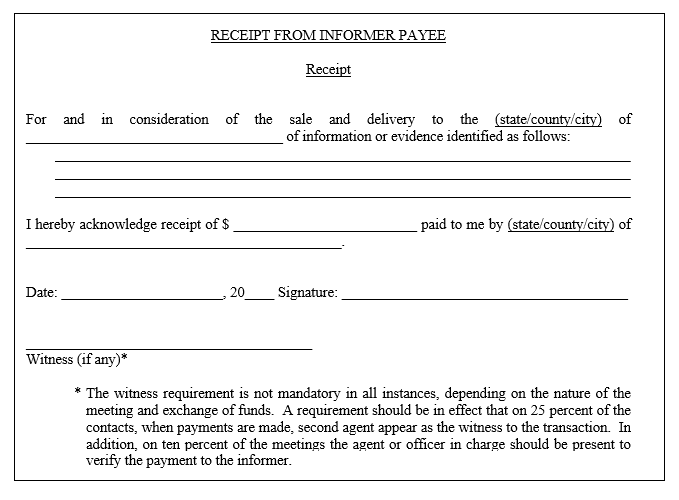
5. The signed receipt from the informer payee with a memorandum detailing the information received must be forwarded to the agent or officer in charge. The agency or officer in charge must compare the signature on the receipt with the confidential file of assumed name signatures. He/she must also evaluate the information received in relation to the expense incurred, and add his/her evaluation remarks to the report of the agent or officer who made the expenditure. A certification of payment to the custodian should serve as support for the expenditure from the imprest fund. The certification should be witnessed by the agent or officer in charge on the basis of the report and informer payee’s receipt.
6. Each agent or officer in charge must prepare a quarterly report showing status and reconciliation of the imprest fund and itemizing each payment, name used by informer payee, information received and use to which information was put. This report must be made part of the files and reviewed quarterly by the head of the municipality’s law enforcement agency.
3 Accounting
3.8 Expenditures
3.8.11 Electronic Funds Transfer (EFT) – Disbursement
3.8.11.10 Electronic funds transfer (EFT) refers to the disbursement from a bank account by means of wire, direct deposit, ACH or other electronic means. In accordance with RCW 39.58.750 we prescribe the following accounting procedures for such transactions.
3.8.11.20 Disbursing money by the EFT:
a. Prepare a record which shows:
b. A file must be maintained of authorizations by payees who have thereby agreed to have moneys added to their accounts electronically.
c. The treasurer should notify the disbursing bank that access to files, records and documentation of all EFT transactions involving the treasurer should be provided to the State Auditor when required for the conduct of the statutory post audit.
3.8.11.30 Policies should be adopted to establish effective internal control to protect EFT transactions from internal and external threats. These policies should include:
3 Accounting
3.8 Expenditures
3.8.2 Employee Travel
3.8.2.10 For the purpose of the BARS, travel expense includes amounts paid for use of personal automobiles, other transportation, and actual expenses or reimbursement in lieu of actual expenses for meals, lodging, and related items.
3.8.2.20 The legislative body of each municipality must pass an ordinance or resolution to establish rules and regulations for the reimbursement of travel expense. There should be rules to cover all municipal officials and employees. The ordinance or resolution should discuss the municipal policy on tipping, charging expenses to the municipality, and it should prohibit reimbursement for personal expenses and entertainment.
3.8.2.30 If any municipal corporation wishes to issue credit cards for travel related expenditures, the legislative body must pass an ordinance or resolution to establish rules and regulations that satisfy provisions of Chapter 42.24 RCW, including:
1. Submission of a fully itemized travel expense voucher by the employee or officer;
2. Settlement by the officer or employee within 30 days of the billing date; and,
3. The establishment of a lien against salary for any disallowed charges.
3.8.2.40 Claims for reimbursement of travel expenses must contain a signed certification that includes the following language, I hereby certify under penalty of perjury that this is a true and correct claim for necessary expenses incurred by me and that no payment has been received by me on account thereof.
3.8.2.50 In addition, if an officer or employee is filing a claim on behalf of others, he/she must prepare a detailed account that includes:
1. Names of the others who traveled, partook of meals, or otherwise incurred expenses.
2. Whether they were municipal employees and, if not, who they were and what connection they had with municipal business. This should not be construed to permit promotional hosting.
3. Who provided the lodging, meals or other services in question, dates and times.
4. A detailed breakdown of amounts.
5. Some statement sufficiently explicit to show what municipal business was being carried out when the expenses were incurred.
3.8.2.60 If a municipality chooses the option of using monthly reimbursements for use of personal automobiles for official business, the following procedures apply.
1. The monthly rate schedule established should be limited to officers and/or employees who actually use their personal automobiles for travel on a regular basis. It is the responsibility of the municipality to assure that each traveler is on official business.
2. The rate must be based on actual costs.
3. A periodic review must be performed to determine whether or not the rate continues to reflect actual costs.
4. A record is needed of the governing body’s determination.
3.8.2.70 If the above procedures are not followed, the “monthly reimbursement for use of personal automobiles” may be treated as additional compensation. According to the Internal Revenue Service, municipalities could be assessed the withholding tax of the employees if the amounts advanced/reimbursed for travel were not for expenses incurred or reasonably expected to be incurred, unless these amounts are reported as taxable wages on the W-2.
3.8.2.80 If a municipality chooses to establish an advance travel expense account (imprest account), pursuant to RCW 42.24.120, the following procedures apply:
1. The imprest amount must be established and maintained in accordance with the procedures prescribed for petty cash (e.g., amount must be established by ordinance or resolution).
2. Upon receipt of the moneys, the custodian will open a checking account in a local bank in the name of the governmental unit entitled Advance Travel Expense Account – John Doe, Custodian. Moneys received from the following sources will be deposited to the account:
From the treasurer or other disbursing officer, the total amount originally establishing the account or subsequently added; from officers and employees, refunds of any unexpended advances; and from the warrant-issuing officer, amounts that reimburse the custodian for travel expenses allowed in the settlement of employee advances.
3. The advance travel expense account must be used solely for travel advances, not direct payments to vendors. In other words, moneys may be advanced to an individual who is going on travel status for travel-related expenses that he/she will pay out of his/her own pocket. It must not be used for personal loans, registration fees, reimbursements to employees or officers for travel already incurred, etc.
4. A check register will be maintained in which will be recorded all transactions of the account, including deposits, disbursements and bank service charges. A reconciliation should be made with the bank statement at the end of each month. When possible, the reconciliation should be made by someone other than the custodian. The balance remaining in the checking account as of a given date, together with any outstanding advances and travel expense claims on hand but not yet reimbursed, should always equal the amount established by the governing body for the account.
5. Employee advances for travel expenses should be made by the issuance of checks drawn on the special bank account, payable to the applicant. Approved requests should be retained in the files of the custodian to support such advances until final settlement is made and claim for reimbursement has been submitted. Requests for such advances should be reasonable estimates of the applicants’ travel expense requirements and should contain as a minimum the following information:
6. Settlement of advances should be made on or before the 15th day following the close of the travel period by filing with the custodian an expense voucher as required by RCW 42.24.090. The custodian should verify the amount shown on such form as having been advanced to the employee. In the event the traveler’s actual expense is less than the amount of the advance received, his/her expense voucher should be accompanied by the unexpended portion of the advance. The expense voucher and original request for the advance will then be used to support the custodian’s claim for a warrant replenishing the account for travel expenses reported. Expense vouchers containing expenses in excess of the amount advanced will be submitted in duplicate to the custodian at the time of final settlement. The original copy of the expense claim and the traveler’s request for an advance will then be used to support the custodian’s claim for a warrant replenishing the account. The other copy of the expense claim will be submitted to the warrant issuing officer for reimbursement of the excess to the traveler. Claims for reimbursement to the account should be submitted by the custodian periodically as needed and at the end of the fiscal year in order that all expenses incurred will be charged against the appropriations for the period then ending.
7. Any default in accounting for or repaying an advance should render the full amount which is unpaid immediately due and payable with interest at the rate of 10 percent per annum from the date of default until repaid. To protect against any losses on advances, the governing body should have a prior lien against and a right to withhold any and all funds payable or to become payable to such officer or employee to whom such advance has been given, up to the amount of the advance and an annual interest rate of 10 percent until repayment or justification is made (RCW 42.24.140). No advance of any kind may be made to any officer or employee at any time when he/she is delinquent in accounting for or repaying a prior advance.
3 Accounting
3.8 Expenditures
3.8.8 Imprest, Petty Cash and Other Revolving Funds
3.8.8.10 Purpose
Guidance in this section applies to petty cash, imprest accounts, working funds, advance travel, stamp funds, change funds, or any other revolving funds set aside for facilitating minor disbursements, making change, and similar uses.
3.8.8.11 Budgeting
Imprest, petty cash and other revolving funds are not budgeted because they represent working capital (cash) for expenditures that are properly budgeted in other funds.
3.8.8.20 Controls
See BARS 3.1.3, Internal Control for general guidance on internal controls. The following are the minimum expected controls for these funds:
The following are the minimum expected controls for the custodian of the account:
3.8.8.30 Accounting
On at least a monthly basis, the fund should be reconciled to the authorized balance and to the actual balance per bank statements or a count of cash on hand. If this reconciliation is done by the custodian, it should be checked or re-performed periodically by someone other than the custodian. It is recommended that independent checks should not be scheduled with the custodian but be done on a surprise basis. Expenditures should be recorded when the funds are replenished to their authorized balance.
The monthly replenishment should be done by warrant or check. The replenishment should be subject to the same review and approval as all other expenditures of the government. The replenishment must be supported with the appropriate receipts attached. The receipts should show the date, recipient, purpose, and amount of each cash disbursement. These receipts must be signed by the person receiving the purchased goods/services. The receipts should be identified by some appropriate means (i.e. a specific date) to prevent reuse. At the time of replenishment, the custodian should ensure that the balance remaining in petty cash, together with the amount of the replenishment voucher, equals the authorized balance.
All funds should be reconciled and replenished to the authorized balance as of fiscal year end to ensure expenditures are recorded in the appropriate fiscal year.
3.8.8.40 Reporting
The funds authorized balance should be reported as cash in the financial statements in the Fund deemed responsible for the fund, generally the Fund expenditures are normally paid from. Replenishments to funds should not be reported as revenues on the financial statements as the movement of the monies from one cash account to another does not constitute an inflow of resources.
The reporting of expenditures should occur when monies are disbursed for replenishment to the fund.
3 Accounting
3.8 Expenditures
3.8.13 Memberships in Civic and Service Organizations
3.8.13.10 There has been a dramatic shift in business, social, and governmental cultures which has impacted the way the legal community views implied powers of municipal corporations. Included in this contemporary analysis is recognition that membership in a local civic or service organization may; indeed, benefit a municipal corporation.
3.8.13.20 The AGO and SAO has concluded that the intent of membership payments by a municipal corporation should be considered. However, payments of memberships to fraternal organizations, or community/social organizations such as golf and country clubs, should continue to be questioned. While municipal corporations have no obligation to pay for employee and officer memberships, should they choose to do so, a formal policy should be adopted to include:
1. The legislative body’s intent that officers and employees be active participants in service and civic organizations.
2. Those services and civic organizations to which membership fees will be paid on behalf of officers and employees.
3. The limit on the number of individuals for whom membership payment will be made to any on organization, and a delineation of criteria for multiple memberships.
4. The benefit, which the municipal corporation will derive from the membership in an organization and the authorized activity to which such benefit, is related.
5. Those municipal corporation positions for which membership fees will be paid.
6. Ancillary costs of membership which the municipal corporation will or will not pay, or provide reimbursement (i.e. meal costs incurred during meeting, costs incurred traveling to and from meetings, costs incurred as a result of the employees membership such as, time required to attend meetings or for committee participation and time required to perform duties of appointed/volunteer/elected positions) or time and expenses incurred as a result of attendance at related meetings such as regional, state, or national conventions.
7. Approval authority for payment of expenses incurred as a result of membership in civic or service organizations, or for deviation from established policy.
8. Limitations on the dollar amount that will be paid to a single organization or on behalf of an individual.
9. A prohibition of employee or officers, whose civic or service organization dues are paid in whole or in part by the municipal corporation:
(a) Exerting influence on other employees or officers to provide financial contributions or other support to the civic or service organization.
(b) Using the civic or service organizations as a forum for lobbying in support of or opposition to political or legislative actions, or the promotion of endeavors in which the officer or employee may have a direct or indirect financial interest or may acquire a personal benefit or gain.
3 Accounting
3.8 Expenditures
3.8.3 Mobile Devices
3.8.3.10 Local governments are responsible for the usage of their cellular telephones. They should decide what type of phone service package (call minutes, texting, internet, etc.) to purchase and whether to allow personal use by employees. If personal use is allowed, a policy should be established identifying the parameters for the allowable use of the phone and its service features. In addition, the local government should be monitoring employee compliance with the policy and whether there are non-public related costs incurred that would require reimbursement from employees.
3 Accounting
3.8 Expenditures
3.8.10 Paths and Trails
This guidance applies only to cities and counties.
3.8.10.10 Under Chapter 47.30 RCW, certain cities, towns, and counties may use a portion of their motor vehicle fuel tax funds to establish and maintain paths and trails for pedestrians, equestrians or bicyclists as a part of streets, roads and highways.
3.8.10.20 The amount a city or county expends annually must be at least .42 percent of the total amount of funds received from the motor vehicle fund according to the provisions of RCW 46.68.090. In lieu of expending the funds each year, however, a city or county may set aside such funds into a financial reserve account or a separate fund to be held for this specific purpose provided it is expended within ten years.
3.8.10.30 Chapter 47.30 RCW is limited to those cities in which the .42 percent exceeds $500 per year and to those counties in which the .42 percent exceeds $3,000 per year. In effect, this means that the annual income from motor vehicle fuel tax must exceed approximately $120,000 for a city or approximately $715,000 for a county before it is mandatory to fund paths and trails. Cities and counties with less annual income from motor vehicle fuel tax may fund paths and trails, but are not required to do so.
3.8.10.40 Also, per the Attorney General Memorandum dated June 7, 1982, until a city or county has set up a comprehensive plan for arterial streets and roads as required by RCW 47.26.170, they are not required to allocate any portion of the motor vehicle funds to a paths and trails fund. If the local government wishes to receive urban arterial trust moneys, they must have a comprehensive plan which includes provisions for paths and trails. Once a plan is set up, the requirements of RCW 47.30.050 apply.
3.8.10.50 Revenues from the motor vehicle fuel tax should be deposited in the respective city street, arterial street, or county road fund and be credited to the appropriate 336 account. All expenditures for paths and trails should be made from the city street, arterial street or county road fund. Account 59562P0 should be charged for construction, 54162P0 for preservation (GAAP entities using modified approach to infrastructure only), and 54262P0 for maintenance.
3.8.10.60 In the event the expenditures accumulated in these accounts at the end of each year do not equal the percentage of motor vehicle fuel tax revenue that is reserved for this exclusive use, the unexpended balance should be set aside (either in the fund or in a separate fund).
3.8.10.70 Cities or counties exercising the option to reserve unspent motor vehicle fuel tax should classify the unspent amount as restricted within the fund balance. Cities or counties exercising the special fund option should create a paths and trails reserve fund.
3 Accounting
3.8 Expenditures
3.8.4 Purchase Cards
3.8.4.10 Credit, fuel, prepaid or other forms of purchase cards are commonly used for purchases when appropriate to improve cash management, reduce administrative costs and increase efficiency.
3.8.4.20 In accordance with RCW 43.09.2855, local governments using credit cards must adopt policies and procedures to control credit card payments, including distribution of cards, credit limits, authorization of purchases and support and payment of bills. If cards are used for travel purchases, policies must conform to requirements of RCW 42.24.115.
3.8.4.30 Credit card payments must be supported by documentation for every purchase and be audited and certified in accordance with RCW 42.24.080 or RCW 42.24.180.
3.8.4.40 Officials and employees are prohibited by law from:
3 Accounting
3.8 Expenditures
3.8.7 Redeemed Warrants/Cancelled Checks
3.8.7.10 Due to many local governments no longer receiving redeemed warrants and canceled checks from their financial institutions the following is guidance which pertains to such effected entities.
3.8.7.20 The State Auditor’s Office recommends local governments receive and retain all redeemed warrants and canceled checks from public accounts as part of their public records. This may be either the original (actual) document or read-only (certified electronic format). Those entities using the county as their fiscal agent may continue allowing the county to maintain these documents.
3.8.7.30 The reasons for this recommendation are twofold:
3.8.7.40 The SAO recognizes a small cost may be associated with receiving these documents from your financial institutions. However, this cost will be substantially less than costs associated with the SAO requesting these documents during an audit.
3 Accounting
3.8 Expenditures
3.8.1 Unemployment and Deferred Compensation
| Quick Links |
| Accounting for state unemployment compensation |
| 3.8.1.20 Option 1 - Taxable (RCW 50.44.035, RCW 50.24, RCW 50.29) |
| 3.8.1.30 Option 2 - In-lieu contribution (Reimbursable) (RCW 50.44.060) |
| Deferred compensation plans |
| 3.8.1.50 Background |
| 3.8.1.70 General requirements |
| 3.8.1.90 Administrative requirements |
| 3.8.1.100 Reporting |
1) Accounting for state unemployment compensation
3.8.1.10 All local governments have a choice between either the tax basis or in-lieu contribution basis for making payments to the Department of Employment Security (ESD) (RCW 50.44.030). The accounting procedures for the two options are detailed below:
3.8.1.20 Option 1 - Taxable (RCW 50.44.035, RCW 50.24, RCW 50.29)
With this option the entity is assigned a rate and pays quarterly based on wages paid to employees. Rates are reassessed annually by the Employment Security Department. Contact the Department of Employment Security to determine the appropriate tax rate(s) for your particular unit of government. Apply the rate to all functional expenditure/expense accounts that have direct salary or wage charges, using the employer fringe or personnel benefits object applicable to your local government, each time a payroll is prepared. Do not apply the rate to salaries and wages of the following: (1) elected officials; (2) Job Training Partnership Act (JTPA) employees to the extent their earnings are within the maximum gross pay allowable under the JTPA programs; or, (3) policy-making employees that do not work more than eight hours per week.
Remit unemployment taxes quarterly to the Department of Employment Security.
3.8.1.30 Option 2 - In-lieu contribution (Reimbursable) (RCW 50.44.060)
Entities must be approved for this status by the Employment Security Department. Entities report quarterly wages to the Employment Security Department, but only pay when an unemployment claim is filed. Under this option, the ESD will pay unemployment claims and then bill the local governments for reimbursement.
Method A
The local government may individually manage resources for unemployment claims. This can be accounted for in the general fund or the local government can create an internal service fund for unemployment – Unemployment Compensation Fund. The purpose of this fund is to create a reserve for future unemployment claims by receiving periodic cash contributions from operating funds. The amount of these cash contributions depends on the estimate of future unemployment claims. The estimates should be reviewed and adjusted periodically, based on experience. Typically, estimates are based on a three to five year history of actual claims, but each entity should determine the method that works best for them. There may be different rates for departments and funds within the same government. The periodic cash contributions from operating funds will be charged to the functional expenditure/expense accounts in the operating funds in the same manner as premium payments paid to the ESD. Payments to the ESD must be made from the Unemployment Compensation Fund. Interest earnings on investment of the contributions may be used for the benefit of the Unemployment Compensation Fund (thereby reducing charges to the operating funds) or the general (current expense) fund per RCW 35.39.034. An ordinance or resolution must govern this choice.
Method B
The local government may participate with other local governments in an unemployment pool or cooperative as provided for in RCW 39.34.030. If you participate in such a cooperative, the contributions from your funds should be charged as expenditures/expenses functionally according to the applicable chart of accounts. In this case, the pool or cooperative will pay the billed amounts to the ESD.
Rates charged to the participants should be adjusted periodically based on the experience of each participant.
Method C
The local government may choose to assume the risk and not set aside resources for future claims. Under this method, the claims are reported as expenditures in the fund that the employee is normally paid from.
3.8.1.40 Since claims made by the ESD must be paid by statute, it is not necessary to appropriate funds for their payment; however, we recommend that appropriations be made by local governments to ensure their ability to pay future claims.
2) Deferred compensation plans
3.8.1.50 Background
RCW 41.50.770 authorizes all local governments to establish deferred compensation plans for the benefit of their employees in conformity with the requirements of Section 457 or Section 401(a) of the Internal Revenue Code. RCW 28A.400.250 further authorizes school districts to establish plans in conformity with the requirements of Section 403(b) of the Internal Revenue Code.
3.8.1.60 Deferred compensation plans permit employees to accept less than the full amount of salary earned thus reducing their current federal income tax liability. The amount by which the salary is reduced is invested by the employer and upon retirement, disability, termination, unforeseen emergency, or death may be withdrawn by the employees or their beneficiaries.
3.8.1.70 General requirements
The plan must be established correctly and administered properly so that the Internal Revenue Service (IRS) does not rule that the plan is not in conformity with the requirements of the Internal Revenue Code.
3.8.1.80 Because of the many administrators and plans available, it is strongly recommended that any local government which intends to establish a deferred compensation plan seek legal counsel to determine conformance with the Internal Revenue Code, and obtain approval of the chosen plan by the district.
3.8.1.90 Administrative requirements
Caution should be exercised in implementing a plan, not only to protect the employer’s legal liability, but also to prevent undue administrative complexities. Some major administrative requirements are as follows:
a. Make written agreements with plan administrator
All local government deferred compensation plans should provide for written agreements which clearly define the duties and responsibilities of the employer and the administrator.
b. Keep an employee file for each employee
A file to keep a deferred compensation record for each participating employee is necessary. Most carriers will provide the forms and basic accounting information for the employer, but the employer is responsible for maintenance of the files.
The participating employees must complete and sign joinder agreements stipulating the amount of their gross salaries or wages to be deferred. The local government should also maintain a written agreement which details any responsibilities of the employer for contributions, fees, charges, earnings, losses and withdrawals.
c. Withdrawals
The procedures for withdrawals should be clearly defined and the employer should be very careful in accepting any employee requests for amounts to be withdrawn from accumulated deferred compensation assets for unforeseeable emergencies, as any employee withdrawal granted which does not qualify under Internal Revenue Code could cause the entire deferred compensation plan for all employees to be considered in violation and invalid by the IRS.
Normally, all withdrawals as a result of retirement, disability, termination, unforeseen emergency or death, will be paid to the employer by the bank, credit union, or other institution (the agent) with which the employer (the principal) has the agreement.
In such cases, the employer will receipt for the payment referred to above, deduct the appropriate amount for federal income tax withholding and disburse the remaining amount to the employee, former employee or beneficiary as applicable. The employer will then remit the federal income tax withheld to the IRS or to the official depository as it presently is required to do. The employer will issue W-2 forms to the participants in the plan who have received payments of deferred income.
The W-2 will show the gross payment made to the participant or beneficiary and any deductions made.
However, the IRS has approved some plans whereby the administering company acts as agent for payments to the employees, issuance of W-2 forms and remittances to the IRS. Such IRS approved plans, which are still in conformance with the requirements of the Internal Revenue Code, will be permitted.
d. Maximum contribution
Local governments should refer to the Internal Revenue Service for allowable annual contribution limits.
e. Budget salaries and wages in year earned
All local governments required to budget revenues and expenditures by fund should be required to budget the gross salaries and wages including the deferred compensation amounts as expenditures of the year in which the salaries or wages are earned.
f. Establish plan as a pension (and other employee benefit) trust fund (if applicable)
All plans established in conformity with the Internal Revenue Code are expected to be held in a trust for the exclusive benefit of participants and their beneficiaries.
3.8.1.100 Reporting
Local governments do not own either the amounts deferred by employees or related income on those amounts. Accordingly, reporting will depend on whether the government is acting as the administrator for the plan. Administration involves managing the assets of the plan through a qualifying trust. In Washington State, this situation is expected to be rare for local governments. When your plan is administered by a third party administrator (example ICMA-RC), the government is not considered the plan administrator for financial statement reporting purposes. If the government contracts with a third party administrator, the government should make disclosures required for defined contribution pension plans and report contributions to the plan as payroll expense but would not report plan assets as a fiduciary fund. In the rare circumstance where a government acts as the administrator for the plan, governments should report their plans as pension (and/or other employee benefit) trust funds in their financial reports.
3.8.1.110 The local governments should keep detailed accounting records of the deferred compensation plan. However, if those records can be provided by the administrator of the plan, no duplication is necessary.
3 Accounting
3.8 Expenditures
3.8.6 Use of Payroll and Claims Funds [1]
3.8.6.10 Purpose
For the purposes of the BARS, the term clearing fund includes both payroll and claims clearing funds.
Clearing funds are an internal accounting control that allow for separate tracking of outstanding warrants or other disbursements. Such funds provide an additional check as part of the bank reconciliation process and provide visibility to the amount of outstanding items for cash management purposes.
3.8.6.20 Budgeting
Payroll and claims clearing funds are not budgeted because they represent an additional internal accounting control for disbursements that are properly budgeted in other funds.
3.8.6.40 Accounting
Money transferred to the clearing fund should be coded in the clearing fund as nonrevenues (3890000) and disbursements should be coded as nonexpenditures (589PP00). For more details see BARS Account Export.
3.8.6.50 The clearing funds are not operating funds, so accounting entries should be limited to beginning cash and investments, nonrevenues for cash transferred from other funds when warrants (or other disbursements) are issued, nonexpenditures for redemptions and ending cash and investments.
3.8.6.60 Therefore, at all times:
3.8.6.65 Clearing funds cannot be provided with any working capital. Therefore, the money for redemptions must be transferred to the clearing fund from the appropriate operating fund on the same day that the warrants (or other disbursements) are issued. If the operating fund is insolvent, it must issue a registered interest-bearing warrant to the clearing fund instead of a transfer. This registered warrant should be deposited along with other cash receipts. When a clearing fund disbursement is canceled, the amount of the canceled warrant must be transferred back to the appropriate operating fund.
If a county issues a registered warrant for a junior taxing district, that is an intergovernmental loan and guidance in BARS section 3.4.7.1, Intergovernmental Loans should be followed.
3.8.6.70 The warrants issued against a clearing fund must be recorded in the appropriate warrant register in strict numerical and chronological order and the expenditures applicable to the claim vouchers supporting the warrant issue must be recorded in the distribution of expenditure ledgers for the various operating funds in the same order and bear the same dates.
3.8.6.80 Controls
The approved warrants should be recorded in the minutes of the governing body (see BARS 3.8.5, Voucher Certification and Approval).
3.8.6.90 The distribution of expenditures from the vouchers to the budgetary control records must agree with the totals accumulated in the warrant registers. On a monthly basis, nonrevenues should be compared to warrants or checks issued, nonexpenditures compared to redemptions and the ending balance to outstanding warrants or checks. Any differences should be investigated and resolved. This process should be documented as part of the bank reconciliation.
3.8.6.100 Reporting
Statutes require use of clearing funds for counties, and use of clearing funds is a common practice for cities and other governments that issue their own warrants and checks. However, clearing funds should not be reported on the financial statements because they represent an internal accounting control for disbursements that are properly reported as expenditures in other funds.
Footnotes:
3 Accounting
3.8 Expenditures
3.8.12 Voter Registration and Election Cost Allocation
This guidance applies only to counties.
3.8.12.10 This interpretation establishes uniform procedures for allocating voter registration and election costs incurred by counties. These procedures are mandatory for elections held after January 1, 2010.
RCW 29A.04.410 Every city, town, and district is liable for its proportionate share of the costs. Special election costs must be borne by the city, town, or district concerned.
RCW 29A.04.420 The state should assume a prorated share of election costs when state officers or measures are voted upon at a state primary or general election held in an odd-numbered year under RCW 29A.04.321.
RCW 29A.08.150 The expense of registration in all rural precincts must be paid by the county. The expense of registration in all precincts lying wholly within a city or town must be paid by the city or town. Registration expenses for this section include both active and inactive voters.
RCW 29A.32.270 The cost of a local voters’ pamphlet shall be considered an election cost to those local jurisdictions included in the pamphlet and shall be prorated in the manner provided in RCW 29A.04.410.
Voter registration or election costs to be allocated
3.8.12.20 BARS account 51490P0 is prescribed for voter registration and voter precinct costs. Costs charged to this account must be specifically for voter registration purposes and will include proper object codes. Time records and other documentation must be maintained to support expenses allocated to voter registration costs.
3.8.12.30 BARS account 51440P0 is prescribed for election costs. Costs charged to this account must be specifically for election purposes and will include proper object codes. Time records and other documentation must be maintained to support expenses allocated to election costs.
3.8.12.40 For allocation requirements and forms please see the Secretary of State’s website.
3 Accounting
3.8 Expenditures
3.8.5 Voucher Certification and Approval
3.8.5.10 Chapter 42.24 RCW requires the auditing officer of a municipality to audit all claims against the municipality prior to payment and certify that claims are just, true and unpaid.
The auditing officer is an individual elected or appointed pursuant to statute. The auditing officer is responsible for certifying claims of officers and employees of the municipality as well as preparing and submitting vouchers for payment. The auditing officer should be a different individual than the check signer.
Claims refer to all external payments that are made to satisfy obligations of the entity, regardless of how payments are processed (e.g., through warrants, checks, EFTs, etc.). Claims include refunds, reimbursements, bond payments, federal tax payments, payments to other governments, grants, transfers or payments made to component units or joint ventures, etc. Claims do not include internal activities such as interfund loans, interfund reimbursements, interfund payments (i.e., to internal service funds), indirect cost allocations or other internal accounting transactions, purchases of investments, transfers between funds/bank accounts owned by the entity, etc.
3.8.5.20 The auditing officer’s certification may be made on each individual claim voucher. Alternately, the municipal legislative body may approve use of a blanket voucher certification.
A blank voucher must indicate the particular claims certified. Blanket certification does not relieve the auditing officer of his/her responsibility and liability for each individual claim.
3.8.5.30 Certifications must be signed and dated by the auditing officer. For all claims, except expense reimbursement claims certified by officers or employees (see 3.8.2 Employee Travel), the certification must include the following language:
I, the undersigned, do hereby certify under penalty of perjury that the materials have been furnished, the services rendered or the labor performed as described, or that any advance payment is due and payable pursuant to a contract or is available as an option for full or partial fulfillment of a contractual obligation, and that the claim is a just, due and unpaid obligation against the (city/county/district), and that I am authorized to authenticate and certify to said claim.
3.8.5.40 The auditing officer’s certification for employee/officer expense reimbursement claims must include the following language:
I, the undersigned, do hereby certify under penalty of perjury that the claim is a just, due and unpaid obligation against the (city/county/district), and that I am authorized to certify to said claim.
3.8.5.50 The certification by the auditing officer does not relieve the governing body from the responsibility and liability for each voucher approved. The governing body is responsible for ensuring the system of auditing and certifying vouchers provides the greatest possible protection of public resources, the governing body, and the municipality.
3.8.5.60 To document governing body approval, the following should be entered in the minutes:
The following voucher/warrants/electronic payments are approved for payment:
| [Funds] | Total |
| Voucher (Warrant) | |
| numbers: _____ through _____ | $_____ |
| Payroll warrant | |
| numbers:_____ through _____ | $_____ |
| Electronic Payments | |
| dates:_____ through _____ | $_____ |
3.8.5.70 The municipality’s legislative body may authorize the procedure for issuing warrants, checks, and/or electronic payments before the legislative body approves claims. The legislative body may stipulate that certain kinds and/or amounts may not be paid before the body has reviewed the supporting documentation and approved the claims.
3.8.5.80 To authorize payments prior to legislative body review, the municipality must enact the policies and procedures meeting the following conditions required by RCW 42.24.180:
3.8.5.90 The original copy of all vouchers should be filed in the office of the auditing officer of the municipality. The detailed accounts to which the expenditures are to be posted must be clearly designated. Supporting documentation must be retained and either attached to the vouchers or canceled by the auditing officer to prevent reuse. See 3.1.4 Original Supporting Documentation or requirements.
3.8.5.100 Municipalities that do not issue their own warrants (i.e., rely on another municipality as treasurer) should retain vouchers and other supporting documentation (e.g., invoices, listing of approved vouchers, etc.). The treasurer may request support with warrant/voucher submissions, but this does not relieve the municipality of the responsibility to retain these supporting documents.
3 Accounting
3.9 Interfund Activities
3.9.7 Equipment Rental and Revolving (ER&R) Fund
3.9.7.10 Equipment Rental and Revolving funds, also known as ER&R funds, are established to provide equipment rental services within a local government. They increase government efficiency by giving the government a way to allow expensive equipment and supplies to, in essence, be rented to the government's various departments. Their rental equipment can include items such as computers, police and fire vehicles, heavy road equipment and specialized high voltage trucks.
All counties (RCW 36.33A.010) and cities with populations over 8,000 (RCW 35.21.088) are legally required to have an ER&R fund for operating county road and city street departments. ER&R funds may be expanded to provide services to other departments including public works, utilities, fire and police.
ER&R funds can be set up as a managerial fund (see BARS 3.1.12, Managerial Funds) or as a separately reported fund. If the government chooses to use a separately reported fund, it is an internal service fund. ER&R funds should operate on a cost reimbursement basis (without generating a profit).
ER&R funds are created by county commissions or city councils. Counties pass a resolution and cities pass an ordinance defining the origin of the resources, purpose, and specific duties of the fund. Start-up resources usually come from an interfund transfer of cash and/or equipment. The transfer may be as a loan or a permanent transfer. Further discussion of internal service funds and overhead cost allocations can be found in BARS 3.9.5, Overhead Cost Allocation and BARS 3.9.6, Internal Service Funds.
3.9.7.20 Operation of the fund
Management of the ER&R fund is responsible for ensuring that the fund’s operation complies with what is set out in the resolution or ordinance.
Goals of the ER&R program may include: setting rates that sufficiently cover the costs of operation and provide for equipment replacement; charges to departments that are equitable, fair, and reasonable; proper tracking of assets and equipment; and proper investment of reasonable and necessary reserves.
The assets of ER&R funds should be tracked and inventoried as with other assets, but also for purposes of assisting management with having sufficient information to establish rates and plan for asset replacement. As such, information about historical cost, purchase date, primary user verses pooled asset, expected life, and anticipated replacement cost of the asset is important. Further discussion on records that should be maintained for revenue assets can be found in BARS 3.9.6, Internal Service Funds, paragraphs .120 and .130.
ER&R funds should charge fees for all services, staff, facilities or equipment in a manner that is consistent and equitable to all participating funds or departments.
ER&R funds, as with other internal service funds, are collected for a specific purpose. The ER&R funds should be segregated, tracked and used for their intended purpose or returned to the originating funds in an equitable manner if they are no longer needed.
The fund balance of the ER&R fund should reflect a level that is anticipated to assure continued operation of the fund. Management policies should support the amount of cash reserves necessary for continued operation of the fund and timely replacement of vehicles or equipment; as determined during the rate setting process.
Guidance on accounting, management and controls over capital assets is available in BARS 3.3.8, Capital Assets Management.
3.9.7.30 Rate setting
ER&R rate structures should cover all costs associated with the operation of the fund. In counties, the rate structures are determined by the county engineer and must be reviewed annually by the legislative body (RCW 36.33A.040). See BARS 3.9.6, Internal Service Funds for more information on rate setting.
3 Accounting
3.9 Interfund Activities
3.9.8 Interfund Activities Overview
3.9.8.10 BARS requires that each fund be supported by its own separate set of self-balancing accounts. As such, funds will often interact with one another.
Interfund activity is defined as financial interactions between the funds of a government (including legally separate blended component units).
3.9.8.15 Interfund activity should be reported within each fund as described below. Governments that roll up or consolidate a fund (or funds) with another fund of the government (for example, the consolidation of managerial funds or activity between departments within a single fund) should redefine the interfund activity between these funds as intrafund activity and eliminate it for reporting. See BARS 3.1.12, Managerial Funds for additional guidance regarding intrafund activity.
3.9.8.20 Interfund activity is split into two broad categories and four smaller subcategories. The categories and subcategories are as follows:
1. Reciprocal interfund activity – A situation or transaction involving the exchange of equal or almost equal value between funds. There are two types of reciprocal interfund activity:
a. Interfund loans – Borrowings or advances from one fund to another fund with the expectation of repayment through collection of principal payments and interest as stipulated in a loan document, resolution, and/or ordinance. Please note that if there is no reasonable expectation for repayment, the loan should instead be reported as an interfund transfer. For more information about loans and what constitutes as reasonable expectation of repayment see BARS 3.9.1, Interfund Loans.
b. Interfund services provided and used – As part of regular fund activity, one fund could sell goods or services to another fund in return for assets (such as cash or goods) of equal or almost equal value. Interfund services provided and used are accounted for and recognized as normal revenues and expenditures/expenses. Examples of interfund services include:
2. Nonreciprocal interfund activity – A situation that does not involve the equal or near equal exchange of value between funds. One fund gives (or receives) value without receiving (or giving) value in return.
a. Interfund transfers – A flow of assets (such as cash or goods) from one fund to another without the return of equivalent assets, goods or services, or requirement for repayment. Examples of interfund transfers include:
b. Interfund reimbursements – A repayment from the fund responsible for a particular expenditure or expense to a fund that initially paid for them. Interfund reimbursements are reported as an expenditure/expense in the fund ultimately responsible and as a reduction of the expenditure/expense in the fund being reimbursed.
Reimbursement situations generally result out of convenience, because of errors, or due to from routine administrative transactions; however, these can also occur when a government is not able to determine proper fund allocation of an expenditure at the time it is incurred. Interfund reimbursements examples include:
3.9.8.25 Interfund services provided and used compared to interfund reimbursements.
As noted above, interfund services provided and used arise when the one fund provides services to another fund, as a part of their normal fund activity. On the other hand, interfund reimbursements are when one fund pays another fund’s expense/expenditure and then is reimbursed. Sometimes these two are misclassified. Here are a couple of things to consider when trying to determine whether an activity is a service provided/used or a reimbursement:
If so, then the activity is more likely to be an interfund service. For example, the internal service fund providing services to other funds is a programmatic activity. It is the reason those funds were established. However, the general fund providing accounts payable and payroll processing to other funds is not a programmatic activity. The general fund was not set up to sell goods/services, so the general fund should treat this as a reimbursement.
If so, then the activity is more likely to be an interfund service. For example, when the water fund provides water to other funds, those other funds are treated like customers. They are charged for water services just like external users.
If so, then the activity is more likely to be interfund reimbursements. The purpose of cost allocation, or spreading the cost amongst the funds, is to move the expenditure into the funds that benefit from the expense/expenditure. No service was actually provided, so it should be treated as a reimbursement, not a service provided/used.
3.9.8.30 Reporting of transactions in funds for interfund activity. Note: for GAAP entities this activity should be recognized according to the fund's basis of accounting:
| Type of Interfund Activity | Fund Providing/Receiving | Fund Benefitting/Paying |
| Interfund loans (Cash) - See BARS 3.9.1. Interfund Loans
|
5811 - Loan disbursed 3812 - Repayment receipts 3614 - Interest receipts |
3811 - Loan received 5812 - Loan payment 592PPPX - Interest paid |
| Interfund loans (GAAP) - See BARS 3.9.1, Interfund Loans | Interfund loan receivable 3614 - Interest receipts |
Interfund loan payable Interest expense |
| Interfund services provided and used | Revenue | Expenditure/Expense |
| Interfund transfers | 397 - Transfer-in | 597 - Transfer-out |
| Interfund reimbursements - See BARS 3.9.4, Interfund Reimbursements | Reduction of expenditure or expense | Expenditure/Expense |
3 Accounting
3.9 Interfund Activities
3.9.1 Interfund Loans
3.9.1.10 This section does not attempt to determine which moneys of a local government may or may not be available for interfund lending, since the special character of some moneys involves commitments and restrictions which would require individual consideration. As a rule of thumb, however, it may be considered permissible to make interfund loans of those moneys which are clearly inactive or in excess of anticipated cash needs throughout the duration of the loan and legally available for investment. Interfund loans can only be done within the primary government (i.e., the governmental and proprietary funds). Loans between governmental or proprietary funds and the fiduciary funds are intergovernmental loans (not interfund loans) and procedures in BARS 3.4.7, Intergovernmental and Forgivable Loans should be followed.
In addition, the governing body may make a management decision (without a formal lending agreement, however documented in governing body meeting minutes) to loan from the General Fund an amount to other governmental or proprietary funds in lieu of a permanent transfer or contribution (for example, loans of unrestricted General Fund monies). Lending of General Fund monies would require the same repayment schedule as described below.
3.9.1.20 The minimum acceptable procedures for making and accounting for interfund loans are as follows:
1. The legislative body of a local government must, by ordinance or resolution, approve all interfund loans, indicating the lending and borrowing funds, and provide in the authorization a planned schedule of repayment of the loan principal as well as setting a reasonable rate of interest (based on the external rate available to the local government) to be paid to the lending fund. The planned schedule of repayment should specify the due date(s) of payment(s) needed to repay the principal and interest on the loan.
2. Interest should be charged in all cases, unless:
a. The borrowing fund has no other source of revenue other than the lending fund; or
b. The borrowing fund is normally funded by the lending fund; or
c. The borrowing fund is a governmental fund and the lending fund in is the General Fund.
3. The borrowing fund must anticipate sufficient revenues to be able over the period of the loan to make the specified principal and interest payments as required in the authorizing ordinance or resolution.
4. The loan status should be reviewed annually by the legislative body at any open public meeting.
5. The term of the loan may continue over a period of more than one year but must be “temporary” in the sense that no permanent diversion of the lending fund results from the failure to repay by the borrowing fund. A loan that continues longer than three years will be scrutinized for a permanent diversion of moneys. (Note: these restrictions and limitations do not apply to those funds which are legally permitted to support one another through appropriations, transfers, advances, etc.)
6. Appropriate accounting records should be maintained to reflect the balances of loans in every fund affected by such transactions.
3.9.1.30 No debt instrument issued by one fund and held by another fund can be considered an investment. Such activity should be accounted for and reported as an interfund loan.
3.9.1.31 When a fund has a negative cash balance, it has effectively borrowed money from other funds. The governing body may authorize a policy for handling negative cash balances administratively that provides for appropriate terms and interest, including negative cash balances of fiduciary funds. However, if negative cash balances are significant or persist beyond 60 days in substance, then procedures described in BARS 3.9.1.10 above should be followed. For negative cash balances of fiduciary funds that are significant or persist beyond 60 days in substance, then procedures described in BARS 3.4.7, Intergovernmental and Forgivable Loans should be followed.
3.9.1.32 When a fund is subject to taxes, fees or other charges from other funds, the resulting receivable is not considered a loan unless and until the fund is given extra time to pay. For example, when a fund has an overdue balance and is subjected to the same collection practices as other customers, or the fund is allowed to pay significantly later than other funds or customers, or unpaid balances are otherwise allowed to accrue. Granting extra time for specific funds to pay or reimburse other funds will be scrutinized to determine whether it represents an extension of credit from one fund to another, which should conform to requirements for interfund loans.
3.9.1.40 Interfund loans are reported as cash inflows and outflows in the funds.
Lending fund journal entries
Initial borrowing
|
581.10.00 Interfund loan disbursement |
$20,000 |
|
|
Cash |
|
$20,000 |
Repayment – payment #1
|
Cash |
$5,500 |
|
|
361.40.00 Interest revenue |
|
$500 |
|
381.20.00 Interfund loan principal receipt |
|
$5,000 |
Subsequent repayments will credit/debit the same accounts. The only things that will change are the amounts. The principal and interest payments should follow the initial repayment schedule from the authorized loan document.
Borrowing fund journal entries
Initial borrowing
|
Cash |
$20,000 |
|
|
381.10.00 Interfund loan receipt |
|
$20,000 |
Repayment – payment #1
|
581.20.00 Interfund loan principal payment |
$5,000 |
|
|
592.PP.80 Interest expense/expenditure |
$500 |
|
|
Cash |
|
$5,500 |
Subsequent repayments will credit/debit the same accounts. The only things that will change are the amounts. The principal and interest payments should follow the initial repayment schedule from the authorized loan document.
3.9.1.45 Interfund loans must be disclosed in the Notes. Interfund loans with an original term of more than one year should be disclosed in Note X - Long-Term Liabilities. Interfund loans with an original term of one year or less should be disclosed in Note X – Short-Term Debt.
3 Accounting
3.9 Interfund Activities
3.9.4 Interfund Reimbursements
3.9.4.10 For cash basis financial reporting purposes, all revenue, expenditures/expenses, gains, losses, and other inflows/outflows resulting from exchange and exchange-like transactions should be recognized according to BARS 3.1.7.40, Fund Accounting and Fund Types. This means transactions should be presented at gross amounts unless the transaction is a reimbursement received in the same fiscal year (netting).
3.9.4.20 Interfund reimbursements are repayments from the fund responsible for particular expenditures to the fund that initially paid for them. They are adjustments to correct the assignment of the expenditures. Reimbursements reduce expenditures in the fund that is reimbursed and move the expenditures to the fund that ultimately pays for it. The offsetting transaction should be posted on an object level.
3.9.4.30 There is one major exception to this definition: frequently, internal service funds are created to account for cost allocation and purchasing. In those funds, cost allocations and payments for pooled purchases are treated as revenues rather than reimbursements.
3.9.4.40 Examples of reimbursements include: (1) correction of errors, (2) internal allocation of overhead and (3) payments received for others’ share of pooled activities (payments for a convenience) such as the distribution of utility and telephone bills among the departments and funds after one department has paid the bill or the allocation of insurance premiums and payrolls among various departments and funds.
(1) Correction of errors and (3) Payments for convenience example: Whether one fund accidentally pays another fund’s bill or whether they purposefully pay the bill with the intention to be reimbursed later, the accounting is the same.
General fund journal entry when paying the sewer fund’s phone bill:
|
Account |
Debit |
Credit |
|
5PP.PP.40 Functional expenditure |
$2,000 |
|
|
Cash |
|
$2,000 |
General fund journal entry when receiving reimbursement:
|
Account |
Debit |
Credit |
|
Cash |
$2,000 |
|
|
5PP.PP.40 Functional expenditure |
|
$2,000 |
The general fund credits the original expenditure account from the first journal entry to reduce the expenditure.
Water fund journal entry when it reimburses the general fund:
|
Account |
Debit |
Credit |
|
534.00.40 Functional expenditure |
$2,000 |
|
|
Cash |
|
$2,000 |
(2) Allocation of overhead costs example: The general fund processes all payroll and accounts payable for other funds/departments within the government. The cost of processing payroll and accounts payable (the general fund’s employee salaries, benefits, and supplies) is then allocated to other funds/departments. Throughout the year the government accounts for the expenditures in the general fund and then does a correcting journal entry at year-end to move the expenditures to the appropriate funds/departments that benefitted from the payroll and accounts payable processing staff and supplies. At year-end the general fund has recorded the following expenditures for processing payroll and accounts payable:
|
Employee salaries |
$50,000 |
|
Employee benefits |
$40,000 |
|
Supplies (paper, ink, etc.) |
$10,000 |
|
Total |
$100,000 |
To remove the costs from the general fund, it needs to credit the original expenditure accounts:
|
Account |
Debit |
Credit |
|
Cash |
$100,000 |
|
|
5PP.PP.10 Salaries expenditure |
|
$50,000 |
|
5PP.PP.20 Benefits expenditure |
|
$40,000 |
|
5PP.PP.30 Supplies expenditure |
|
$10,000 |
The sewer fund is responsible for 10% of the total costs. The sewer fund’s journal entry is:
|
Account |
Debit |
Credit |
|
535.00.10 Salaries expenditure |
$5,000 |
|
|
535.00.20 Benefits expenditure |
$4,000 |
|
|
535.00.30 Supplies expenditure |
$1,000 |
|
|
Cash |
|
$10,000 |
The other funds/departments that costs are allocated to will have similar journal entries to report their portion of the expenditures.
3.9.4.50 Reimbursements do not include recoveries for damages, whether from insurance or from private sources, grants, contractual payments, impact payments, or shared costs of providing services from the federal, state or local governments. Also, do not include expenditures which constitute direct cost of the activity like interfund taxes, utility payments, licenses, interest, etc.
Reimbursements from external parties
This information has moved to BARS 3.1.10.35, Accounting Principles.
3 Accounting
3.9 Interfund Activities
3.9.6 Internal Service Funds
3.9.6.10 The use of internal service funds is not required. However, governments are permitted to use internal service funds for activities that provide goods and services to other funds or departments or other governments on a cost reimbursement basis. The use of an internal service fund is only appropriate if the sponsoring government is the predominant user of the services. Otherwise, an enterprise fund should be used.
3.9.6.20 For counties and cities (with population over 8,000), equipment rental funds are legally mandated for operating county road and city street departments by Chapter 36.33A RCW and RCW 35.21.088, respectively. This can be set up as a managerial fund (see BARS 3.1.12, Managerial Funds) or as a separately reported internal service fund (see BARS 3.9.7, Equipment Rental and Revolving Fund).
3.9.6.30 The internal service fund is used as a way to identify the costs of providing specific services and equitably allocate those costs to benefiting funds. Internal service funds should operate on a cost reimbursement basis (without generating a profit).
Internal service funds are set up specifically to provide services to other funds. Therefore, this activity should be accounted for as interfund services provided/used. The internal service fund should record a charge for service revenue (BARS code 348.00.00 Internal Service Funds Sales and Services) and the other funds should report a functional expenditure. Revenue collected from an external party should not be coded to BARS code 348.00.00. Instead, the internal service fund should use one of the other charge for service revenue codes in the 340 series. The specific code depends on the service provided.
3.9.6.40 Prior to establishing a new fund, a review of existing state laws and regulations should be conducted to ensure the legality of using this fund classification. Careful consideration must also be given to defining the specific activity to include in the fund, the specific cost objectives associated with providing the service, development of pricing rates and budgetary concerns.
Establishment
3.9.6.50 The internal service fund is usually accomplished by contributions and/or transfers of cash or capital assets from other funds. When nonmonetary assets are contributed or transferred from other funds, it should be recorded as a change in location and/or custodian. There would be no accounting entry since cash basis governments do not report capital assets. See BARS 3.9.2, Property Transfers for additional guidance.
Rates
3.9.6.80 Rates charged for use of internal service equipment facilities should normally include three components:
a. Current cost of maintenance and operation,
b. A surcharge for equipment replacement, if applicable
3.9.6.90 Rates can be developed for individual assets or similar groups of assets. They can also be billed as a single rate or separately. Composite rates (single rates that apply to dissimilar assets) should be avoided as they tend to lead to overcharges or undercharges.
All actual costs associated with the operation of the internal service fund should be included when determining the rate structure for equipment. Allocation of the costs should be made on an equitable basis.
3.9.6.100 It is not necessary to record the individual components of the rate. However, it is important to have a system in place that separates charges for replacing equipment from the other components. Most federal grants allow only actual costs to be submitted for reimbursement. Surcharges for equipment replacement are an estimate and not allowable under the Uniform Guidance, 2 CFR 200, Subpart E – Cost Principles. Inclusion of surcharges for equipment replacement in federal reimbursement requests could lead to questioned costs.
3.9.6.110 Rates should be re-evaluated on a yearly basis and adjusted when needed. This would include review of the inflation factor as well as operational costs. Governments should avoid locking in rates contractually with departments over long periods as they will need to be periodically adjusted to ensure adequate amounts are charged to recoup costs and plan for the replacement of equipment.
Deficiencies in revenues should be made up from rate increases, or transfers from the general fund or funds of the departments using the services. Excess revenue should be allocated back to departments that are overcharged. Governments should ensure practices are equitable to prevent one fund benefitting another inappropriately (RCW 43.09.210).
Management information
3.9.6.120 Management must maintain records which will identify all revenues and costs associated with an asset or asset group.
Revenue assets are those facilities or items of equipment, which are directly rented to users or operated directly for a user. Examples include motor pool vehicles, computer mainframes and terminals, and telephone systems.
Dedicated revenue assets are those which have a single fund or department as their primary user, such as police cars or election equipment.
3.9.6.130 A separate record of costs and revenues should be maintained for each internal service fund revenue asset, but group asset records can be acceptable. This requirement does not apply to service equipment, such as repair shops or fuel pumps. The record for each revenue asset should include the following items:
1. Type of asset and a cross reference to the individual capital asset record (see general capital asset tracking requirements in BARS 3.3.8, Capital Assets Management); identification of primary user if it is dedicated, or whether it is a pool asset.
2. A periodic summary (at least annually) of all operating expenses, including any special operator costs.
3. Periodic indirect expenses.
4. Periodic rental income, service charges, or user fees.
5. Periodic calculation of net income or loss.
6. Annual summary of 2-5 above.
7. Cumulative net income or loss of the capital asset.
This record should supplement the individual capital asset record.
3 Accounting
3.9 Interfund Activities
3.9.5 Overhead Cost Allocation
3.9.5.10 Overhead costs consist of the costs of central services or support functions shared across departments. They may include, but are not limited to accounting, human resources, payroll, information technology, and janitorial services. Overhead costs may include the salaries and wages, employee benefits, utilities, supplies, information technology, building maintenance and other costs that support operations of the central service or support function. Typically, services are initially paid through the general fund or an internal service fund and then charged to the departments and programs that directly benefited from them. The cost allocation process must be guided by an overhead cost allocation plan that describes how the organization will allocate costs reasonably and equitably across funds and departments and identifies the documentation required to support the charges.
Laws and requirements applicable to cost allocations
3.9.5.20 RCW 43.09.210 indicates that when one fund is charging another, the fund being charged must only pay for the actual costs of the services it receives. Governments are expected to document those services and the costs of providing them to demonstrate these charges are fair, equitable and valid and reflect services provided.
Unrestricted vs. restricted revenues
3.9.5.40 Unlike all other funds, the general fund revenues consist largely of unrestricted sales taxes, property taxes, and other general revenues that can be used to support any fund or undertaking of the government, including utilities or other funds with restricted revenues and their share of government-wide overhead costs.
In contrast, a utility fund’s revenues consist of user fees that are restricted to paying for the costs of operating the utility, including necessary capital and debt service costs. These user fees cannot be used to support other funds or general government activities that benefit the public at large. Utility funds and other funds with restricted revenue sources should only reimburse the general fund or internal service fund for costs incurred to render services to the utility funds and other funds with restricted revenue sources.
3.9.5.50 Consistent with state law, general government costs that benefit the public at large should not be charged to the utilities or to other funds with restricted revenues that cannot be used for such expenditures. These costs include police, parks and recreation, community and economic development, worker apprenticeship programs, and other similar costs. These costs do not benefit the utilities and may not benefit other funds with restricted revenue sources. In most instances, these costs must be charged to the general fund.
General government staff costs allocated to funds with restricted revenues
3.9.5.60 Under state law, government officials may charge a portion of the costs for their central overhead services to funds with restricted revenues, like utility funds or special revenue funds, only to the extent that each fund benefits from those services.
Local governments should carefully consider whether to charge the costs associated with elected officials to the utilities or other funds with legally restricted revenues.
Ask the following question: “Do elected officials benefit the public at large in the form of citizen representation, or do they benefit the funds they oversee or legislate (municipal code, budget, etc.)?” If governments choose to allocate executive and legislative costs to the utilities or other funds with restricted revenues sources, they should exercise caution and should maintain documentation to show that those charges are equitable and reflect the cost of actual services provided to the utilities and other funds with restricted revenues.
If local governments decide to allocate council/commission/oversight board costs across funds, the use of agenda items as the basis to allocate these costs across funds likely results in a fairer and more equitable allocation than one based solely on budgeted expenditures. Local governments are typically prohibited from allocating the costs of elected officials to federal awards by the cost principles requirements located in Subpart E of 2 CFR 200 – Uniform Guidance.
3.9.5.70 RCW 35A.33.122, RCW 35A.34.205 and RCW 35.33.123 indicate that a city may only charge its utilities for the value of services provided by general government staff:
RCW 35A.33.122 Administration, oversight, or supervision of utility - Reimbursement from utility budget authorized states:
Whenever any code city apportions a percentage of the city manager's, administrator's, or supervisor's time, or the time of other management or general government staff, for administration, oversight, or supervision of a utility operated by the city, or to provide services to the utility, the utility budget may identify such services and budget for reimbursement of the city's current expense fund for the value of such services.
Overhead allocation plans
3.9.5.90 Overhead cost allocation plans allow a government to forecast the amount of overhead it will charge each department each year. Overhead allocation plans that equitably share overhead costs facilitate compliance with the above statutes. Governments should maintain a written cost allocation plan that documents why and how it allocates overhead costs. A cost allocation plan should include relevant, up-to-date information about overhead costs and how to allocate it equitably. Different factors are necessary to equitably allocate the various overhead costs and are dependent on the government’s determination of equitable allocation.
Examples of allocation factors include items such as, but not limited to, the following: square footage (for electric, other external utilities, maintenance, and janitorial costs), number of transactions/checks or warrants issued (for accounting or payroll where appropriate, accounts payable, or purchasing), number of staff (full-time employee equivalent – FTE) (for accounting, payroll, or human resources departments where appropriate), number of computers, phones, and other information technology equipment (for information technology services), etc.
3.9.5.100 Overhead costs must be allocated fairly and equitably to those funds and departments that benefit from overhead services. Charges to the benefiting funds must not exceed the cost and level of service that each fund receives.
3.9.5.110 Although costs can be charged quarterly, monthly, or more frequently, they must always be charged after services are rendered. If the general fund charges overhead costs before services are rendered, it has borrowed money from other funds, and interfund loan rules must be followed, see BARS (interfund loans 3.9.1). Additionally, if local governments charge departments and funds based on estimated overhead costs, they should reconcile and adjust those estimates to actual costs at least once a year.
3.9.5.120 In addition to the written plan, supporting charges and how they were determined need to be documented and retained to demonstrate compliance with RCW 43.09.210. Governments cannot demonstrate compliance with this law unless they maintain documentation that shows: (1) the cost of each overhead cost center, (2) the level of service each provided to benefitting funds and departments and how it was determined, and (3) the amount charged to each fund and department.
3 Accounting
3.9 Interfund Activities
3.9.2 Property Transfers
3.9.2.10 If the contributed nonmonetary assets were originally acquired with restricted resources, the government must monitor their usage and disposal to assure that one fund does not benefit from another (RCW 43.09.210). If management's intentions are to repay the cash transferred to the internal service fund, the transfer should be recorded as an interfund loan in the appropriate funds (see BARS 3.9.1, Interfund Loans). Transfers of assets within the government must be reported at book value. It cannot result in an overall increase in net position/fund balance within the government.
The transfer of general capital assets (originally purchased with unrestricted resources) between funds of the same government should be accounted for as a change in location and/or custodian. If the resources involved with the original purchase were restricted, the capital assets must be paid for by the receiving fund.
3 Accounting
3.9 Interfund Activities
3.9.3 Utility Surplus Transfers
This guidance applies only to cities.
3.9.3.10 Surplus – The amount by which operating revenues exceeds operating expenses. When determining the available surplus in a proprietary fund, the following must first be deducted from the proprietary fund balance: capital asset replacement cost, future capital expansions and improvements and any legally restricted resources.
3.9.3.20 The surplus can be transferred to the general (current expense) fund under the following circumstances:
3 Accounting
3.10 Compliance
3.10.3 Bond Coverage for Public Officials and Employees
3.10.3.10 These recommendations are intended to make local governments aware of possible bond restrictions and limitations. Any modifications made in bond coverage should be thoroughly reviewed with your legal counsel.
3.10.3.20 Cover all employees
Bond coverage should be provided for all employees. Since individual position bonds often are limited in coverage, the entity should consider an employee blanket bond.
3.10.3.30 Increase amounts of coverage
Dollar limits of current bond coverage may be established by the statute; however, this minimum amount may not be enough. The bond coverage amounts should be reviewed to ensure that there is adequate coverage over loss. Costs associated with increased bond coverage are often minimal considering the protection that increased coverage provides.
A reasonable amount of bond coverage will vary with the size and financial activities of each local government. In determining the amount of coverage needed the insurance broker, legal counsel and other municipalities should be consulted when determining amount of coverage needed.
3.10.3.40 Improve type of coverage
Consideration should be given to the value of the less restrictive coverage of faithful performance bonds. Honesty bonds often require evidence of the employee’s dishonesty before recovery can be made. Faithful performance bonds only require proof that a loss has been incurred.
3.10.3.50 Eliminate restrictions on coverage
Non-cumulative coverage – A common restriction in bond coverage is limiting any recovery to the face amount of the bond, regardless of the number of years the loss covered.
For example: Assume losses of $10,000, $20,000 and $20,000 were incurred in three consecutive years, respectively, and a $20,000 bond was in force for all three years. Non-cumulative coverage would limit the total bond recovery to $20,000, thereby resulting in an uninsured loss of $30,000.
The effect of the non-cumulative limitation should be considered when determining amounts of coverage.
Audit costs – Sometimes an extensive audit is required in order to prove and document a loss. Audit costs are often not recoverable due to limitations in bond coverage. Specifically including audit costs in the bond coverage should be considered when establishing coverage.
Filing on bond – Restrictions as to who can file for recovery on behalf of the bondholder should be reviewed. Such restrictions could prevent filing by the Attorney General’s Office or other regulatory agency, resulting in additional legal costs to the local government.
3.10.3.60 Bond coverage does not replace errors and omission coverage
A bond is not insurance. Although the bonding company may pay on a loss, it can seek to recover the amount it paid from the bonded official. To protect officials from such liability, local governments should consider carrying errors and omission insurance.
3 Accounting
3.10 Compliance
3.10.1 County Fair Operations
This guidance applies only to counties.
3.10.1.10 Management of fair operations
RCW 36.37.040 states in part:
"The board of county commissioners may employ persons to assist in the management of fairs or by resolution designate a nonprofit corporation as the exclusive agency to operate and manage such fairs."
3.10.1.20 Deposit of funds received by a county fair operation
All funds received by a county fair operation, such as allocated parimutuel funds, donations, and proceeds from the operation of the fair, must be properly deposited in the county treasury under the provisions of RCW 36.29.010 and RCW 36.29.020.
However, if the county has contracted with a nonprofit corporation as the exclusive agency to operate the county fair, funds would be received by the county in accordance with such contract and subject to audit under Chapter 43.09 RCW.
3.10.1.30 Establishment of fund to operate fair
At the option of the board of county commissioners, the county fair may be operated as a department within the general (current expense) fund or it may be operated as a separate County Fair Fund. If a fair fund is established and borrows from the general (current expense) fund, interfund loan procedures must be followed, except that no interest on the interfund loan needs to be charged.
Within the fund chosen for the operation of the fair, the board of county commissioners may authorize the county auditor to provide a revolving fund to be used by the fair officials for the conduct of the fair. The purpose of the revolving fund is to allow for immediate payment of premiums, casual labor and the many other items needed during the period the fair is being conducted without going through the formality of a warrant issue.
BARS 3.8.8, Imprest, Petty Cash and Other Revolving Funds, contains the minimum requirements for the establishment and operation of a revolving fund. All those requirements apply except that a paid receipt or properly executed invoice voucher will not be required for premiums or prizes disbursed. A list of premium or prize winners, supplemented by entry records and certified by the fair board, will suffice to evidence expenditures for this purpose.
3 Accounting
3.10 Compliance
3.10.5 Limitation of Indebtedness
3.10.5.10 The amount of debt a government may incur is limited by the State constitution (constitutional debt limit) and individual statutes (statutory debt limit). Debt limits are based on total taxable property value and vary by type of government. Each government should calculate its available debt capacity each time it is considering issuing additional debt.
The Department of Commerce provides governments with a spreadsheet to assist in the Calculation of Limitation of Indebtedness for the government. If the specific entity type is not available, use the general spreadsheet. With the proper inputs and adjustments, this spreadsheet can be used by any municipality to compute both its constitutional and statutory debt limits.
3.10.5.40 What is the difference between the constitutional debt limit and the statutory debt limit?
The constitutional debt limit is the maximum debt a government would ever be allowed. Statutory debt limits are usually set at a much lower level based on the Legislature’s perception of what is a safe and reasonable amount for each government type to carry.
There is one difference in what debt is included in these calculations. Although state law (RCW 39.36.060) allows local governments to exclude state and federal government loans from the statutory debt limit, these government loans are not excluded from the constitutional limit (RCW 39.69.030).
Example – Assume a city has taken out Public Works Trust Fund loans that are considered to be general obligation debt and equal to 1% of its assessed valuation. These loans are excluded from the statutory debt limit calculation (1.5%), but not from the constitutional debt limit calculation (also 1.5%). Its statutory margin of indebtedness without a vote would still be 1.5%. However, it could only issue an additional 0.5% of non-voted debt because to issue any more would exceed the constitutional limit.
Note that many government loans (including some of the Public Works Trust Fund loans) are not considered a debt for purposes of calculating debt limits because they are revenue debt payable solely from specified revenue sources, rather than being a general obligation of the government. [1] Therefore, these revenue debts are outside both the statutory and constitutional debt limit calculations.
3.10.5.50 For information on what debt is included, constitutional and statutory debt limits by government type, and assistance with calculations please see the Department of Commerce’s website.
Footnotes
[1] Debt is defined as borrowed money payable from taxes (State ex rel. Witter v. Yelle, 65 Wn.2d 660, 339 P.2d 319 (1965); Troy v. Yelle, 36 Wn.2d 192, 217 P.2d 337 (1950). Because most of the Public Works Trust Fund loans are utility infrastructure loans in which user fees payable into special funds are pledged for repayment, these loans fall under the special fund doctrine and are considered revenue bond debt, rather than a debt of the municipality. (Municipality of Metropolitan Seattle v. Seattle, 57 Wn.2d 446, 357 P.2d 863 (1960)).
3 Accounting
3.10 Compliance
3.10.6 New Entity Creation or Dissolution Notification
3.10.6.10 This requirement is in addition to the reporting requirements for counties contained in state law (RCW 36.96.090).
3.10.6.20 In recent years we have encountered public entities that were created by local governments through interlocal agreements or other arrangements (e.g., transportation benefit districts, community facility districts and any entities created by interlocal agreements). These entities were not audited timely or found themselves facing issues that may have been avoided if our Office had known about these entities. To avoid similar situations, we are requiring all local governments to continuously report to our Office information regarding the creation or dissolution of such entities.
3.10.6.30 This will allow our Office to provide timely advice and assistance in the initial stages of formation so entities understand state, local and federal requirements and foster public accountability and meet public expectations. Our Office will be able to assist the new entity in establishing the appropriate accounting and financial reporting model and determine if the entity requires a separate audit and, if it does, schedule it in a timely manner.
3.10.6.40 Similarly, the ongoing report regarding dissolution of entities would allow us to conduct timely final audits and provide us with opportunities to provide advice or referral regarding issues associated with dissolutions.
3.10.6.50 The New Entity Creation or Dissolution Notification form (available on our BARS Reporting Templates page) outlines the required details. The completed form should be submitted electronically to the local audit team. For questions regarding this process, please use the HelpDesk through our Online Services.
3 Accounting
3.10 Compliance
3.10.7 Promotional Hosting
This guidance applies only to port districts and public facility districts.
3.10.7.10 Promotional hosting means furnishing customary meals, refreshments, lodging, transportation or any combination of those items in connection with:
3.10.7.20 Hosting may also include reasonable, and customary entertainment and souvenirs of nominal value, all incidental to such events.
3.10.7.30 Promotional hosting must be explicitly related to promoting trade and industrial development.
3.10.7.40 Ports - RCW 53.36.120 authorizes expenditures for industrial development, trade promotion, and promotional hosting and requires that such expenditures be “. . . pursuant to specific budget items as approved by the port commission . . . .” RCW 53.36.130 limits funds for promotional hosting expenses to a formula based upon total gross operating revenues. RCW 53.36.140 requires the port commission to adopt written rules and regulations governing promotional hosting expenses, and RCW 53.36.150 directs the State Auditor to audit promotional hosting expenses and to promulgate appropriate rules and definitions as a part of its uniform system of accounts.
3.10.7.45 Public Facility Districts (PFD) - RCW 35.57.060 authorizes expenditures for preparing and distributing information to the general public and promoting, advertising, improving, developing, operating, and maintaining a regional center. “For promotional hosting the district board must: (a) identify the proposed expenditure in its annual budget; and (b) adopt written rules governing promotional hosting by employees, agents, and the board, including requirements for identifying and evaluating the public benefits to be derived and documenting the public benefit realized.”
3.10.7.50 Promotional hosting expenses should include not only money spent directly by the government's officers and employees, but also money spent by contractors or consultants when a contract explicitly or by clear implication calls for contractors or consultants to engage in promotional hosting with the funds they received from the government.
3.10.7.60 Governments may host a variety of people: private individuals, union officials, foreign or U.S. government dignitaries, officials from local, Washington and other states, officials from out-of-state or in-state ports or PFDs. In all cases, to correctly categorize the incurred costs as promotional hosting expenses, the government must reasonably believe that a particular individual or a group of people could sufficiently influence trade or industrial development. The indiscriminate hosting of people who have no conceivable influence in that area is a violation of the statute.
3.10.7.70 Governments should also exercise a caution regarding hosted officials and the legality of accepting gifts and gratitudes (e.g., the federal employees may be prohibited from doing that). Also representatives from state or local governments are often reimbursed for expenses incurred in connection with such events. However, if those costs are unreimbursable or when they are inseparable as practical matter from otherwise promotional activities, they can be treated correctly as appropriate promotional hosting expenditures. Above rule may also apply to the government’s own officials or employees participating in the promotional event.
3.10.7.80 If a government official or employee is authorized by the government's governing body to make expenses for promotional hosting and if such hosting is done while in travel status, then that cost may be paid with moneys advanced from the Advance Travel Expense Account.
3 Accounting
3.10 Compliance
3.10.4 Public Works Records
3.10.4.10 RCW 39.04.070 requires all local governments to keep records of cost of public works performed by municipalities’ own employees. The records should be available to the public and state auditors. RCW 43.09.205 directs the State Auditor’s Office to prescribe a form to gather the required cost information. For reporting requirements related to public works, see BARS 4.8.6 Public Works - Cities and Counties (Schedule 17).
3.10.4.20 The first class cities with population of 150,000 or less, second class cities, and code cities are allowed to keep the records only of public works projects in excess of $5,000 and not let by contract. Note that the $5,000 refers to entire project and not just the current year portion. (RCW 35.23.352(4), RCW 35.22.620(4) and RCW 35A.40.210)
Sample form
Local governments may use different forms as long as required information is available.
|
Project Description/Identification Number |
Total Budget for the Public Work Construction Project |
Current Year Portion − Actual Amount |
Current Year Portion Performed by Own Employees − Actual Amount |
|---|---|---|---|
|
|
|||
|
|
|||
|
|
|||
|
|
|||
|
|
|||
|
|
|||
|
|
|||
|
|
|||
|
|
|||
|
|
|||
|
|
|||
|
|
|||
|
|
|||
|
|
|||
|
|
|||
|
|
|||
|
|
3 Accounting
3.10 Compliance
3.10.2 Reporting Losses of Public Funds or Assets or Other Illegal Activity
3.10.2.10 Revised Code of Washington (RCW 43.09.185) requires that all state agencies and local governments immediately notify the State Auditor’s Office (SAO) in the event of a known or suspected loss of public funds or assets or other illegal activity.
3.10.2.20 Entities are encouraged to develop policies and procedures to implement this statute. This guidance should establish an individual responsible for informing managers and employees about these reporting requirements and ensuring the SAO is promptly informed of losses as required. These actions will also help to ensure that:
3.10.2.30 Entities should take the following actions when a loss of public funds or assets or other illegal activity is suspected or detected:
3.10.2.40 Entities should immediately notify the appropriate local or state law enforcement agency of the following:
3.10.2.50 Entities are not required to report the following to the SAO:
These items should be documented and interested parties are notified depending on the source of funds.
If employee involvement cannot be ruled out in any of the listed exemptions, governments should then report the loss or illegal activity to SAO even if the loss or activity is on the exemption list. “Employee involvement” means the scheme involved or was carried out by an employee of the affected government.
3.10.2.60 Please do not attempt to correct the loss without reporting to the authorities identified above. In addition, RCW 43.09.260 requires written approval of the State Auditor and Attorney General before state agencies and local governments make any restitution agreement, compromise, or settlement of loss claims covered by RCW 43.09.185.
3 Accounting
3.11 Special Topics
3.11.1 Transportation Benefit Districts (TBD)
This guidance applies only to cities, counties and transportation benefit districts.
3.11.1.10 Transportation Benefit Districts (TBDs) are separate legal entities that are created by cities or counties under Chapter 36.73 RCW for the purpose of financing their transportation improvements. The governing body of the creating city/county serves also as the governing body of the district and the district’s area of operation is limited to the boundaries of the creating city/county.
3.11.1.20 Any transportation improvement funded by the district must be owned by either the creating city or county or by the State or a participating port or transit district. Transportation improvement projects may also include the operation, preservation, and maintenance of facilities, so not all spending must result in an asset.
3.11.1.30 Generally, a TBDs only activity is to collect a non-voted car tab fee or a voter-approved sales tax and to remit the proceeds to the creating city/county. However, under Chapter 36.73 RCW, TBDs may also collect voter-approved property taxes, impact fees and tolls. Districts may also issue bonds, accept grants and donations, and create LIDs.
3.11.1.40 Per RCW 36.73.050, the ordinance that establishes the district must specify the functions and transportation improvements to be funded by the district. Some ordinances establishing TBDs identify projects with a definitive completion date and restrict allowable expenditures to specific costs; however, most ordinances provide for ongoing projects and any spending allowable for a street or road fund.
3.11.1.50 Each unassumed TBD should have its own MCAG number, submit its own annual report, and is subject to a separate audit in accordance with Chapter 43.09 RCW.
3.11.1.60 Accounting
Per RCW 36.73.020(3), districts must use the creating city or county as their fiscal agent. Accordingly, the TBD should be accounted for in the city/county’s general ledger and its transactions should be processed through the city/county’s regular bank accounts and systems. There is no requirement for the city/county to open a separate bank account for the TBD.
Typically, all TBD revenues are immediately disbursed to the creating city/county as contract expenditure. Under this typical model the TBDs would not have any direct expenditures or hold any cash or assets.
3.11.1.70 Accounting for revenues and expenditures
The TBD’s revenues should be accounted for as BARS code 3176000 for car tab fees and 3132100 for sales tax. If the TBD disburses these revenues to the city/county, it should record the payment as contract expenditure (54PPP40). The city/county would then record 3441000 for receipt of the contract revenues and record actual expenditures using appropriate expenditure codes (54PPPP0, 595PPP0, etc.). If the TBD expends funds directly, it would record expenditures using appropriate expenditure codes for the transaction. The city/county should ensure that there is no double counting of the same expenditures in the city/county and TBD’s accounting system. Furthermore, the city/county’s capital assets value should be adjusted to reflect improvements accounted for directly in the TBD.
Financial reporting by creating city/county
TBDs should be reported in the financial statements of their creating city/county as follows:
3.11.1.80 Cash basis cities/counties: The TBD should be reported in the city/county’s annual report as a fiduciary custodial fund. Also, the city/county as a treasurer should prepare a separate annual report for the TBD since the TBD is a separate legal entity. From the TBD’s perspective, it reports as a general fund and the fund number should be 001.
3.11.1.90 GAAP cities/counties: For reporting purposes, TBDs are considered blended component units. This relationship should be disclosed in the notes to financial statements. Generally, the TBD is blended into the city/county fund that receives and spends the tax revenues (e.g., general fund, street fund, etc.). Blending into the city/county fund that receives and spends the TBD’s revenues results in an intra-fund elimination to avoid double counting and reporting. The city/county should also report actual expenditures related to performed work (54PPPP0, 595PPP0, etc.). However, the city/county may choose to blend the TBD by reporting it as a separate special revenue fund of the city/county, in which case eliminations would only be made for the government-wide statements.
3.11.1.100 Also, the city/county as a treasurer should prepare a separate annual report for the TBD since the TBD is a separate legal entity. From the TBD’s perspective, it reports as a general fund and the fund number should be 001.
3.11.1.110 Compliance requirements
General compliance requirements apply to TBD’s, including the Open Public Meetings Act, public disclosure, expenditure audit and certification, conflict of interest, insurance/bonding requirements, limitation of indebtedness and authorized investments.
RCW 36.73.160(2) requires the district to issue an annual report describing the status of transportation improvements, expenditures, revenues and construction schedules. This requirement is separate from, and in addition to, the BARS annual reporting requirements of RCW 43.09.230.
3.11.1.120 Assumption of TBDs by Cities and Counties
Chapter 36.74 RCW authorizes cities and counties assumption of existing TBDs. When the TBD ceases to exist as a separate legal entity, the district is still require to prepare the final annual report (financial statements and appropriate schedules) for the last (entire or partial) year of its existence. The district will be also subject to close-out audit. The assumption of TBDs by cities and counties require reporting to the State Auditor’s Office through the New Entity Creation or Dissolution Notification form, described in BARS 3.10.6, New Entity Creation or Dissolution Notification and available on the BARS Reporting Templates page. This form should be submitted electronically to your local audit team.
GAAP governments should treat this transaction as a transfer of operations described in the Governmental Accounting Standards Board (GASB) Codification (Cod.) Section (Sec.) C010 "Transfers of Operations".
In both GAAP and cash basis entities, the final entry should be coded to either account 3850000 or 5850000, Special/Extraordinary Items. These accounts should be used in both situations: (1) in the TBD (5850000) when disposing the operations, and (2) in the city/county (3850000) when receiving the money. It should not be coded as street expenditure in the TBD.
4 Reporting
4.1 Reporting Principles and Requirements
4.1.5 Reporting Requirements and Filing Instructions for Cities and Counties
4.1.5.10 Pursuant to RCW 43.09.230, Annual Reports are to be certified and filed with the State Auditor’s Office (SAO) within 150 days after the close of each fiscal year.
4.1.5.20 The following table provides a list of all components of the annual report. This is a guide to help local governments ensure they submit all applicable components. Please see footnote references for additional guidance on a specific component.
| Statements and Schedules | Cities/Towns and Counties |
| C-4 Fund Resources and Uses Arising from Cash Transactions | X – See financial statement information |
| C-5 Fiduciary Fund Resources and Uses Arising from Cash Transactions | X – See financial statement information |
| 01 Revenues/Expenditures/Expenses | X |
| 06 Summary of Bank Reconciliation | X – See footnote 1 |
| 09 Liabilities | X – See footnote 2 |
| 15 Expenditures of State Financial Assistance | X – See footnote 2 |
| 16 Expenditures of Federal Awards | X – See footnote 2 |
| 17 Public Works | X – See footnote 3 |
| 20 Sale and use Tax for Public Facilities - Rural Counties | X |
| 21 Risk Management | X |
| 22 Assessment Questionnaire | X - See footnote 4 |
X - Required to be prepared by cities and counties and submitted to the SAO
Footnotes
[1] Cities were required to prepare the Schedule 06 beginning in reporting year 2019. Counties were required to prepare the Schedule 06 for reporting year 2020.
[2] Only required if the activity applies to the government for the reporting year. Please see schedule instructions in the reporting section of the BARS Manual.
[3] See BARS 4.8.6, Public Works (Schedule 17) for detailed instructions indicating which cities and counties are required to prepare this schedule.
[4] Cities with total revenues usually less than $300,000 are also required to submit a Schedule 22 Questionnaire.
Financial Statement Information
4.1.5.30 The SAO filing system will automatically produce the C-4 and C-5 statements for all cash basis local governments. Note that local governments with total revenues of $3 million or less are not required to prepare a financial statement package unless debt covenants, a contract, a grantor or the government’s legislative body requires the government to prepare the financial statements or if the government is to receive a financial statement audit. If this request is made, the financial statement package containing the C-4 and C-5 statements and notes should be prepared. The $3 million threshold calculation excludes any proceeds from issuance of long-term debt and resources held by the government in its fiduciary capacity.
4.1.5.40 If more than $1,000,000 in federal funding was expended by the entity during the year and a federal single audit is required, the entity must prepare financial statements if it has expenditures of federal moneys from more than one program or cluster. However, an entity that normally does not prepare financial statements may not need to prepare them for the single audit if it has expenditures from only one program or cluster. Entities should consult with their local SAO audit team or the SAO HelpDesk if they have questions about this requirement.
4.1.5.50 Forms
The templates for the filing system are available on the BARS Reporting Templates page on the SAO website. The filing system will only accept the forms in the prescribed layout, so do not alter the templates. The templates are designed as a tool to import data into the filing system. Once the data is imported via the template or manual input, the filing system provides the option to export each schedule in a professional formatted version.
4.1.5.60 Subsequent corrections
All subsequent discoveries of errors and omissions in the annual report – from the date of original submission up through the end of the audit applicable to that period – are required to be corrected by resubmitting the annual report. For any misstatements discovered during the audit, governments should ensure open communication with the audit team about the correction. Any misstatements discovered after the audit is completed that affect Schedule 01 should follow BARS 3.1.10.60, Accounting Principles. If misstatements discovered after completion of the audit are material, governments should immediately alert their audit team.
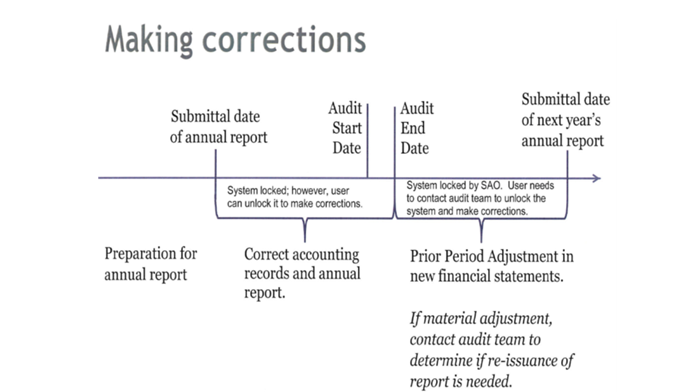
4.1.5.70 Filing instructions
Electronic reporting is strongly encouraged when filing annual reports. Annual reports should be submitted via the filing system on the State Auditor’s website at: https://portal.sao.wa.gov/saoportal/. For assistance with filing the government’s annual report, please review the BARS & Annual Report Filing FAQ page for resources.
For questions and/or support e-mail the SAO HelpDesk through Online Services.
If the city or county cannot provide the annual report via the filing system, mail the annual report to:
Annual Report
State Auditor’s Office
Local Government Support Team
P.O. Box 40031
Olympia, WA 98504-0031
CAUTION: if the local government chooses to mail the annual report, please confirm the government is using the most current version of the prescribed templates found on the BARS Reporting Templates page.
4 Reporting
4.1 Reporting Principles and Requirements
4.1.6 Reporting Requirements and Filing Instructions for Special Purpose Districts
4.1.6.10 Pursuant to RCW 43.09.230, Annual Reports are to be certified and filed with the State Auditor’s Office (SAO) within 150 days after the close of each fiscal year.
4.1.6.20 The following table provides a list of all components of the annual report. This is a guide to help local governments ensure they submit all applicable components. Please see footnote references for additional guidance on a specific component.
|
Special Purpose Districts |
||
|
Statements and Schedules |
No Financial Activity |
With Financial Activity |
|
C-4 Fund Resources and Uses Arising from Cash Transactions |
||
|
C-5 Fiduciary Fund Resources and Uses Arising from Cash Transactions |
||
|
01 Revenues/Expenditures/Expenses |
X |
X |
|
09 Liabilities |
X – See footnote 1 |
X – See footnote 1 |
|
15 Expenditures of State Financial Assistance |
Not applicable |
X – See footnote 1 |
|
16 Expenditures of Federal Awards |
Not applicable |
X – See footnote 1 |
|
21 Risk Management |
Not applicable |
X |
|
22 Assessment Questionnaire |
X - See footnote 2 |
X – See footnote 3 |
X Required to be prepared by special purpose districts and submitted to SAO.
Footnote:
[1] Only required if the activity applies to the government for the reporting year. Please see schedule instructions in the reporting section of the BARS Manual.
[2] No Financial Activity reports do not require a formal Schedule 22 to be completed. Governments who file a no activity report will be required to submit supporting documents to confirm no activity, such as meeting minutes, county reports and/or bank statements.
[3] The Schedule 22 questionnaire is required for all special purpose districts that receive less than $300,000 in annual revenue. Some government types are required to complete the schedule regardless of annual revenue, such as conservation, fire, etc. See BARS 4.8.14, Assessment Questionnaire (Schedule 22) for a complete list of government types required to complete this schedule.
Financial Statement Information
4.1.6.20 The SAO filing system will automatically produce the C-4 and C-5 statements for all cash basis local governments. Note that local governments with total revenues of $3 million or less are not required to prepare a financial statement package unless debt covenants, a contract, a grantor or the government’s legislative body requires the government to prepare the financial statements or if the government is to receive a financial statements audit. If this request is made, the financial statement package containing the C-4 and C-5 statements and notes should be prepared. The $3 million threshold calculation excludes any proceeds from issuance of long-term debt and resources held by the government in its fiduciary capacity.
4.1.6.25 Local governments with no financial activity, defined as having neither expenditures, other than small automatic bank fees (such as dormant account fees) and the state auditor's office audit billings, nor revenues other than interest income on any cash balances, have the option to submit summarized annual reports. These governments need to submit a Schedule 01 reporting cash balances at the beginning and end of the reporting year as well as any investment income received on those balances if applicable. These governments also will be required to submit no activity supporting documents such as meeting minutes and county reports and/or bank statements verifying no activity. Note that by selecting this submission option, preparers of the annual reports are certifying that their government meets the definition of no activity as explained above.
For questions and/or support e-mail the SAO HelpDesk through our Online Services.
4.1.6.30 If more than $1,000,000 in federal funding was expended by the entity during the year and a federal single audit is required, the entity must prepare financial statements if it has expenditures of federal money from more than one program or cluster. However, an entity that normally does not prepare financial statements may not need to prepare them for the single audit if it has expenditures from only one program or cluster. Entities should consult with their local SAO audit team or the SAO HelpDesk if they have questions about this requirement.
4.1.6.40 Forms
The templates for the filing system are available on the BARS Reporting Templates page on the SAO website. The filing system will only accept the forms in the prescribed layout, so do not alter the templates. The templates are designed as a tool to import data into the filing system. Once the data is imported via the template or manual input, the filing system provides the option to export each schedule in a professional formatted version.
4.1.6.50 Subsequent corrections
All subsequent discoveries of errors and omissions in the annual report – from the date of original submission up through the end of the audit applicable to that period – are required to be corrected by resubmitting the annual report. For any misstatements discovered during the audit, governments should ensure open communication with the audit team about the correction. Any misstatements discovered after the audit is completed that affect Schedule 01 should follow BARS 3.1.10.60, Accounting Principles. If misstatements discovered after completion of the audit are material, governments should immediately alert their audit team.
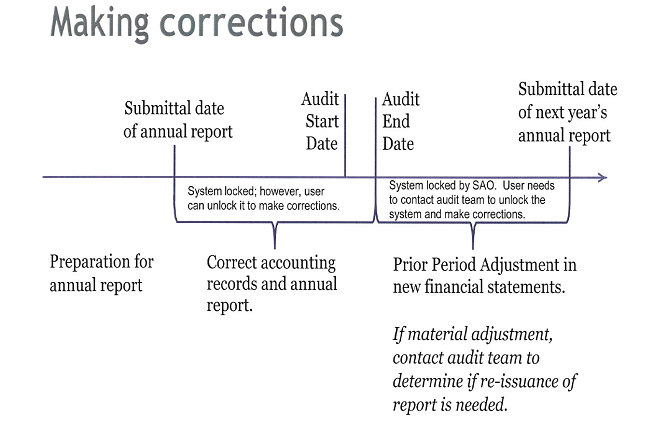
4.1.6.60 Filing instructions
Electronic reporting is encouraged when filing annual reports. Annual reports should be submitted via the filing system on the State Auditor’s website at: SAO. For assistance with filing the government’s annual report, please review the BARS & Annual Report Filing FAQ page for resources.
For questions and/or support e-mail the SAO HelpDesk through our Online Services.
If the special purpose district cannot provide the annual report via the filing system, mail the annual report to:
Annual Report
State Auditor’s Office
Local Government Support Team
P.O. Box 40031
Olympia, WA 98504-0031
CAUTION: if the local government chooses to mail the annual report, please confirm the government is using the most current version of the prescribed templates found on the BARS Reporting Templates page.
The conservation districts are also required to submit their annual report to:
Washington State Conservation Commission
PO Box 47721
Olympia, WA 98504-7721
4 Reporting
4.1 Reporting Principles and Requirements
4.1.3 Certification
Instructions
Every annual report must be certified per RCW 43.09.230. If the local government uses the Online annual reporting system, the certification is built into the filing process.
Official Name
Enter the official name of the government. If the government operates under a DBA this should also be listed. For example: Thurston County Fire Protection District No. 5, doing business as Black Lake Fire Department.
MCAG No.
The MCAG is a unique identifying number assigned by the State Auditor’s Office to each local government. This number can be found on SAO’s website page, BARS Reporting Templates. If you are not sure of the government’s assigned MCAG number, please use the SAO HelpDesk through our Online Services.
Fiscal Year Ended
Enter the date (day, month and year) of the end of the 12 month period covered by the annual report. For example, most local governments close their books and report on a calendar year and would report December 31, 2018, for their 2018 annual report.
Official Address
Enter the legal business address of the government.
Official Website
Enter the official website of the government. If the government does not have a website, then enter none.
Audit Contact or Preparer Information
Enter the name and position of the person the State Auditor’s Office should contact with any questions regarding the annual report. Enter the phone number or numbers where our Office can reach the contact person during regular business hours to discuss the annual report. Also, enter the email address where our Office can communicate with the contact person. If there is no email address for this person, then enter none.
Certification
Annual reports are required to be certified by RCW 43.09.230. The certification should be made by the person preparing the annual report. Certifications do not alter or add to the fundamental responsibilities of employees or officials. Rather, they acknowledge and attest to management’s existing responsibilities for accurate reporting. We understand that representations made are not a guarantee, but rather constitute a good faith statement to the best of your knowledge and belief. Although the Office prescribes the language of the certification, the representations are yours. If you are not sure about the meaning of the certification or feel that you cannot certify the annual report in good faith, please contact the SAO HelpDesk.
ANNUAL REPORT CERTIFICATION
________________________________________
(Official Name of Government)
____________________
MCAG No.
Submitted pursuant to RCW 43.09.230 to the Washington State Auditor’s Office
For the Fiscal Year Ended _______________, 20__
GOVERNMENT INFORMATION:
Official Mailing Address _______________________________________________________________
Official Website Address ______________________________________________________________
Official E-mail Address _______________________________________________________________
Official Phone Number _______________________________________________________________
AUDIT CONTACT or PREPARER INFORMATION and CERTIFICATION:
Audit Contact or Preparer Name and Title _______________________________________________
Contact Phone Number _____________________________________________________________
Contact E-mail Address _____________________________________________________________
I certify ______ day of ______________, 20__, that annual report information is complete, accurate and in conformity with the Budgeting, Accounting and Reporting Systems Manual, to the best of my knowledge and belief, having reviewed this information and taken all appropriate steps in order to provide such certification. I acknowledge and understand our responsibility for the design and implementation of controls to ensure accurate financial reporting, comply with applicable laws and safeguard public resources, including controls to prevent and detect fraud. Finally, I acknowledge and understand our responsibility for immediately submitting corrected annual report information if any errors or an omission in such information is subsequently identified.
Audit Contact or Preparer Signature: ____________________________________________________
4 Reporting
4.1 Reporting Principles and Requirements
4.1.7 GAAP Versus Cash Basis Reporting
4.1.7.10 Approximately 20 percent of local governments – the largest and most complex in the state – report financial information in accordance with generally accepted accounting principles (GAAP). All other local governments report on a cash basis as prescribed in the Budgeting, Accounting, and Reporting System (BARS) Manual.
4.1.7.20 Under authority of RCW 43.09.200, the Washington State Auditor’s Office allows local governments the option to report on either a GAAP or cash basis. However, while the State Auditor’s Office does not require reporting on a GAAP basis, it may be a requirement of federal grants, bonds, contracts, or other oversight agencies.
4.1.7.30 As discussed in the BARS Manuals, the design of a government’s accounting system and controls for financial reporting is a management decision – including the selection of the basis of reporting. Adequate accountability, oversight and control can be achieved whether reporting on a cash or GAAP basis.
4.1.7.40 The most appropriate basis of reporting for a particular government is a matter of judgment based on the needs, activity and resources of that government. Each method has advantages and disadvantages. We recommend that governments carefully consider the costs verses benefits. To assist governments in this decision, a summary of common benefits and drawbacks of different reporting options is provided below.
4.1.7.50 GAAP basis reporting
| Advantages | Disadvantages |
|
|
4.1.7.60 Cash basis reporting
| Advantages | Disadvantages |
|
|
4.1.7.70 Governments should evaluate these general benefits and costs in relation to their specific situation, including their personnel, software systems, organizational structure and activities. Other factors that may be specifically considered include:
4 Reporting
4.3 Financial Statements
4.3.12 Fund Resources and Uses Arising from Cash Transactions (C-4)
Applicability
4.3.12.10 Statement C-4 should be prepared for the general (current expense) fund, and all other governmental, and proprietary funds. Do not prepare it for trust and fiduciary funds. Statement C-4 does not need to be prepared if the government is completing the annual report schedule via the filing system. The filing system will automatically generate this Statement based on the Schedule 01 data.
4.3.12.15 Local governments are required to update the incorrect financial statements. The requirement applies to all errors found prior or during an audit.
4.3.12.20 Local governments with total revenues of $3 million or less are not required to prepare C-4 or C-5 statements unless debt covenants, a contract, a grantor or the government’s legislative body requires the government to prepare the financial statements or to receive a financial statements audit. If this request is made, C-4 and C-5 statements and notes should be prepared. The $3 million threshold calculation excludes any proceeds from issuance of long-term debt and resources held by the government in its fiduciary capacity. Local governments which choose not to prepare C-4 and C-5 statements must have their budgeted information available for the audit.
4.3.12.30 If more than $1,000,000 in federal funding was expended by the entity during the year and a federal single audit is required, the entity must prepare financial statements if it has expenditures of federal funds from more than one program or cluster. However, an entity that normally does not prepare financial statements may not need to prepare them for the single audit if it has expenditures from only one program or cluster. Entities should consult with their local SAO team or the SAO HelpDesk if they have questions about this requirement.
4.3.12.40 In addition to reporting all of their funds on a cash basis, as described in this chapter, cash basis cities and counties may choose to separately report their utility funds on the GAAP basis, if necessary to meet their individual needs. In such a case, they need to prepare two reports:
4.3.12.50 Instructions for preparing GAAP basis financial statements can be found in the GAAP BARS Manual.
Instructions
4.3.12.60 Sometimes governments will create other funds for internal accounting or managerial purposes. When preparing annual report schedules and financial statements, any such accounting or managerial funds should be rolled into appropriate fund types as discussed in BARS 3.1.12, Managerial Funds.
a. To prepare, enter the beginning amounts of cash and investments (3082100, 3083100, 3084100, 3085100, 3089100). The line below should include any adjustments (accounts 388/588). Then list revenue (310, 320, etc.) and expenditures (510, 520, etc.) accounts. The other increases should include: debt proceeds (391-393, 596), transfers-in (397), special/extraordinary items (385/585), and other increases (381, 382, 395, 398). The other decreases should include: capital expenditures (594-595), debt service (591-593, 599), transfers-out (597) and other decreases (581, 582, 589). Display of the ending cash and investments (5082100, 5083100, 5084100, 5085100, 5089100) is required.
b. Beginning and ending cash and investments on Statement C-4 should equal the beginning and ending cash and investments on Schedule 01. These amounts should also agree to the beginning and ending cash and investments on Schedule 06, if applicable.
4.3.12.70 Each fund should be presented in a consolidated manner. That is, any intrafund activity, representing transactions or transfers occurring within the fund between departments, programs or managerial funds, should be eliminated, see BARS 3.1.12, Managerial Funds.
4.3.12.80 Fund names should be appropriately clear for external financial reporting purposes. The name does not need to match exactly to the fund name used in the government’s accounting system.
4.3.12.90 The Total for All Funds (Memo Only) column is a total of amounts reported for all funds. It is labeled as a memorandum total because interfund activity is not eliminated.
4.3.12.100 For financial reporting purposes, amounts should be presented in whole dollars.

4 Reporting
4.3 Financial Statements
4.3.13 Fiduciary Fund Resources and Uses Arising from Cash Transactions (C-5)
Applicability
4.3.13.10 Statement C-5 should be prepared for all fiduciary trust and custodial funds. Exclude all payroll and claims clearing funds. Statement C-5 does not need to be prepared if the government is completing the annual report schedule via the filing system. The filing system will automatically generate this Statement based on the Schedule 01 data.
4.3.13.15 Local governments are required to update the incorrect financial statements. The requirement applies to all errors found prior or during an audit.
4.3.13.20 Local governments with total revenues of $3 million or less are not required to prepare C-4 or C-5 statements unless debt covenants, a contract, a grantor or the government’s legislative body requires the government to prepare the financial statements or to receive a financial statements audit. If this request is made, C-4 and C-5 statements and notes should be prepared. The $3 million threshold calculation excludes any proceeds from issuance of long-term debt and resources held by the government in its fiduciary capacity. Local governments which choose not to prepare C-4 and C-5 statements must have their budgeted information available for the audit.
4.3.13.40 Instructions
a. To prepare, enter beginning cash and investments. Enter any adjustments (net 388/588). Then enter total additions and total deductions. Then foot the statement to calculate ending cash and investments.
b. Beginning and ending cash and investments on Statement C-5 should equal the beginning and ending cash and investments on Schedule 01.
4.3.13.50 Each fiduciary fund type is presented in a consolidated manner. There is no elimination required for interfund activities across the fund types, however intrafund activities within each fund type column should be eliminated. For example, movement of resources from the custodial fund group to the investment trust fund group would not be eliminated. Movement of resources between custodial funds that represent transfer like activity would be eliminated.
4.3.13.60 Fund types should be appropriately clear for financial reporting purposes.
4.3.13.70 The Total for All Funds (Memo Only) column is a sum of amounts reported for all funds.
4.3.13.80 For financial reporting purposes, amounts should be presented in whole dollars.
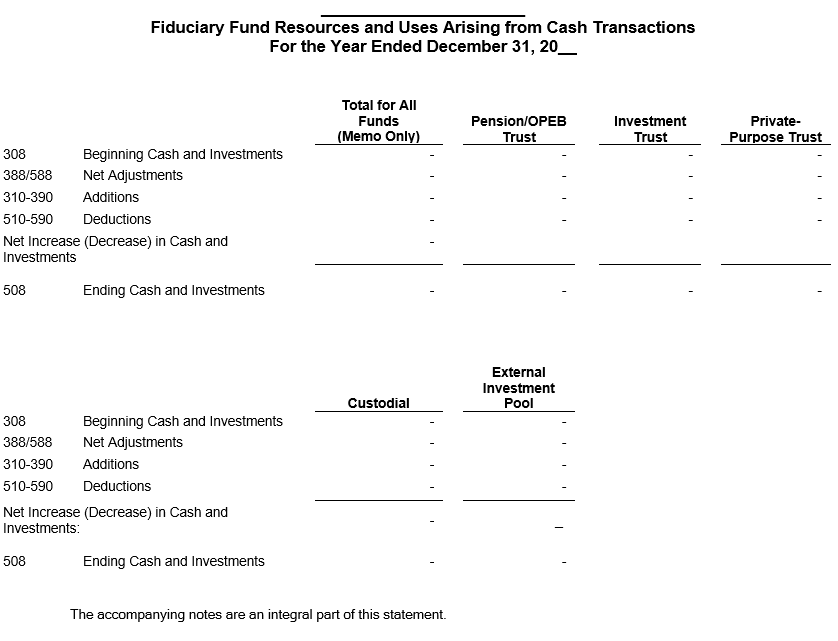
4 Reporting
4.6 Notes to Financial Statements
4.6.2 Instructions
4.6.2.10 Notes to financial statements are intended to communicate information necessary for a fair presentation of financial position and results of operations that is not readily apparent from, or cannot be included in, the financial statements themselves. The notes are an integral part of the financial statements and should supplement them. Therefore, separate notes should be prepared for each fiscal year presented. The note templates are designed to illustrate the disclosures required for cash basis local governments, as applicable. The notes must reflect the local government’s accounting policies and must include disclosure in the areas listed as they relate to the government’s financial position.
4.6.2.20 Notes to the financial statements should be prepared by reviewing and compiling templates provided in the manual that are needed for readers to understand the financial statements:
4.6.2.30 The notes to financial statements can be presented in any format (i.e., narratives, tables, schedules, matrixes, etc.) as long as they contain the required information. Note disclosures should be expressed as clearly and simply as possible and include explanations as necessary to ensure it is understandable by users. However, this does not mean that disclosures should avoid precise technical terms or omit or abridge information that may be complicated or difficult to understand.
4.6.2.40 The notes should be immediately presented after the financial statements.
4.6.2.50 Example notes in BARS Manual consist of Sample Text and Instructions to Preparer.
Sample Text – example of common or standard language meant to help write the note. Sample text should be modified, deleted or added to as necessary to fairly present the government’s circumstances. While sample text is given, it is the local government responsibility to determine accuracy and adequacy of the disclosure.
Instructions to Preparer – comments and instructions on how to write the note, including required elements or additional versions of the note not shown in the sample text.
4.6.2.60 Notes should not include irrelevant, obsolete, trivial or superfluous information. For example, governments should refrain from negative disclosure (stating that a potential disclosure is inapplicable, such as there were no subsequent events requiring disclosure).
Note 1 – Summary of Significant Accounting Policies
The (official name of the government) was incorporated on (date) and operates under the laws of the state of Washington applicable to a (type of government). [1] The (city/county/district) is a (general/special) purpose local government and provides (list major types of services). [2]
The (city/county/district) reports financial activity in accordance with the Cash Basis Budgeting, Accounting and Reporting System (BARS) Manual prescribed by the State Auditor’s Office under the authority of Washington State law, Chapter 43.09 RCW. This manual prescribes a financial reporting framework that differs from Generally Accepted Accounting Principles (GAAP) in the following manner:
A. Fund Accounting
Financial transactions of the government are reported in individual funds. Each fund uses a separate set of self-balancing accounts that comprises its cash and investments, revenues and expenditures. The government’s resources are allocated to and accounted for in individual funds depending on their intended purpose. Each fund is reported as a separate column in the financial statements, except for fiduciary funds, which are presented by fund types. The total column is presented as “memo only” because any interfund activities are not eliminated. The following fund types are used:
Governmental Fund Types: [3]
General Fund
This fund is the primary operating fund of the government. It accounts for all financial resources except those required or elected to be accounted for in another fund.
Special Revenue Funds
These funds account for specific revenue sources that are restricted or committed to expenditures for specified purposes of the government. (Describe the special revenue funds. The description should be specific to the government rather than generic. Identify which revenues and other resources are reported in the funds.)
Debt Service Funds
These funds account for the financial resources that are restricted, committed, or assigned to expenditures for principal, interest and related costs on general long-term debt. (Describe the debt service funds. The description should be specific to the government rather than generic. Identify which revenues and other resources are reported in the funds.).
Capital Projects Funds
These funds account for financial resources which are restricted, committed, or assigned for the acquisition or construction of capital facilities or other capital assets. (Describe the capital project funds. The description should be specific to the government rather than generic. Identify which revenues and other resources are reported in the funds.).
Permanent Funds
These funds account for financial resources that are legally restricted to the extent that only earnings, and not principal, may be used for purposes that support programs for the benefit of the government or its citizenry. (Describe the permanent funds including the purpose the interest must be used for).
Proprietary Fund Types: [3]
Enterprise Funds
These funds account for operations that provide goods or services to the general public and are supported primarily through user charges. (Describe the purpose of the enterprise funds such as water fund).
Internal Service Funds
These funds account for operations that provide goods or services to other departments or funds of the government on a cost reimbursement basis. (Describe the activities of the internal service funds).
Fiduciary Fund Types: [3]
Fiduciary funds account for assets held by the government in a trustee capacity or as a custodian on behalf of others.
Pension (and Other Employee Benefit) Trust Funds
These funds are used to report fiduciary activities for pension and OPEB plans administered through trust. (Describe the activities of the Pension (and Other Employee Benefit) Trust Funds)
Investment Trust Funds
These funds are used to report fiduciary activities from the external portion of investment pools and individual investment accounts that are held in trust. [4] (Describe the activities of the Investment Trust Funds).
Private-Purpose Trust Funds
These funds report all trust arrangements under which principal and income benefit individuals, private organizations or other governments. (Describe the activities of the Private-Purpose Trust Funds).
Custodial Funds
These funds are used to account assets that the government holds on behalf of others in a custodial capacity. (Describe the activities of the Custodial Funds).
B. Basis of Accounting and Measurement Focus
Financial statements are prepared using the cash basis of accounting and measurement focus. Revenues are recognized when cash is received and expenditures are recognized when paid.
In accordance with state law the (city/county/district) [5] also recognizes expenditures paid during twenty days after the close of the fiscal year for claims incurred during the previous period.
C. Cash and Investments
It is the (city/county/district’s) policy to invest all temporary cash surpluses. (The interest on these investments is prorated to the various funds (or if not prorated, explain your unique circumstances).) [6] For further information see Note X – Deposits and Investments.
D. Capital Assets
Capital assets are assets with an initial individual cost of more than $____ and an estimated useful life in excess of __ year(s). Capital assets and inventory are recorded as capital expenditures when purchased.
E. Compensated Absences
Vacation leave may be accumulated up to ___ days and (is or is not) payable upon separation or retirement. Sick leave may be accumulated (indefinitely or up to X hours). Upon separation or retirement employees (do or do not) receive payment for unused sick leave. Payments are recognized as expenditures when paid. (Describe any other items in the compensated absence policy that can affect the calculation of liability (such as paying at different pay rate, flow assumption, only a percentage of hours are eligible, or a cap to the hours that can be paid out)).
F. Liabilities [7]
See (include any references to notes regarding long term liabilities, including pensions, OPEB, long-term liabilities, etc.)
G. Leases and Subscription Based Information Technology Arrangements (SBITA) [8]
Leases are reported as liabilities if the total payments over the life of the lease is more than $_______. SBITAs are reported as liabilities if the total payments over the life of the SBITA is more than $_______. For more information see Note X – Leases and Note X – SBITA.
H. Restricted and Committed Portion of Ending Cash and Investments [9]
Beginning and Ending Cash and Investments are reported as restricted or committed when it is subject to restrictions on use imposed by external parties or due to internal commitments established by _____________. When expenditures that meet restrictions are incurred, the (city/county/district) intends to use the most restricted resources first.
Restrictions and commitments of Ending Cash and Investments consist of ________________.
Instructions to preparer:
[1] For type of government describe the legal formation of your government, such as second-class city with a mayor-council form of government.
Return to Reference 1
[2] For major types of services, summarize the functions that your government performs, such as:
Public safety, fire prevention, street improvement, parks and recreation, health and social services, and general administrative services. In addition, the (city/county/district) owns and operates a sewer system.
Return to Reference 2
[3] Eliminate labels and descriptions of any funds that your government does not use. The external portion of investment pools that are not held in trust should be reported in a separate external investment pool fund column under the custodial funds classification.
Return to Reference 3 - Governmental
Return to Reference 3 - Proprietary
Return to Reference 3 - Fiduciary
[4] Counties only – If there is an external investment pool, the county should use these fund types for all transactions for the Special Purpose Districts. The county should not record the maturity and repurchase transactions as additions and reductions.
Return to Reference 4
[5] Counties that elected under RCW 36.40.200 to allow appropriation account to remain open after the end of the fiscal year should include the following disclosure:
In accordance with state law, the (county) also recognize expenditures paid during (number of days) after the close of the fiscal year for claims incurred during the previous period.
Junior taxing districts/special purpose districts within these counties should verify with the County if the open period applies to them. If so, the following disclosure is required:
In accordance with state law, the (district) uses the (__________ county) as their treasurer and under the County’s RCW 36.40.200, District expenditures may be recognized during the (number of days) days after the close of the fiscal year for claims incurred during the previous period.
Return to Reference 5
[6] If the government has multiple funds, include the prorated statement, or other statement that is appropriate for how interest is allocated to the funds. Disclose any income from investments associated with one fund that is assigned to another fund. See BARS 3.2.3, Sweeping Interest and Investment Returns into General Fund for legal requirements related to interest diversion.
Return to Reference 6
[7] Include references to notes regarding other liabilities of the government. If there is an unusual accounting policy regarding these liabilities, the government should disclose that information here.
Return to Reference 7
[8] Governments are allowed to adopt policy that identifies a threshold for leases/SBITAs but are not required to. If the government has a policy, disclose the threshold. If the government does not have a policy, then modify the note disclosure. For example:
The (city/county/district) does not have a lease/SBITA threshold and therefore reports a liability for all leases/SBITAs regardless of their dollar amount.
Return to Reference 8
[9] In relation to internal commitments, describe the government’s highest level of decision-making authority and the formal action required to establish, modify or rescind a fund balance commitment. For example: “…by ordinance or resolution of the City Council.”
If the government reports any restricted and committed amounts of ending cash and investments, it should describe the specific purposes (not functions) and amounts of these restrictions and commitments.
Return to Reference 9
Note X ‑ Accounting Changes and Error Corrections
A template for this note is not available. See “Instructions to preparer:” for disclosures that may be required.
Instructions to preparer:
Include changes in accounting principles, changes to or within the reporting entity, and error corrections in previously issued financial statements as defined at BARS 3.1.10, Accounting Principles.
For all accounting changes and error corrections, the circumstance surrounding each change should be separately disclosed by:
A narrative of the change or error, as detailed below
A formatted table detailing the impact of each change or error that reconciles to the adjustment totals in BARS Codes 388.XX and 588.XX
Specific narrative requirements for each accounting change and/or error correction are listed below:
Change in accounting principle:
Identification of the new accounting standard implemented as required by the BARS Manual
Change to or within the financial reporting entity:
The nature of the change
The reason for the change
Error correction:
Identification of the error and the correction, including the period(s) affected by the error
Identification of the line items that are affected by the error
The effect (amount) on the prior period’s cash and investment balance, had the error not occurred
Examples:
Example – change in accounting principle: During fiscal year 20XX, the (government type) implemented (describe accounting standard) as required by the BARS Manual. The effect of that accounting standard is shown in Column (X) of the table below.
Example – change in financial reporting entity: During fiscal year 20XX, the (government type) reported Fund XXX as (fund type) whereas in (prior fiscal year) it was reported as Fund XXX as (fund type). This change has occurred due to (describe reason for the change). The effect of the change in reporting entity is shown in the table below, see column (X).
Example – error correction: During fiscal year 20XX, the (government type) identified (describe error). This error causes the beginning cash balance to be restated by (dollar amount) less/more than previously reported. The effect of that error is shown in Column (X) of the table below.
Table format example:
|
|
12/31/20XX |
Change in accounting principle |
Change to or within the financial reporting entity |
Error correction |
12/31/20XX |
|---|---|---|---|---|---|
|
Fund 1* |
|
|
|
|
|
|
Fund 2 |
|
|
|
|
|
|
Total Funds |
|
|
|
|
|
*Include all funds with an accounting change or error correction, including fiduciary funds.
Note X – Budget Compliance
The (city/county/districts) [1] adopts (annual/biennial) appropriated budgets for _____ [2] funds. These budgets are appropriated at the fund level (except the general (current expense) fund, where budget is adopted at the department level.[3] The budget constitutes the legal authority for expenditures at that level. (Annual/biennial) appropriations for these funds lapse at the fiscal year end.
(Annual/biennial) appropriated budgets are adopted on the same basis of accounting as used for financial reporting.
The appropriated and actual expenditures for the legally adopted budgets were as follow: [4]
|
Fund/Department |
Final Appropriated Amounts |
Actual Expenditures |
Variance |
|
General Fund: |
|||
|
……. Department |
$ |
$ |
$ |
|
……. Department |
$ |
$ |
$ |
|
……. Department |
$ |
$ |
$ |
|
……. Department |
$ |
$ |
$ |
|
……. Department |
$ |
$ |
$ |
|
……. Department |
$ |
$ |
$ |
|
……. Department |
$ |
$ |
$ |
|
……. Department |
$ |
$ |
$ |
|
Total General Fund |
$ |
$ |
$ |
|
….. Fund |
$ |
$ |
$ |
|
….. Fund |
$ |
$ |
$ |
|
….. Fund |
$ |
$ |
$ |
[5] The (city/county/district) adopts budgets for (list managerial funds that have separate legal budgets), these funds are not reported separately on the financial statements, but in the (list the fund the managerial funds are reported in).
Budgeted amounts are authorized to be transferred between (departments within any fund/object classes within departments); however, any revisions that alter the total expenditures of a fund, or that affect the number of authorized employee positions, salary ranges, hours, or other conditions of employment must be approved by the (city/county/district’s) legislative body. [6]
Instructions to preparer:
[1] The note is applicable only if the city/county/district is legally required to appropriate its expenditures. The data in the matrix should match the amounts in the city/county/district’s budget document (i.e., ordinance, resolution, etc.). If the city/county/district adopts budgets for the managerial funds that are combined for the financial presentation, the note should disclose the legally adopted budgets information.
Back to Reference 1
[2] List the funds for which the city/county/district adopts appropriated budgets.
Back to Reference 2
[3] If the city/county/district adopts budgets on a level other than fund, list the funds and describe the level.
Back to Reference 3
[4] Present general fund budget on the department level only if the city/county/district legally approves the budget on that level.
If the city/county/district adopts a biennial budget:
The first year:
Final appropriated amount will be the total biennial appropriated budget
Actual expenditures will be the expenditures for the first year
The second year:
Final appropriated amount will be the total biennial appropriated budget
Actual expenditures will be the total expenditures for both years
Note: Biennial budgets should be reported at the same level of detail as the adopted budget (i.e. if the government adopts their budget presenting two individual budget years or as one single biennial budget, the budget to actual comparison is presented the same).
Also, if any funds besides the general fund adopts a budget that is legally approved on a level lower than fund (e.g., activities, etc.) the government needs to present the budgeted information on that level.
Back to Reference 4
[5] If the city/county/district legally adopts budgets for managerial funds then they should be reported separately in the note and disclosed below the table.
Back to Reference 5
[6] Provide a description, including affected fund(s) and amount(s), of any material budget transfers or amendments during the fiscal year. If there are significant variances, provide an explanation.
Note X - Certain Risk Disclosures
A template for this note is not available. See “Instructions to preparer:” for various disclosures that may be required.
Instructions to preparer:
This disclosure is required only if all the following criteria is met:
A concentration or constraint is known before the financial statements are issued
The concentration or constraint makes the government (or fund) vulnerable to the risk of substantial impact
An event associated with the concentration or constraint that could cause substantial impact has occurred, started to occur, or is 50% or more likely to occur within 12 months after the financial statements are issued
The disclosure criteria should be evaluated for the primary government. However, if any funds report a liability for revenue debt, the disclosure criteria should also be evaluated in the context of those individual funds.
Concentration: A lack of diversity related to an aspect of a significant inflow of resources or outflow of resources. Examples include, but are not limited to, a lack of diverse employers, industries, workforce, or suppliers.
Constraint: A limitation imposed on a government by an external party or by formal action of the government’s highest level of decision-making authority. Examples include, but are not limited, to limitations on raising revenue, spending, or incurring debt. Mandated spending may also be a constraint.
If all the disclosure criteria are met, however the government takes mitigating actions prior to the issuance of the financial statements that cause any of the disclosure criteria to no longer be met, a disclosure would no longer be required.
Note: if the contents required of this note are disclosed as part of another note disclosure, the notes can be combined to avoid unnecessary duplication.
Disclosure contents:
For each concentration or constraint that meets all the disclosure criteria, the required disclosure should describe:
a) The concentration or constraint
b) Each event associated with the concentration or constraint that could cause a substantial impact if the event had occurred or had begun to occur
c) Actions taken by the government prior to the issuance of the financial statements to mitigate the risk.
The disclosure should provide adequate detail of the circumstances and vulnerability for a reader to understand the risk and the impact to the government.
Example notes:
Ex. a. Concentration of Financial Resource Provider
The Airport Fund accounts for the (City/County/District) airport operations and reports $X million of revenue bonds outstanding on December 31, 20XX. The bond indentures state that the revenue generated by airport operations is pledged as the sole source of repayment for the bonds. XX percent of the Airport Fund’s revenues are associated with a single airline customer who has notified the (City/County/District) that it plans to terminate its lease and discontinue service to the (City/County/District)’s airport by March 31, 20XX. A loss of revenue from that airline could adversely affect the Airport Fund. (Note: in this example the government has not taken any mitigation actions, therefore this note does not provide a description of the mitigating actions).
Ex. b. Concentration of Employer
Employer A is a large employer in (City/County/District) that employs nearly (number of employees) personnel. The various tax revenues received by the (City/County/District) directly or indirectly related to the operations of Employer A represent XX percent of the (City/County/District) resources for the year ending December 31, 20XX. On November 30, 20XX, Employer A initiated closure of its facilities in the (City/County/District) and are expected to complete all of the closure actions within six years. The Governing Body has approved various economic incentives aimed at encouraging the redevelopment of the property associated with Employer A.
Ex. c. Constraint: Mandated Spending
The (City/County/District)’s wastewater treatment operations are subject to environmental regulations established by the State Department of Ecology. The Department of Ecology had proposed new regulations that would require reducing the allowable level of certain pollutants in the wastewater treatment plant’s discharge by one-third. If adopted, the (City/County/District) would be responsible for complying with the regulations by modifying the plant at a substantial cost to its ratepayers by September 20XX.
On June 15, 20XX, the Board approved an increase in the rates charged to private and commercial customers to partially address improvements to the wastewater treatment plant aimed at reducing pollutants.
Note X – COVID-19 Pandemic
If governments continue to have substantial impacts, either positive or negative, or have significant amounts of federal funding related to the pandemic this should be disclosed in the (Cash – Note X – Other Disclosures).
Note X – Deposits and Investments
Investments are reported at (amortized cost/face value/fair value). [1] Deposits and investments by type at December 31, 20XX are as follows:
| Type of deposit or investment [2] | (City/County/ District's) own deposits and investments [3] | Deposits and investments held by the (City/County/District) as custodian for other local governments, individuals, or private organizations [4] | Total |
| Bank deposits | $ | $ | $ |
| Certificates of deposit | |||
| Local Government Investment Pool | |||
| U.S. Government securities | |||
| (Other) | |||
| (Other) | |||
| Total | $ | $ | $ |
Investments in the State Local Government Investment Pool (LGIP)
The (city/county/district) is a voluntary participant in the Local Government Investment Pool, an external investment pool operated by the Washington State Treasurer. The pool is not rated and not registered with the SEC. Rather, oversight is provided by the State Finance Committee in accordance with Chapter 43.250 RCW. Investments in the LGIP are reported at amortized cost, which is the same as the value of the pool per share. The LGIP does not impose any restrictions on participant withdrawals.
The Office of the State Treasurer prepares a stand-alone financial report for the pool. A copy of the report is available from the Office of the State Treasurer, PO Box 40200, Olympia, Washington 98504-0200, online at www.tre.wa.gov.
Investments in (county investment pool) [5]
The (city/county/district) is a (voluntary/involuntary) participant in the (county investment pool), an external investment pool operated by the County Treasurer. The pool is not rated or registered with the SEC. Rather, oversight is provided by the County Finance Committee in accordance with RCW 36.48.070. The (city/county/district) reports its investment in the pool at (amortized cost/fair value), which is (the same as the value of the pool per share/or disclose the difference between the reported amount and the value of pool shares). (The pool does not impose restrictions on participant withdrawals/or disclose restrictions).
Custodial Credit Risk [6]
Custodial credit risk for deposits is the risk that, in event of a failure of a depository financial institution, the (city/county/district) would not be able to recover deposits or would not be able to recover collateral securities that are in possession of an outside party. The (city/county/district’s) deposits and certificates of deposit are mostly covered by federal depository insurance (FDIC) or by collateral held in a multiple financial institution collateral pool administered by the Washington Public Deposit Protection Commission (PDPC).
All investments are insured, registered or held by the (city/county/district) or its agent in the government’s name.
Other Disclosures [7]
Instructions to preparer
[1] Investments may be presented at amortized cost, face value or fair market value. With amortized cost, interest earnings are recorded when earned. With face value, interest earnings are recorded only when received. With fair value, unrealized changes in fair value are recorded as interest revenue. If presentation varies by investment type or fund, these differences must be described.
[2] If cash on hand is not significant, governments may report it as part of the “Bank Deposits” category.
[3] The total deposits and investments disclosed in this column should equal total ending cash and investments reported on the Statement C4.
[4] The total deposits and investments disclosed in this column should equal total ending cash and investments reported on the Statement C5. If the government does not report any fiduciary funds, then this column should be deleted.
[5] Participants in external investment pools must disclose:
That the pool is not SEC-registered and a brief description of any regulatory oversight for the pool.
Whether investments in the pool are reported at amortized cost or fair value.
Whether fair value of the position in the pool is the same as the value of the pool shares.
Whether participation is voluntary or involuntary. If the county acts as the government’s treasurer, participation in the county pool is considered involuntary since it is specified by law.
For pools reported at amortized cost, any limitations or restrictions on withdrawals from external investment pools (such as redemption notice periods, maximum transaction amounts, and the external investment pool’s authority to impose liquidity fees or redemption gates).
If the government cannot obtain information from a pool sponsor to make one or more disclosures, the government’s understanding of the pool should be disclosed along with the fact that the government was unable to obtain confirmation from the pool about this understanding.
[6] If the city/county/district deposits are not entirely insured, disclose the amount that is uncollateralized. If investments are uninsured, unregistered and held by the counterparty’s trust department or agency in the government’s name, disclose the circumstances.
[7] Additional disclosures are needed if the government holds any of the following types of deposits or investments:
If the government participated in any securities lending transactions during the period, disclose the type of securities lent and collateral received, the amount by which the value of the collateral provided is required to exceed the value of underlying securities, any loss indemnification, whether the maturities of the investments made with cash collateral generally match the maturities of their securities loans, amount of credit risk, if any, related to the securities lending transactions and any losses resulting from defaults.
If the government participated in any reverse repurchase agreement transactions during the period, disclose the fair value of securities to be repurchased and description of the terms of the agreements.
If the government used, held, or sold any derivatives or similar instruments during the period covered by the financial statements, it must disclose the nature of transactions, objective for entering into transactions, the notional amount, effective date and other significant terms and the fair market value of the derivatives as of fiscal year end.
If the government has any compensating balance agreements (See BARS 3.2.5, Compensating Balances) with banks in lieu of payments for services rendered, disclose the average compensating balances maintained during the year.
If the government has any deposits or investments denominated in foreign currency, disclose the US dollar value, organized by each different foreign currency denomination and type of investment.
Note X - Environmental and Certain Asset Retirement Liabilities
Instructions to preparer:
Disclose any additional information that are essential to a user’s understanding of the financial statements, for example:
Pollution Remediation(Environmental)/Retirement of Certain Assets
List polluted site(s), type of contamination, clean-up action(s), assets subject to special retirement rules, potential liability and any payments incurred during reporting year. Add any other significant information (e.g., money set aside for this purpose, sources of future funding, method used to determine the liabilities, etc.). Note: For certain asset retirement obligations, obligations with reasonably certain retirement timeframes need be disclosed. Additionally, asset retirement obligations that could be significant but have no planned retirement should be disclosed.
The (city/county/district) has contaminated ground under oil storage tanks. Under the (federal/state) law, the (federal/state agency) named the (city/county/district) as potentially responsible for remediation. The (city/county/district) is working with the (federal/state agency/contractor, etc.) to clean up the site. The (city/county/district) recorded $____ as pollution remediation liability on the Schedule of Liabilities. During (reported year) the (city/county/district) paid $____ for the clean-up.
The (city/county/district’s) airport was found to have pesticide residue from previous agricultural activities. No clean-up action is required at this time.
The (city/county/district) has ground contaminated with fuel from fuel storage tanks. Under the (federal/state) law, the (federal/state agency) named the (city/county/district) as potentially responsible for remediation. At this time, the (city/county/district) doesn’t have sufficient information to reasonably estimate the liability related to potential cleanup of the site.
The (city/county/district) has (number and size) underground fuel storage tanks. Under state law, the (city/county/district) is required to decommission the tank and the (city/county/district) plans to (retire/replace) the tanks and tank sites by (date). The (city/county/district) will incur estimated costs of $_____related to the project. These liabilities are reported on the Schedule of Liabilities. During (reported year) the (city/county/district) paid $____ for the related work.
The (city/county/district) has (___number of____) wells requiring capping in the foreseeable future. Due to the (federal/state) law and/or the legal agreement with (________) the (city/county/district) will incur estimated costs of $_____related to the capping. These liabilities are reported on the Schedule of Liabilities. During (reported year) the (city/county/district) paid $____ for the related work.
The (city/county/district) has property (describe in adequate detail) required to be decommissioned by (date). Due to contractual obligations with (________) the (city/county/district) will incur estimated costs of $_____related to the project. These liabilities are reported on Schedule of Liabilities. During (reported year) the (city/county/district) paid $____ for the related work.
The (city/county/district) owns contaminated property due to the former tenant dry cleaning business. The (city/county/district) is working with the (federal/state agency/contractor, etc.) to clean up the site. The (city/county/district) recorded $____ as pollution remediation liability on the Schedule 09. However, the recent work at the cleanup site revealed additional contaminated areas requiring to reevaluate the future cost of the project. As a result the (city/county/district) increased the amount of liabilities reported on Schedule of Liabilities by $_____. During (reported year) the (city/county/district) paid $____ for the clean-up.
Based on the engineering firm’s estimate, the (city/county) has the following liabilities associated with the closure of its landfill(s). These amounts were updated in (year) to values determined by the engineering firm. The amounts were last updated for inflation as of (date). The amount of post-closure costs reported on the Schedule of Liabilities is $_____.
Note X – External Investment Pool
The County sponsors the (pool name) External Investment Pool pursuant to state laws that authorize the County Treasurer to invest its surplus cash and any funds of municipal corporations which are not required for immediate expenditure and are in the custody or control of the county treasurer. The pool’s investments are limited to those authorized by state law for local governments. The pool is not registered with the SEC but is subject to oversight by the County Finance Committee. The Committee is responsible for adopting investment objectives and policies, for hiring investment advisors, and for monitoring policy implementation and investment performance. The Committee’s primary role is to oversee the allocation of the Pool’s portfolio among the asset classes, investment vehicles, and investment managers.
The pool is reported on (an amortized cost / a fair value) basis [1]. The pool (is / is not) held in a trust for participants and is therefore reported as an (Investment Trust / Custodial activity). The County has not provided nor obtained any legally binding guarantees to support the value of shares in the Pool. Any credits or payments to pool participants are calculated and made in a manner as required by RCW 36.29.024. [2]
In accordance with state law, the County acts as the treasurer for most local governments within the County. (Percentage) of the pool consists of these involuntary participants. [3]
(Separate financial statements for the Investment funds may be obtained from the County Treasurer’s Office, or by visiting the County’s website /or since a separate annual financial report is not available for the External Investment Pool, the following additional disclosures are being provided in the County’s financial statements.) [4]
Instructions to preparer:
Each county is expected to have at least one external investment pool as described in BARS 3.2.9, County's External Investment Pool. If the county operates multiple pools, then disclosures must distinguish between each pool.
Counties may also maintain Individual Investment Accounts, to hold specific investments acquired for individual municipalities, and for which the changes in the value of those investments affect only the municipality for which they are acquired. Note, there are no additional disclosures for Individual Investment Accounts.
[1] See Governmental Accounting Standards Board (GASB) Codification of Governmental Accounting and Financial Reporting Standards Section In5 "Investment Pools (External)" for requirements for the pool to be report on an amortized cost basis. If the pool does not meet these requirements, it should be reported on a fair value basis for purposes of the county and participants’ financial statement reporting. The Local Government Investment Pool (LGIP) has met these requirements and should be reported at amortized cost even if the County’s investment pool is reported at fair value.
[2] If the County diverted any interest or other earnings from external pool participants under authority of RCW 36.29.020, then this fact should be disclosed, along with the total amount of investment income assigned to the County’s general fund for the year.
[3] If the county acts as the government’s treasurer, participation in the county pool is considered to be involuntary since it is specified by law.
[4] If the County publishes a separate annual financial report for the pool, this may be referenced in lieu of additional disclosure. This report may be audited or unaudited but must be available before the issuance of the County’s financial statements for that period in order to be referenced. The reference should describe how a user can obtain this report. If the County does NOT PUBLISH A SEPARATE ANNUAL FINANCIAL REPORT FOR THE POOL, the following additional disclosures must be added:
Frequency of determining the fair value of investments
Method used to determine participants' shares sold and redeemed and whether that method differs from the method used to report investments
Summary of the fair value, carrying amount (if different from fair value), number of shares or the principal amount, ranges of interest rates, and maturity dates of each major investment classification.
Custodial Credit Risk and Other Disclosures as applicable for the pool, see Note X – Deposits and Investments instructions.
Counties may also maintain Individual Investment Accounts, to hold specific investments acquired for individual municipalities. There is no required note disclosure for Individual Investment Accounts.
Note X – Going Concern
Use the following disclosure in circumstances where substantial doubt is alleviated by management's plans:
(Describe conditions or events giving rise to a substantial doubt about the government's ability to continue as a going concern for a reasonable period of time). [1]
(Describe management's plan) [2] These planned actions are expected to enable the government to continue operating and meeting its obligations as they come due.
Use the following disclosure in circumstances where substantial doubt is not alleviated by management's plans:
The financial statements have been prepared on a going concern basis, which assumes the (city/county/district) will be able to realize its assets and settle its liabilities in the normal course of business for the foreseeable future. (Describe conditions or events giving rise to a substantial doubt about the government's ability to continue as a going concern for a reasonable period of time). [1]
These conditions raise substantial doubt about the (city/county/district)'s ability to continue operating as it has in the past. (Describe management's plan) [2] The ability to continue as a going concern is dependent upon (describe conditions needed, such as a favorable outcome to litigation, ability to secure permanent financing, continuing to receive outside assistance with deficits, reduction of certain expenditures or increase in certain revenues, success of management's plans as described above, etc.).
Instructions to preparer
Financial statements are prepared on a going concern basis, which is, in the absence of significant information to the contrary, the continuation of a legally separate governmental entity. Generally, significant information to the contrary would consist of a government’s inability to continue to realize its assets and settle its liabilities in the normal course of business for the foreseeable future, sale of substantial assets to meet obligations, restructuring debt, submitting to government oversight or fiscal assistance to operate, or similar actions.
Governments are required to evaluate whether there is a substantial doubt about the district’s ability to continue as a going concern for a reasonable period of time (which is generally considered to be 15 months beyond the date of the financial statements) without needing to default on obligations or take emergency actions outside the normal course of business. If no substantial doubt exists, then no disclosure is needed. However, if conditions or events exist that raise a substantial doubt, the note disclosure is required.
The contents of the note disclosure will be different, depending on whether the substantial doubt is alleviated by management’s plans or not.
[1] The description of conditions or events giving rise to a substantial doubt should include disclosure of the following, as appropriate:
Relevant conditions and events
The possible effects of such conditions and events, including possible discontinuation or severe reduction of operations, if applicable
Government officials' evaluation of the significance of those conditions and events and any mitigating factors,
Government officials' plans, including relevant prospective financial information or subsequent events
[2] The description of the government’s plans should include disclosure of the following information, as appropriate:
Relevant actions taken or planned to address the conditions or events.
The estimated time frame for planned actions, if known.
Whether the planned action has been approved by the governing body or is just being considered.
Information about possible direct or indirect effects of disposal on operations or levels of service, if applicable.
Relevant prospective financial information or subsequent events, if applicable.
Information about the recoverability or classification of recorded assets or the amounts or classification of liabilities, if applicable.
The following include examples of plans that management may implement to mitigate conditions or events, along with specific considerations regarding information to disclose about those plans. Note: examples are not an all-inclusive list.
Discontinuing or outsourcing certain activities or operations. Consider disclosing estimated transition costs and future cost savings (if known) and any restrictions, whether services are expected to be assumed by other governments, and any encumbrances or uncertainties related to the discontinuance, such as the need to negotiate with service providers or contractors.
Selling assets - Consider disclosing any conditions, restrictions, encumbrances or uncertainties related to the sale or marketability of the asset.
Borrowing money or restructuring debt - Consider disclosing availability and terms of planned financing and any expected need for collateral or third-party guarantees.
Reducing or delaying expenditures. Consider disclosing whether reductions are planned to be temporary or permanent and any restrictions, encumbrances or uncertainties related to the reduction, such as the need to negotiate with unions, vendors or other parties.
Raising revenues. Consider disclosing any conditions or uncertainties such as the outcome of a vote or grant application.
Note X – Joint Ventures, Component Unit(s), and Related Parties
A template is not provided since each situation is unique. The instructions below provide information on what should be included in the note disclosure.
Instructions to preparer:
Joint ventures, Component units and foundations:
The notes should provide the following information for any legally separate organization that the government controls or participates in joint control (e.g., because it appoints one or more members of the board), holds an ongoing financial interest or financial responsibility, or that is a foundation dedicated to benefiting the government:
Description of the Component Unit/Joint Venture; such as:
date of formation,
governing body, who oversees the management of the organization,
the purpose of the component unit/joint venture, why the organization was formed.
Information regarding the nature of the relationship with the government.
Information regarding the performance and activity of the organization by providing financial information such as:
Operating budget – budgeted revenues and expenditures
Operating actuals – actual revenues and expenditures
If applicable, any amounts remitted to or received from the joint venture / component unit.
Provide other information that may be of interest or benefit to the users of the financial statements; such as if separate financial statements are provided, how to obtain more information, etc.
Sample note:
(Each situation is unique, this sample may not provide complete disclosure of the component unit or joint venture; adjust the note as necessary.)
The (component unit/joint venture) was formed by (ordinance/vote of the citizens/etc.) of (county/city/district). The (component unit/joint venture) provides (purpose of formation, function, activity) for the (county/city/district/etc.). The (component unit/joint venture) is governed by a (number of officials) board composed of (appointed/voted) by the (county/city/district's) citizens.
The (County/City/District) is/isn’t obligated to (provide nature of relationship, such as required funding from County/City/District, support for component unit/joint venture operations, revenue or net income sharing arrangements, etc. If applicable, provide information on who receives assets of the component unit/joint venture upon dissolution).
In 20__ the (component unit/joint venture) remitted/received $___________ to/from the (county/city/district). The (component unit/joint venture) also reported the following:

The financial statements for the (component unit/joint venture) can be obtained at (address/website).
Related party:
These disclosures are required for any significant transactions with related parties, other than normal transactions conducted in the ordinary course of operations (such as compensation of employees or licensing or permitting for other governments). When evaluating the necessity of a disclosure, governments should consider both the form and substance of the transaction.
Related parties include:
A government's joint ventures, component units and foundations
Elected and appointed officials of the government, executive management and immediate family members of officials and executive managers
Other parties that the government can significantly influence
Other parties that can significantly influence the government
Other parties that are under the influence of a related party to the government
Disclosure should include (for each period for which financial statements are presented):
The nature of the relationship(s) involved.
A description of the transactions, including transactions with nominal or no amounts and other information deemed necessary to gain an understanding of the effects of the transactions on the financial statements.
The dollar amounts of transactions and the effects of change in the method of establishing the terms used in the preceding period.
Amounts due from or to related parties and, if not otherwise apparent, the terms and manner of settlement.
Note X – Leases (Lessees)
A template for this note is not available. See “Instructions to preparer:” for disclosures that may be required.
Instructions to preparer:
A lessee (i.e., renter) should disclose the following about its lease activities (which may be grouped for purposes of disclosure), other than short-term leases (leases that have a maximum possible term of less than one year):
To “group” leases, consider logical groupings such as lease type (land, buildings, equipment, etc.), lease term (5-10-25+ years), vendor (if leasing various things from a single vendor), etc.
1. A general description of its leasing arrangements, such as the assets leased, terms of the leases, the amount of the monthly (quarterly/annual) payments, cancellation clauses, significant commitments before the start of the lease, changes in lease term for previously reported leases, etc.
Examples:
During the year ended (fiscal year end), the (city/county/district) adopted guidance for the presentation and disclosure of leases, as required by the BARS manual. This requirement resulted in the addition of a lease liability reported on the Schedule of Liabilities.
The (city/county/district) leases land and buildings from the State for $500 per month under lease agreements that range from 10 to 20 years. The leases began in January of 2015 and will end December of 2035 and include options to cancel after the first 10 years.
The (city/county/district) leases vehicles from the County motor pool for $200 per month under 5-year lease agreements with rotating end dates. In addition, the (city/county/district) pays $300 per month under a 50-year lease with the State for storage space. This lease can be cancelled by us with 1-year's notice.
The (city/county/district) leases 30 copiers from Office Min for $500 per month under 3-year lease agreements that can be cancelled with 90-days' notice and severe penalties.
2. The total amount paid for leases in the current reporting period and future lease payments for each of the five subsequent years and in five-year increments thereafter.
Example:
The total amount paid for leases in 2020 was $6,000. As of December 31, 2020, the future lease payments are as follows:
|
Year ended December 31 |
Total |
|
2021 |
$6,000 |
|
2022 |
$6,000 |
|
2023 |
$6,000 |
|
2024 |
$6,000 |
|
2025 |
$6,000 |
|
2026-2030 |
$30,000 |
|
2031-2035 |
$30,000 |
|
2036-2038 |
$18,000 |
|
Total |
$108,000 |
Note X - Long-Term Liabilities (Formerly Long - Term Debt)
The following table provides details of the outstanding debt of the (city/county/district) and summarizes the (city/county/district's) debt transactions for year ended December 31, 20XX.
The debt service requirements for (general obligation bonds, revenue bonds and ______________ )[1] are as follows:
| Principal | Interest | Total | |
| 20XX [2] | $ | $ | $ |
| 20XX | |||
| 20XX | |||
| 20XX | |||
| 20XX | |||
| 20XX - 20XX | |||
| TOTALS | $ | $ | $ |
Debt Refunding [3]
The (city/county/district) issued $__________ of (general obligation, revenue) refunding bonds to retire $______ of existing ______ series bonds. This refunding was undertaken to reduce total debt service payments over the next _____ years by $__________. The financial statements reflect other financing sources of $______ and other financing uses of $_____ pertaining to this transaction.
Debt Guarantees/Conduit Debt [4]
In 20XX, (city/county/district) (guaranteed the debt/issued conduit debt on behalf) of the (other entity name), a legally separate entity. In the event that the (other entity name) is unable to make a payment, (city/county/district) will be required to meet the obligation. The total amount of outstanding (debt subject of this guarantee/conduit debt) at year end was $___________.
Unused Lines of Credit [5]
At fiscal year end, the (city/county/district) had $________ available in unused lines of credit.
Assets Pledged as Collateral for Debt [6]
The following debt is secured by assets that are pledged as collateral:
| Debt: | Asset: |
| [2020 G.O. Bond] | 123 Oak St. Building |
Significant Debt Agreement Terms [7]
The following financial instruments contain debt agreement terms with finance related consequences:
| Debt: | Clause: |
| [2020 G.O. Bond] | [E.g., If the borrower defaults on two or more payments, the lender may require the borrower to repay the entire amount of the loan immediately.] |
Interfund Loans [8]
Interfund loans at fiscal year end were as follows:
|
Borrowing Fund |
Lending Fund |
Balance 1/1/20XX |
New Loans |
Repayments |
Balance 12/31/20XX |
|
|
|
|
|
|
|
|
|
|
|
|
|
|
|
|
|
|
|
|
|
Compensated Absences [9]
During the year ended December 31, 20XX, the following changes occurred in compensated absences:
|
|
Beginning Balance 01/01/20XX |
Additions |
Reductions |
Ending Balance 12/31/20XX |
|
Compensated Absences* |
|
|
|
|
*additions and reductions are reported as a net change
Instructions to preparer:
[1] Include other debt such as notes, loans (including loans from banks, individuals, other governments, etc.), installment purchases, special assessment bonds, etc. When reporting loans, only the amount actually drawn should be included here.
Return to Reference 1
[2] Separately list total debt payments for the next five years and in five-year increments thereafter.
Return to Reference 2
[3] The city/county/district should provide this disclosure in the year of transaction. Details concerning debt service reductions should be part of closing documents provided by the financial advisor.
Return to Reference 3
[4] If it is determined that the city/county/district is more likely than not (more than 50% likely) to make payments on the debt guarantee or conduit debt, add the following disclosure:
As a result of (reason for trigger), the (city/county/district) determined that it was more likely than not that the (city/county/district) would be required to pay $_______of the (other entity's name) debt service payments. This amount has been added to the (city/county/district's) Schedule of Liabilities (Schedule 09).
Return to Reference 4
If the city/county/district is more likely than not to make payments on the debt guarantee/conduit debt, they should report a liability on the Schedule 09 for the amount of debt they anticipate they will pay.
[5] Amounts available on purchase, store and fuel cards should not be included.
Return to Reference 5
[6] Identify the specific debts and their related pledged assets. In the event of any default event, these assets have been identified in the debt agreement as providing recourse to the bond holder. For example, a loan to purchase a building will likely have that building identified as collateral to the lender.
Return to Reference 6
[7] Identify the specific debt and describe any default or termination events included in the debt agreements which have a stated financial consequence. For example, missed payments may result in a new accelerated payment schedule (an acceleration clause).
Return to Reference 7
[8] List the funds that are involved in interfund loans and the purpose of those loans.
Return to Reference 8
[9] The liability recorded in this note should tie to the amount that is recorded on the Schedule of Liabilities (Schedule 09). The additions and reductions can be netted for compensated absences only. The government can list the types of compensated absences individually or as one line item. In the implementation year (Fiscal Year 2024), there is no restatement of the beginning balance, report the impact of the change in the additions and/or reductions column).
Return to Reference 9
Note X – Other Disclosures
A template for this note is not available. See “Instructions to preparer:” for various disclosures that may be required.
Instructions to preparer:
Disclose any additional information that are essential to a user’s understanding of the financial statements, for example:
If there was a violation of finance-related legal or contractual provisions the city/county/district should disclose both the description of the violation(s) and the action(s) taken to address the violation(s).
Extraordinary events with a significant effect on reported cash transactions. The disclosure should describe the event and its impact on cash transactions. Extraordinary means both (1) unusual in nature (possessing a high degree of abnormality and clearly unrelated to, or only incidentally related to the ordinary and typical activities of the entity) and, (2) infrequent in occurrence (not reasonably expected to recur in the foreseeable future). For example, this may include a natural disaster, discontinuance of a major program or merger with another government.
Special items are significant items subject to management’s control that meet one but not both of the criteria used for identifying extraordinary items. For example, a major sale of land.
Contingencies and litigations. Include contingencies that have at least a reasonable possibility of an unfavorable outcome resulting in a financial loss such as those related to litigation, claims and assessments (including due to unasserted or threatened claims that are probable of assertion). Disclosure is not required for claims covered by insurance unless it is material or significant and would otherwise be misleading to omit. For example, claims that may exceed insurance coverage or with significant deductibles should be disclosed. Other examples of potential contingencies requiring disclosure are material uncollectable receivables, uncompleted contracts that city/county/district is obligated to perform, disallowable grant expenditures, lawsuits settled adversely, their appeals (if applicable), material disputed contracts and any other uninsured risks affecting the government. Disclose all financial guarantees regardless of the probability of a loss. Include contingencies existing at the date of the financial statements and any that arose since that date. Disclose the nature of the contingency and, if possible, the estimated range of the potential loss or state that such an estimate is not possible. Be sure to consult with the government’s attorney and auditor for appropriate wording of the disclosure.
Subsequent events occurring after the end of period but before issuance of the statements that are essential to a user’s understanding of the financial statements (e.g., issuance of new debt, discontinuation or divestiture of major operations, settlement of major litigation, or an extraordinary event occurring after the end of the period).
Significant commitments or obligations which impose restrictions on the future use of financial resources that are not already disclosed in other sections (e.g., pollution remediation, construction and other contracts, etc.).
Construction Commitment
The (city/county/district)has active construction projects as of December 31, 20__. The projects include: ____________________.
At year-end the district’s commitments with contractors are as follows: [1]
|
Project |
Spent to Date |
Remaining Commitment |
|
|
$ |
$ |
|
|
|
|
|
|
$ |
$ |
(Of the committed balance of $__________ the (city/county/district) will be required to raise $__________ in future financing.)
Footnote:
[1] Describe the financing arrangements for each project
Government combinations
This disclosure is required when the government underwent any changes related to its operations due to a merger, acquisition, or transfer of operations (e.g., annexation, shared service arrangement, redistricting, reorganization, etc.) or disposed of some operations.
Any monetary consideration should be accounted for and reported as special item and the note should disclose at minimum:
Brief description and reason for the combination,
Effective date or expected date of the cease of existence,
The amount of added/reduced cash (i.e., amount of the special item),
Assumed/transferred debt.
Any other items you may consider significant.
Note X – Other Postemployment Benefits
If the government provides other postemployment benefits (OPEB), include the following information for each plan:
Instructions to preparer:
Examples:
The (city/county/district) is a participating employer in the state’s Public Employees Benefits Board (PEBB) program, a defined benefit plan administered by the Washington State Health Care Authority. The plan provides medical, dental, and life insurance benefits for public employees and retirees and their dependents on a pay-as-you-go basis. The plan provides OPEB benefits through both explicit and implicit subsidies. The explicit subsidy is a set dollar amount that lowers the monthly premium paid by members over the age of 65 enrolled in Medicare Parts A and B. PEBB determines the amount of the explicit subsidy annually. The implicit subsidy results from the inclusion of active and non-Medicare eligible retirees in the same pool when determining premiums. There is an implicit subsidy from active employees since the premiums paid by retirees are lower than they would have been if the retirees were insured separately.
|
Fiscal Year 20XX |
|
|
Number of Active Plan Members |
(input number) |
|
Number of Retired Plan Members |
(input number) |
|
Contributions made |
(input dollar amount) |
|
*Total OPEB Liability |
(input dollar amount) |
*Measured using the alternative measurement method.
The LEOFF I Retiree Medical Plan is a closed, single-employer, defined-benefit OPEB plan administered by the (city/county/district) as required by (RCW __.__.___). The plan pays for 100% of eligible retirees’ healthcare costs on a pay-as-you-go basis. As of December 31, 20__, the plan had (number) members, all retirees.
|
Fiscal Year 20XX |
|
|
Number of Retired Plan Members |
(input number) |
|
Benefits paid |
(input dollar amount) |
|
*Total OPEB Liability |
(input dollar amount) |
*Measured using the alternative measurement method
The (city/county/district) administers the Retirees Life Insurance Plan. The defined benefit OPEB plan provides a death benefit for eligible retirees of $50,000. The (city/county/district) pays 100% of annual life insurance premiums on a pay-as-you-go basis.
|
Fiscal Year 20XX |
|
|
Number of Active Plan Members |
(input number) |
|
Number of Retired Plan Members |
(input number) |
|
Premium Payments Made |
(input dollar amount) |
|
Total OPEB Liability |
(input dollar amount) |
Note X – Paid Family Medical Leave Act Self-Insurance
The (city/county/district) administers a voluntary plan for paid family (and/or) medical leave benefits for its employees. Voluntary plans are approved by the Employment Security Department and are available for employers who wish to opt out of the State of Washington’s Paid Family & Medical Leave Program for either family leave benefit, medical leave benefit, or both, and instead administer their own internal plan. Employers with voluntary plans are required to offer benefits that are equal to or exceed the benefits offered by the State’s program and must report employee hours, wages, premiums deducted from employee pay, and other information to the Employment Security Department on a quarterly basis.
The (city/county/district) paid $____ in claims during (20XX) and held $____ of employee premiums at fiscal year-end.
Note X – Pension Plans
A. State Sponsored Pension Plans [1]
Substantially all (city/county/district’s) full-time and qualifying part-time employees participate in the following statewide retirement systems administered by the Washington State Department of Retirement Systems (DRS), under cost-sharing, multiple-employer public employee defined benefit and defined contribution retirement plans (list only applicable plans [2]).
The State Legislature establishes, and amends, laws pertaining to the creation and administration of all public retirement systems.
The Department of Retirement Systems, a department within the primary government of the State of Washington, issues a publicly available Annual Comprehensive Financial Report (ACFR) that includes financial statements and required supplementary information for each plan.
The DRS ACFR may be downloaded from the DRS website at www.drs.wa.gov.
LEOFF Plan 1 [3]
The (city/county/district) also participates in LEOFF Plan 1. The LEOFF Plan 1 is fully funded and no further employer contributions have been required since June 2000. If the plan becomes underfunded, funding of the remaining liability will require new legislation. Starting on July 1, 2000, employers and employees contribute zero percent.
LEOFF Plan 2 [3]
The (city/county/district) also participates in the LEOFF Plan 2. The Legislature, by means of a special funding arrangement, appropriates money from the state general fund to supplement the current service liability and fund the prior service costs of Plan 2 in accordance with the recommendations of the Pension Funding Council and the LEOFF Plan 2 Retirement Board. This special funding situation is not mandated by the state constitution and could be changed by statute.
[3] Volunteer Fire Fighters’ Relief and Pension Fund (VFFRPF) and Reserve Officers’ Relief and Pension Fund (RORPF)
The (city/county/district) also participates in the VFFPRPF and RORPF administered by the State Board for Volunteer Fire Fighters and Reserve Officers. Detailed information about the plan is included in the State of Washington ACFR available from the Office of Financial Management website at www.ofm.wa.gov.
At June 30, 20XX (the measurement date of the plans), the (city/county/district’s) proportionate share of the collective net pension liabilities (assets) [4], was as follows: [5]
|
|
Employer Contributions |
Allocation % |
Liability (Asset) |
|
PERS 1 |
$ |
% |
$ |
|
PERS 2/3 |
|
|
|
|
PSERS 2 |
|
|
|
|
LEOFF 1 |
|
|
|
|
LEOFF 2 |
|
|
|
|
VFFRPF |
|
|
|
|
RORPF |
|||
|
[Name of other plan(s)] |
|
|
Only the net pension liabilities are reported on the Schedule of Liabilities. [6]
B. Local Government Pension Plans [7]
The (city/county/district) is the administrator of the (name of plan, e.g., Firefighter’s and Police Officer’s Pension plan, etc.), a closed, single-employer, defined benefit pension plan established under (RCW 14.16, 14.18, and 14.20 – as applicable). As of December 31, 20XX, membership consisted of (number of individuals) and the net pension liability (or asset) was $____ as reported on the Schedule of Liabilities. [6]
C. Defined Contribution Pension Plans [8]
Instructions to preparer:
[1] Additional information helping with preparation of this note are available here.
[2] Example: Public Employees’ Retirement System (PERS), Public Safety Employees’ Retirement System (PSERS), Law Enforcement Officers’ and Fire Fighters’ Retirement System (LEOFF), etc.
[3] Only include this paragraph if your government participates in this plan. If your government participates in only VFFRPF or only the RORPF, update the note to only refer to the plan your government participates in.
[4] For DRS sponsored plans, list the allocation percentage and proportionate share of the liability (asset) for each plan.
[5] Only report applicable plans. Delete rows for plans that are not applicable to your government.
[6] Only report liabilities on the Schedule of Liabilities (Schedule 09); do not report assets on the Schedule of Liabilities.
[7] If the government administers its own pension plan, include the following:
[8] Including nongovernmental (e.g., union sponsored) plans. If the government contributes to a defined contribution plan, include the following:
The name of the pension plan, the name of the plan administrator, and identification of the plan as a defined contribution plan,
A brief description of the benefit terms,
The contribution rates (in dollars or as a percentage of salary) for employees and the employer,
The dollar amount the employer contributed in the reporting period.
If the government does not contribute to the plan (i.e., only employees contribute), no disclosures are required. The government may elect to disclose the plan in the notes, but must clearly state that it does not contribute.
Note X – Property Tax
The county treasurer acts as an agent to collect property tax levied in the county for all taxing authorities. Collections are distributed (at/after) the end of each month.
|
Property Tax Calendar |
|
|---|---|
| January 1 | Tax is levied and becomes an enforceable lien against the properties. |
| February 14 | Tax bills are mailed |
| April 30 | First of two equal installment payments are due |
| May 31 | Assessed value of property established for next year's levy at 100 percent of market value. |
| October 31 | Second installment is due |
Property tax revenues are recognized when cash is received by (city/county/district). Delinquent taxes are considered fully collectible because a lien affixes to the property after tax is levied.
[1] The (city/county/district’s) regular levy for the year 20__ was $__________ per $1,000 on an assessed valuation of $__________ for a total regular levy of $__________.
Washington State Constitution and Washington State law, RCW 84.55.010, limit the rate.
Instructions to preparer:
[1] The levy information in this note should be for the fiscal year being reported.
If your government has any special levies, they should be disclosed separately. For example:
In 20, the (city/county/district) levied also $_____ per $1,000 for (give purpose) for a total additional levy of $_____.
Counties should add the following paragraph and should supplement the note with disclosure of any diverted road levy as authorized by RCW 84.52.043(1)(d).
The county is also authorized to levy $2.25 per $1,000 of assessed valuation in unincorporated areas for road construction and maintenance. This levy is subject to the same limitations as the levy for general government services. The county's road levy for 20__ was $_____ per $1,000 on an assessed valuation of $ for a total road levy of $_____.
Note X - PPP (Operator)
A template for this note is not available. See "Instructions to preparer" for disclosures that may be required.
Instructions to preparer:
A government should disclose the following about its Public-Private and Public-Public Partnerships (PPP) contracts (which may be grouped for purposes of disclosure):
1. A general description of PPP contracts, such as the PPP term, status of projects during the construction period, the amount of the monthly (quarterly/annual) payments, cancellation clauses, etc.
2. The total amount paid for PPPs in the current reporting period and future payments for each of the five subsequent years and in five-year increments thereafter.
Example:
The total amount paid for PPPs in 20XX was $XX. As of December 31, 20XX, the future payments are as follows:
|
Year ended December 31 |
Total |
|
20XX |
$ |
|
20XX |
$ |
|
20XX |
$ |
|
20XX |
$ |
|
20XX |
$ |
|
20XX-20XX |
$ |
|
20XX-20XX |
$ |
|
Total |
$ |
Note X – Risk Management
A template for this note is not available. See “Instructions to preparer:” for various disclosures that may be required.
Instructions to preparer:
Disclose a description of the types of risk the city/county/district faces and how it is handling those risks; indicate whether you individually self-insure, individually purchase commercial insurance policies, participate as a member of a joint insurance pool, or use a combination of the above.
Provide a sufficient amount of information (e.g., the type of coverages, type of funds to account for risk management activities, the expected annual claims, name of insurer, amount deductible, etc.) to inform the user of the financial statements about the risk management activities of the government.
If the city/county/district participates in a risk pool, it should describe that arrangement. The description should specifically address the rights and responsibilities of the government and the pool. The city/county/district does not need to list detailed information for every coverage type provided by the risk pool, a general description of the arrangement and coverage provided is adequate.
Self-insurance – If the city/county/district retained any risk, it should specifically describe the retained risk.
Note X - Subscription Based Information Technology Arrangements (SBITA)
A template for this note is not available. See "Instructions to preparer" for disclosures that may be required.
Instructions to preparer:
A government should disclose the following about its SBITA contracts (which may be grouped for purposes of disclosure), other than short-term SBITAs (SBITA contracts that have a maximum possible term of less than one year):
1. A general description of its SBITA contracts, such as the SBITA term, the amount of the (monthly/quarterly/annual) payments, cancellation clauses, significant commitments before the start of the SBITA, changes in subscription term for previously reported SBITA, etc.
Example:
The (city/county/district) makes subscription payments $300 per month for general ledger software. The SBITA contract is for 10 years and includes the option to extend the contract for another 5 years.
2. The total amount paid for SBITAs in the current reporting period and future SBITA payments for each of the five subsequent years and in five-year increments thereafter.
Example:
The total amount paid for SBITAs in 20XX was $3,600. As of December 31, 20XX, the future SBITA payments are as follows:
| Year ended December 31 | Total |
| 20XX | $3,600 |
| 20XX | $3,600 |
| 20XX | $3,600 |
| 20XX | $3,600 |
| 20XX | $3,600 |
| 2026-2030 | $18,000 |
| 2031-2035 | $18,000 |
| Total | $54,000 |
Note X - Short-Term Debt
Short-term activities for the year ended December 31, 20__ were as follows:
|
Debt |
Beginning Balance 01/01/20__ |
Issued |
Redeemed |
Ending Balance 12/31/20__ |
|
_____ |
$____ |
$____ |
$____ |
$____ |
|
_____ |
_____ |
_____ |
_____ |
_____ |
|
_____ |
_____ |
_____ |
_____ |
_____ |
|
_____ |
_____ |
_____ |
_____ |
_____ |
Instructions to preparer:
The city/county/district should provide information about short-term debt activities (e.g., short-term interfund loans, anticipation notes, use of line of credit and similar loans, etc.) during the year, even if short-term debt is not outstanding at the year end.
The city/county/district should describe the purpose for which the short-term debt was issued.
The city/county/district may also address how it intends to finance the payment of short-term debt outstanding at the end of the fiscal period.
Note X – Telecommunication Services
A template for this note is not available. See “Instructions to preparer:” for various disclosures that may be required.
Instructions to preparer:
If a government (county, city, town, port, or PUD) provides any telecommunication services under RCW 54.16.330, the district should:
(1) Describe the type of services provided.
For PUDs: If telecommunication systems were developed prior to fiscal year 2000, the district should briefly describe those activities.
(2) List related revenues and expenses by major categories. Also, disclose its capital investment in telecommunication services which should include a current and an aggregate (since beginning telecommunication services) amount of the government’s capital investment.
For PUDs: The disclosure should include a current and an aggregate (since fiscal year 2000) amount of the district’s capital investment.
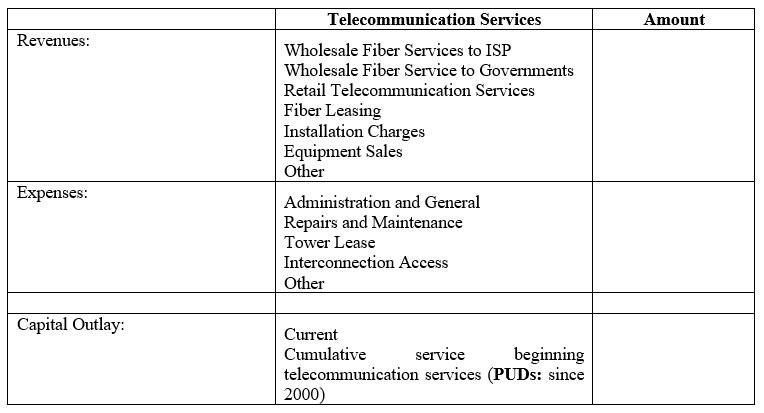
(3) Disclose any assumptions for allocating revenues, expenses, and capital investment costs (including depreciation) between telecommunication and other services.
4 Reporting
4.14 Supplementary and Other Information
4.14.13 Liabilities (Schedule 09)
4.14.13.10 The purpose of this schedule is to provide information about the liabilities of the local government. This schedule is required to be completed if the government had activity or an outstanding balance during the period for any reportable liability. This schedule is required to be included as supplementary information with any audited financial statements.
4.14.13.30 Local governments are required to update the incorrect financial data submitted on this schedule. The requirement applies to all errors found prior or during an audit.
4.14.13.40 The schedule should be prepared on the same basis of accounting, for the same period and reporting entity, and using the same underlying accounting records as the Schedule 01 and financial statements. The schedule should include current and noncurrent liabilities. Local governments should report short-term liabilities even if they are both incurred and fully redeemed during the reporting period.
4.14.13.50 The schedule should exclude the following:
Payments due to vendors or employees that are expected to be paid normally as part of the disbursement cycle. For example, any accounts payable, payroll accruals, retainage payable, or customer deposits.
Short-term leases or subscriptions where the maximum possible term is 12 months or less. For example, month-to-month contracts.
Contracts or commitments for expenditures that have not yet been realized.
Interfund payables and loans (for details regarding interfund loans see BARS 3.9.1, Interfund Loans).
Liabilities of fiduciary funds or of other entities for which the government is not itself obligated. For example, conduit debt, financial guarantees (to the extent the government does not estimate it will need to make payments), and assessment debt without commitments. Counties would not report liabilities of their special purpose districts.
4.14.13.71 Proper classification of grant and loan transactions require the analysis of the underlying documentation. The criteria for determining if a funding source is a grant (revenue) or loan (other financing source) is the existence of a note payable or loan contract. For annual report purposes, Schedule 09 should report all applicable liabilities. Federal grant loans will be reported on both the Schedule 09 and 16.
4.14.13.90 All applicable liabilities should be listed on Schedule 09, regardless of if it is for operating, capital or refunding purposes. Debt should be reported at face value (that is, only the principal amounts of debt should be reported and not any anticipated interest, issuance costs, premiums, or discounts).
Refunding transactions (including advance refunding through legal or in-substance defeasance) should be reported on the schedule as reduction of the refunded debt and addition of the new debt.
4.14.13.100 All the following types of liabilities should be included in the schedule using the most appropriate identifying code.
Note: There are three categories of liabilities: General Obligation, Revenue and Other, and Assessment. Ensure the correct category is being used.
General obligation debt/liabilities
A general obligation debt or liability is one that is secured by a pledge of the full faith and credit of the government and its taxing power. This means that the government would be obligated to repay the debt using all available means, including raising taxes to the extent allowable by law.
General obligation debt and liabilities are subject to constitutional and, for certain government types, statutory debt limits see BARS 3.10.5, Limitation of Indebtedness.
|
I.D. No. |
General obligation debt/liabilities |
|---|---|
|
251.11 |
Non-voted general obligation bonds, excluding those issued for certain purposes listed below |
|
251.12 |
Voted general obligation bonds, excluding those issued for certain purposes listed below |
|
251.21 |
Voted general obligation bonds for utility purposes issued by cities and towns |
|
251.22 |
Voted general obligation bonds for open space, parks, and capital facilities issued by cities and towns |
|
251.31 |
Non-voted general obligation bonds for metropolitan municipal corporations issued by counties |
|
251.32 |
Voted general obligation bonds for metropolitan municipal corporations issued by counties |
|
251.41 |
Non-voted general obligation bonds for construction issued by ports |
|
251.42 |
Non-voted general obligation bonds for airport improvements issued by ports |
|
251.43 |
Voted general obligation bonds for airport improvements issued by ports |
|
251.44 |
Voted general obligation bonds for foreign trade zones issued by ports |
|
263.51 |
Installment purchases (formally known as capital leases) - see BARS 3.4.1.80, installment-purchase agreements (e.g. rent to own), conditional sales and Certificates of Participation (COPS) other than LOCAL program financing |
|
263.56 |
Leases (see BARS 3.4.1), Subscription Based IT Arrangement (SBITA - see BARS 3.4.21) and Public-Private and Public-Public Partnership (PPP - see BARS 3.4.22) liabilities. |
|
263.61 |
Notes payable (such as promissory notes, Bond Anticipation Notes (BANs), Tax Anticipation Notes (TANs), or Grant Anticipation Notes (GANs). Do not report notes payable to federal state, or local government (use the appropriate codes defined below). |
|
263.81 |
Loans and all other obligations payable to the federal government or other out-of-state governments. The USDA bonds/loans should be reported to this code. |
|
263.83 |
Loans and all other obligations payable to Washington state agencies (except LOCAL and Public Works Board loans, see codes below). |
|
263.85 |
Loans and all other obligations payable to other Washington local governments |
|
263.87 |
Public Works Board loans from the Washington Department of Commerce. |
|
263.91 |
Miscellaneous debt - report any formal debt instruments that have a specific general obligation pledge that are not properly categorized to other Debt IDs. This would include debt instruments such as mortgages or loans from banks, non-government organizations, or individuals. |
|
263.94 |
Lines of credit with a general obligation pledge from non-governmental sources (federal, state or local government lines of credit should be reported in codes listed above). Report any lines of credit that had activity during the year, even if there was no outstanding balance at year end. Inactive lines of credit that had no balance or activity at any point during the year should not be reported. |
|
263.96 |
LOCAL program financing - see BARS 3.4.11 |
|
263.98 |
Miscellaneous liabilities – report any other liability with a specific general obligation pledge within the scope of the schedule but not properly categorized under any other Debt ID. |
|
239.70 |
Registered warrants issued pursuant to RCW 39.56 |
Revenue and other (non G.O.) debt/liabilities
Include in this category all obligations that do not have a specific general obligation pledge debt regardless of the fund type that is reporting this debt or liability. This category should include revenue debt, other secured debt (e.g., mortgages, etc.) and unsecured debt (e.g., compensated absences, etc.). Exclude the assessment debt. Revenue debt is secured by a pledge of revenue from a particular activity, such as a water utility. Unsecured debt and liabilities are those that do not specifically pledge an asset as collateral or revenue source for repayment. In cases where a debt or liability is secured by either a revenue or asset as well as a specific pledge of the government’s full faith and credit, the debt should be classified as general obligation using the codes listed above.
|
I.D. No. |
Revenue and other (non G.O.) debt/liabilities |
|---|---|
|
252.11 |
Non-voted revenue bonds |
|
252.12 |
Voted revenue bonds |
|
259.12 |
Compensated absences, see BARS 3.4.23 |
|
263.12 |
Claims and judgments determined by legal judgment (such as a court order) or mutual consent. All unpaid judgments should be reported regardless of whether the government intends or is in process of appealing or settling the judgment. |
|
263.13 |
Self-insurance and risk pool claims liabilities such as open claims, incurred but not reported (IBNR), unallocated loss adjustment expense (UALE). Governments with self-insurance programs should only report a liability on the Schedule 09 if there is an actuarially determined liability. |
|
263.22 |
Liabilities for landfills closure and post-closure – report balances and changes in the same amount as reported to the Department of Ecology on your financial assurance analysis annual update (as required by WAC 173-351-600, WAC 173-350 and WAC 173-304). |
|
263.40 |
Revenue warrants issued by cities pursuant to RCW 35.41.050, by ports pursuant to RCW 53.40.135, by municipal airports pursuant to RCW 14.08.118, or by water districts pursuant to RCW 57.20.027. |
|
263.52 |
Installment purchases (formally known as capital leases - see BARS 3.4.1.80), installment-purchase agreements (e.g. rent to own), conditional sales and Certificate of Participation (COPS) other than LOCAL program financing. |
|
263.57 |
Lease (see BARS 3.4.1), Subscription Based IT Arrangement (SBITA - see BARS 3.4.21) and Public-Private and Public-Public Partnership (PPP - see BARS 3.4.22) |
|
263.62 |
Notes payable (such as promissory notes, Bond Anticipation Notes (BANs), Grant Anticipation Notes (GANs), or Revenue Anticipation Notes (RANs)). |
|
263.72 |
Arbitrage rebate tax, see BARS 3.4.6 |
|
263.82 |
Loans and other obligations payable to the federal government or other out-of-state governments. This would include federal agency debt that is issued in the form of a bond, anticipation note or line of credit (in order to properly categorize the debt as a government loan for the purposes of calculating debt limits). |
|
263.84 |
Loans and all other obligations payable to Washington state agencies (except LOCAL and Public Works Board loans, see codes below) |
|
263.86 |
Loans and all other obligations payable to other Washington local governments |
|
263.88 |
Public Works Board loans from the Washington State Department of Commerce |
|
263.92 |
Miscellaneous debt - report any formal debt instruments that do not have a specific general obligation pledge that are not properly categorized to other Debt IDs. This would include debt instruments, such as mortgages or loans from banks, non-government organizations, or individuals. |
|
263.93 |
Environmental liabilities (e.g. pollution remediation, certain assets retirement, etc.) – report balances and changes in the portion to be paid by the government based on the cost estimate prepared or approved by the Department of Ecology or other federal agencies. |
|
263.95 |
Lines of credit without a general obligation pledge from non-governmental sources (federal, state or local government lines of credit should be reported in codes listed above). Report any lines of credit that had activity during the year, even if there was no outstanding balance at year end. Inactive lines of credit that had no balance or activity at any point during the year should not be reported. |
|
263.99 |
Miscellaneous liabilities – report any other liability within the scope of the schedule but not properly categorized under any other Debt ID. This would include liabilities for when the government is more likely than not to make payments on conduit debt or financial guarantees. |
|
264.30 |
Pension liabilities – report the net pension liability amount in accordance with BARS 3.4.13. |
|
264.40 |
OPEB Liabilities – report the actuarially determined liability for defined benefit other postemployment benefit plans in accordance with BARS 3.4.16. |
Assessment debt/liabilities (with commitments)
An assessment debt or liability is issued by the government but secured only by revenue from taxes on a certain area, such as a Local Improvement District. Only assessment debt with commitments should be reported on the Schedule 09. If the government is obligated in some manner to assume payments on special assessment debt in the event of default by the property owners, it is assumed the government has a commitment. In cases where the debt or liability is also secured by the government’s full faith and credit, the debt should be classified as general obligation using the codes listed above.
|
I.D. No. |
Assessment debt/liabilities (with commitments) |
|---|---|
|
253.11 |
Special assessment bonds with commitments |
|
253.13 |
Road Improvement District (RID) debt |
|
253.15 |
County Road Improvement District (CRID) debt issued by counties |
|
253.43 |
Local Improvement District (LID) warrants with commitments |
|
253.63 |
Local Improvement District (LID) notes payable with commitments |
|
253.98 |
Miscellaneous assessment debt with commitments |
4.14.13.110 Instructions for preparer
List each obligation separately and its related details as listed below. All amounts should be reported as positive numbers.
Identifying Number: Include appropriate number (see the listing above).
Description: Include the identifying name, number and/or description of the debt or liability. For bonds, notes, and other loans, list each debt issue separately providing date of original issuance.
Beginning Balance: In this column, report the principal amount that was owed at the beginning of this period. *The amount reported should equal the prior year ending balance.
*If there is a discrepancy due to errors in the prior year report, governments should report the correct beginning balance and attach an explanation in the annual filing system in the "Other Attachments" module.
Additions: In this column report the entire principal amount of any new debt issued (or borrowed) and any increase in liabilities during the current period. For example, if a G.O. bond was authorized in the previous year at $5,000,000, with $4,000,000 issued that year and an additional $500,000 issued in the reporting year, this column should show $500,000.
Reductions: In this column, report the amount of debt principal that was paid or reduction of liabilities during the reporting period. Do NOT include interest paid on the redeemed debt. The total amount of redeemed debt should equal payments reported on Schedule 01 (object code 70). Include here decreases due to triggering a forgiveness clause or otherwise having debt forgiven.
Note: Additions and reductions can be netted for the following liabilities: 259.12 Compensated absences, 264.30 Pensions, 264.40 OPEB, 263.50 Self-insurance and risk pool claims liabilities.
Ending Balance: In this column, report the outstanding amount of debt principal and other liabilities that were owed as of the end of the reporting period.
Note: Ending balance is calculated by adding Beginning Balance and Additions and subtracting Reductions.
4.14.13.120 The Schedule 09 template for the filing system is available on the SAO's website page at BARS Reporting Templates. Local governments have the option to import the Schedule 09 data via the template or manually enter the data in the filing system. The following is an example of the system formatted schedule after the data is imported or manually entered.

4 Reporting
4.14 Supplementary and Other Information
4.14.5 Expenditures of Federal Awards (SEFA/Schedule 16)
4.14.5.10 The purpose of this Schedule is to summarize federal award expenditures as a basis for planning and conducting the single audit. It also serves to provide assurance to those agencies that award federal financial assistance that their programs were included in the audit. This schedule is required to be completed if the government had any expenditures of federal awards during the period.
4.14.5.20 The Uniform Administrative Requirements, Cost Principles, and Audit Requirements for Federal Awards 2 CFR 200 (Uniform Guidance), requires auditees to prepare a Schedule of Expenditures of Federal Awards (SEFA) for the period covered by the auditee’s financial statements. NOTE: Revisions to the Uniform Administrative Requirements, Cost Principles, and Audit Requirements for Federal Awards (Uniform Guidance) at 2 CFR 200 were issued on April 22, 2024. Revisions to the administrative requirements (Subparts A-D) and cost principles (Subpart E) are effective for new federal awards executed by a federal agency on or after October 1, 2024. Revisions will not be applicable to federal awards issued prior to October 1, 2024 unless the federal agency early implemented. Look to the terms and conditions of the award or consult the federal awarding agency for questions about the applicability of the revisions. Revisions to the audit requirements (Subpart F), including the increased single audit threshold of $1 million, are applicable to audits of fiscal years beginning on or after October 1, 2024 (fiscal year end September 30, 2025 and later). No early implementation is allowed for the revisions to the audit requirements. Click here for the Uniform Guidance (for awards issued prior to 10/1/2024) and here for the revised Uniform Guidance (for awards issued on or after 10/1/2024).
If the government expends $750,000 or more (or 1,000,000 for fiscal years beginning on or after October 1, 2024) in federal awards in a year, an audit is required by Uniform Guidance, 2 CFR 200, Subpart F – Audit Requirements. Governments that require a single audit must prepare financial statements even if they are not otherwise required to under the BARS Manual, and the SEFA must be included as supplementary information. If the government received and spent federal funds under only one program (or cluster), and the federal program’s statutes, regulations, or the terms and conditions of the federal award do not require a financial statement audit, the government may elect a program-specific audit in which the SEFA is the only financial statement. Governments must contact their local audit team to arrange for the audit and must submit the completed audit reporting package to the Federal Audit Clearinghouse within 30 calendar days after receiving the audit report (report issuance date) or within nine months following the end of the audit period, whichever is earlier.
It is important to prepare this Schedule carefully to ensure that it is accurate and complete. Any program or award expenditures omitted from this Schedule will be considered unaudited under Uniform Guidance.
Determining Federal Awards Expended
4.14.5.30 Include on this Schedule all expenditures of federal awards that were received directly from a federal agency and indirectly (pass-through) from a state agency, local government or other nongovernmental entity.
4.14.5.40 Uniform Guidance: (2 CFR §200.510(b)) describes the requirements for preparing the Schedule. The SEFA must be prepared for the same period and reporting entity, and using the same underlying accounting records as the Schedule 01 and (as applicable) financial statements, except for specific exceptions described below starting at paragraph 4.14.5.70. The Schedule includes amounts required to be recorded, if any, during the statutorily required open period for cash basis cities and towns (20 days) and optional open period for cash basis counties (30 days to receive the invoice with the option to remain open for up to 60 days thereafter (per the county auditor’s discretion) to pay claims incurred prior to the close of the year).
Example: A calendar year government orders supplies and receives the supplies and invoice in December 2024. The government has an open period of 20 days after yearend. The government pays the invoice on February 5, 2025.
Report award-related expenditures in the year they take place, even if the government will not be reimbursed by the awarding agency until the following year. For most programs, do not report amounts on this Schedule based on the date(s) that funds are received from the awarding agency (e.g., the date the government submitted a reimbursement request or received a reimbursement payment). See information on fixed amount awards below.
4.14.5.50 Federal awards expended include the following (2 CFR §200.1 Definitions Expenditures and §200.502 Basis for determining Federal awards expended):
4.14.5.60 Fixed Amount Awards
Fixed amount awards are a type of grant or cooperative agreement pursuant to which the Federal agency or pass-through entity provides a specific amount of funding without regard to actual costs incurred under the Federal award. For example, a fixed amount is paid for a specified deliverable met or milestone achieved. This type of Federal award reduces some of the administrative burden and record keeping requirements for both the recipient or subrecipient and the Federal agency or pass-through entity. Accountability is based primarily on performance and results. With fixed amount awards, the amount reported on the SEFA is the amount that was earned (amount to be paid per the terms and conditions) in the period it was earned, for example the deliverable was met or the milestone achieved. Cash basis entities would report in the period the payment was received.
Guidance for Specific Types of Costs
Equipment and supplies (non-cash assistance)
4.14.5.70 The receipt of federally-funded equipment, materials or supplies whether received directly from a federal agency or received indirectly from a pass-through agency is considered a non-cash award that must be reported on the SEFA. The recipient must report the fair market value at the time of receipt or the assessed value provided by the awarding agency of the non-cash items on the SEFA. Regardless of the basis of accounting used by the recipient, non-cash awards are reported in the fiscal year they are received.
Other non-cash assistance
4.14.5.80 Food stamps, food commodities, vaccines, donated property (including surplus), and other non-cash assistance should be valued at fair market value at the time of receipt or the assessed value provided by the awarding agency. The notes to the Schedule of expenditures of federal awards should disclose the nature of the amounts reported. Regardless of the basis of accounting used by the recipient, non-cash awards are reported in the fiscal year they are received.
Matching/cost sharing
4.14.5.90 The amount of state and/or local funding contributed by the entity in the form of matching funds or in- kind match required by the awarding agency should not be reported on the SEFA. If program regulations allow a federal award to be used as match, those expenditures would be reported on the SEFA.
Program income
4.14.5.100 Many awardees earn program income while administering federal programs or projects. For most programs, the receipt or use of program income is reported on the SEFA in the period the expenditure occurs in accordance with the basis of accounting. However, federal agencies differ on the treatment of program income on the SEFA. Therefore, it is recommended that the government consults with the awarding agency about how it requires the program income to be reported if not clear in the terms and conditions of the award or awarding agency guidance.
A note disclosure regarding the inclusion of expenditures from program income is recommended.
Note: If the awardee has received written (documented) approval to use program income as match/cost sharing, it is not reported on the SEFA.
Note: See BARS 4.14.5.140 below for accounting for program income related to revolving loans.
Unless otherwise specified in the awarding documents, interest earned on cash advances or idle award funds are not considered program income. Interest earnings are recorded in the BARS account 361.
Retainage
4.14.5.110 Retainage is an amount withheld from contractor payments until the end of the project when work has been completed to satisfaction. Per 2 CFR §200.305(b)(8), retainage is not an allowable cost that can be charged to the federal award and should not be reported on the SEFA as a federal expenditure until one of the following has been met:
a) The retainage is paid to the contractor. Regardless of the basis of accounting used by the awardee, the retainage payment is reported in the fiscal year it is paid.
b) The retainage is paid into an escrow/trust account. Regardless of the basis of accounting used by the awardee, the retainage payment is reported in the fiscal year(s) it is paid into the escrow/trust account.
Note: If retainage was not paid to the contractor or paid to an escrow/trust account, but was incorrectly reimbursed by the awarding agency, a cash advance has occurred. Contact the awarding agency for instructions on what to do with the funds (such as return to them or move to an escrow/trust account).
Disbursements to subrecipients
4.14.5.120 Per 2 CFR §200.502, “the determination of when a Federal award is expended must be based on when the activity related to the Federal award occurs. Generally, the activity related to the Federal award pertains to events that require the non-Federal entity to comply with Federal statutes, regulations, and the terms and conditions of Federal awards, such as…the disbursement of funds to subrecipients…” Federal funds are determined to be expended when the pass-through agency becomes obligated to the subrecipient for payment. Generally, that is when the pass-through agency has made the determination the costs are allowable, they are charged to the federal award, and the payment is made to (or authorized to be made to) the subrecipient. It would not be when the subrecipient incurred the costs that are to be reimbursed.
Valuation of Federal Loans
4.14.5.130 Use the following guidelines to calculate the value of federal awards expended under loan programs:
Question 1: When do I report the loan on my SEFA?
Answer: Uniform Guidance: 2 CFR §200.502(a), and guidance from the AICPA states the loan is considered expended when the loan proceeds are used under loan and loan guarantee programs. Note exception to the rule for certain programs below.
Question 2: What is a continuing compliance requirement?
Answer: The government is considered to have a continuing compliance requirement if the lender continues to impose a requirement over the outstanding loan balance in any one of the following 12 areas in years following receipt of the loan.
Examples of continuing compliance requirements:
Question 3: If my project takes several years to complete, will I have continuing requirements throughout the duration of the project until it is complete?
Answer: Most likely. For example, many lenders will set aside a portion of the funding until all inspections are made and all supporting documentation encompassing the entire project is submitted and approved. CAUTION: If the lender is waiting to reimburse a portion of costs submitted for reimbursement until the project is approved, be sure to report the expenditures in the year occurred, not when reimbursed. Consult with the lender about its expectations over reporting loans for projects that span multiple years.
Question 4: How do I determine the amount of any interest subsidy I am receiving?
Answer: The OMB has not issued any official guidance on this topic. Typically, an interest subsidy means the federal government is paying or waiving a portion of the interest cost that would ordinarily have to be paid by the borrower. Consult with the lender to determine if any portion of interest is being subsidized.
Question 5: What if my project is complete and there are no requirements other than to repay the loan?
Answer: If the laws, regulations, and the provisions of contracts or loan agreements pertaining to the loan impose no continuing compliance requirements other than to repay the loan, the loan does not have to be reported on the SEFA.
Question 6: What if our entity makes a loan to another entity or program participant?
Answer: Report the amount of loans made during the year. If the entity administers a revolving loan program where federal funds are lent to third parties, repaid, and then lent to again to other parties, the repayment of principal and interest is considered program income (revenues) and loans of such funds to eligible recipients are considered expenditures. For purposes of SEFA presentation, report the amount of loans the government made during the year. This includes all loans that are funded by the original loan and program income. However, be sure to check the terms of the award and discuss with the awarding agency because some federal agencies have different rules for presenting revolving loans on the SEFA. For example, the Department of Commerce for its Economic Adjustment Assistance Revolving Loan Fund program (ALN 11.307) requires awardees to report the principle balance of loans outstanding at year-end, instead of the amounts lent. See the Compliance Supplement Part 4 for this program, IV. Other Information for the specific calculation.
Reporting revolving loans
4.14.5.140 Although the repayment of principal is not considered revenue from the GAAP accounting perspective, it has to be considered as such for the purpose of SEFA. The expenditures from the revolving loan should include expenditures from the initial loan and subsequent repayments of the loans, including interest generated by the loan.
Guidance on SEFA Reporting for Specific Programs
Note: For program specific requirements please see the Program Specific Packet.
Employer Identification Number (EIN) for federal award recipients
4.14.5.150 Recipients of federal funds must arrange to have a single audit in accordance with Uniform Guidance, 2 CFR 200, Subpart F – Audit Requirements if they expend $750,000 or more in federal awards in a year (or $1,000,000 for audits of fiscal years beginning on or after 10/1/2024). Most federal agencies define a recipient according to the Employer Identification Number (EIN). That is, the awarding agency makes its awards to each recipient based on the EIN, rather than entity name. For example, if a small fire district uses the county’s EIN for payroll tax purposes, and also applies for a federal award using the county EIN, some federal agencies will make the official award to the county. As a result, the awarding agency expects the award to be included in the county’s Schedule of Expenditures of Federal Awards (Schedule 16) and thus subject to audit at the county. Further, at the conclusion of a single audit, the fire district’s audit will be misfiled with the Federal Audit Clearinghouse because the county’s EIN was listed on the Data Collection Form. This puts the county in a difficult position with the federal government and can cause additional audits. Therefore, it is recommended that all special purpose districts without an EIN make application for this number with the IRS (Form SS-4) and use this number when applying for federal financial assistance as well as IRS tax purposes. The district also should consult with its county auditor and/or treasurer for the protocol concerning payroll taxes.
Preparing the SEFA template for upload into the filing system
4.14.5.160 SEFA information may be manually input into the filing system or uploaded using the template from SAO’s website on the BARS Reporting Templates page. Instructions for the template are as follows:
Column A (ALN): Enter the Assistance Listing Number (ALN). If unknown or does not exist, follow detailed instructions below under number 3 included in BARS 4.14.5.190 below.
Column B (COVID-19 Expenditures): Enter “Yes” if these are COVID-19 expenditures. As noted, COVID-19 expenditures must be reported separately by ALN. If these are not COVID-19 expenditures, please leave this column blank.
Column C (Federal Agency Name): The filing system will pre-populate the official federal agency name from SAM.gov Assistance Listings based on the ALN entered. However, if the ALN is unknown or doesn’t exist, manually add the federal agency name.
Column D (Federal Program Name): The filing system will pre-populate the official federal program name from SAM.gov Assistance Listings based on the ALN entered. However, if the ALN is unknown or doesn’t exist, manually add the federal program name.
Column E (Pass-through Agency Name): Enter the name of the pass-through agency for indirect awards. If there is no pass-through agency, leave this field blank.
Column F (Other Award I.D. Number): For indirect awards, add the other award identification number assigned by the pass-through agency (contract/agreement number). If no identification number was provided by the pass-through agency, enter “NA”. For direct awards, the other award identification number is optional and may be left blank. Refer to the detailed instructions below under number 4 included in BARS 4.14.5.190 for the requirements to include the other award identification number when the ALN is unknown.
Column G (R&D): Enter "Yes" if this award is research and development (R&D). Otherwise leave this column blank.
Column H (Total): Enter the total federal awards expended. Refer to detailed instructions below for calculating the total.
Column I (Passed Through to Subrecipients): Of the total amount of federal awards expended, report how much of that was passed on to subrecipients.
Column J (Footnote Reference): If applicable, enter the reference number that corresponds with the "Notes to the Schedule of Expenditures of Federal Awards."
Finalized Schedule of Expenditures of Federal Awards
4.14.5.170 Annual reports should be submitted via the filing system on the State Auditor’s website at: www.sao.wa.gov. Local governments have the option to import the SEFA data via the template or manually enter the data in the filing system. The example SEFA below is the formatted version that is generated by the filing system after the data is imported or manually entered.
4.14.5.180 Local governments are required to update the incorrect financial data submitted on this Schedule. The requirement applies to all errors found prior or during an audit. For questions and/or support e-mail the SAO Client HelpDesk through our Online Services.
Uniform Guidance Requirements for Reporting
4.14.5.190 The following are detailed SEFA requirements found at 2 CFR §200.510(b). An example of a completed Schedule follows the instructions. Instructions for using the annual template are found above at BARS 4.14.5.160.
1. List the name of the federal agency. If the government receives federal funds as a subrecipient, identify the pass-through agency.
2. List individual federal programs by federal agency. Provide the official name of the federal award from the Assistance Listings at SAM.gov (avoid nicknames, abbreviations, or acronyms).
As noted in the Program Specific Packet, COVID-19 expenditures must be reported on a separate line by ALN with “COVID-19” as a prefix to the program name, including new COVID-19 only programs, such as the Coronavirus State and Local Fiscal Recovery Fund 21.027.
IMPORTANT NOTE: For federal programs included in a cluster of programs, provide the official cluster name (e.g., CDBG – Entitlement Grants Cluster) regardless of whether the expenditures were incurred under only one program or multiple programs within the cluster, list the individual federal programs within the cluster (e.g., 14.218 Community Development Block Grants/Entitlement Grants and 14.225 Community Development Block Grants/Special Purpose Grants/Insular Areas) and provide a total for the cluster (see the example SEFA below). For research and development, total federal awards expended must be shown by either the individual award or by federal agency and major subdivision within the federal agency. A listing of programs included in a cluster can be found in Part 5 of the Compliance Supplement. Note the Compliance Supplement is updated annually, including the list of clusters found in Part 5, so it is important to consult the applicable Compliance Supplement (e.g., for audits of fiscal years beginning after June 30, 2024, consult the 2025 Compliance Supplement).
3. List the applicable ALN for each award. This is a five-digit (XX.XXX) identification number assigned by the federal government and published in Assistance Listings at SAM.gov. This number must be provided, for all federal awards received either directly from a federal agency or indirectly through a state agency or local government.
Awarding agencies are required to provide the ALN when making an award; however, if one was not provided, the government should make every effort to research the program before the government concludes an ALN does not exist. Steps to take:
If an ALN does not exist or is unknown, governments must use the following formula for the ALN:
Enter the Federal Agency’s two-digit prefix (see list of agencies in BARS 4.14.5.210 below) followed by the letter “U”, for unknown, followed by a two-digit sequential number starting with “01”.
For example, if the government has two awards from the Department of Defense where the ALN does not exist or is unknown the government should report these awards using “12.U01” and “12.U02” as the ALN.
NOTE: When the ALN is unknown, the Other Award Number is required by Uniform Guidance (2 CFR 200.510(b)(3)), even if it is a direct award.
WARNING ERROR CAUTION: When entering an unknown ALN, you will get a “warning error”. That is because the filing system pulls from Assistance Listings at SAM.gov. If the ALN is unknown, it is not going to be in Assistance Listings. Also, if you enter an ALN that has been archived by the Federal Awarding Agency, in other words the program is no longer giving awards but you still have some federal expenditures to report, you will also get a warning error. In both of these cases, it is ok to ignore the warning error; you do not need to contact our Office.
4. For indirect awards or direct and indirect awards with an unknown ALN, list the identifying number assigned by the awarding agency, such as the contract or agreement number. If an identification number is not available for an indirect award, or one was not provided by the pass-through entity in the awarding documents, enter "N/A". For direct and indirect awards with an unknown ALN, an identifying number is required. For direct awards with a known ALN, the identification number is optional and may be left blank. If there isn’t an other award identification number, consult the federal or pass-through agency for guidance on what number to use.
5. Report current year expenditures (generally, determined on the same basis of accounting as the financial statements, disclose any departures in the notes). See requirements for valuing loans and noncash assistance above.
Expenditures from Pass-Through Awards – Enter the amount of expenditures for federal assistance received as a pass-through award from a state agency, local government, etc. When calculating the amount expended for each program, be sure to include both direct costs and indirect costs. If the government made a subaward to another entity, these amounts should also be reported as expenditures.
Expenditures from Direct Awards – Enter the amount of expenditures for assistance received directly from a federal agency. When calculating the amount expended for each program, be sure to include both direct costs and indirect costs. If the government made a subaward to another entity, these amounts should also be reported as expenditures.
Note: If the entity receives an award under the same ALN from multiple awarding agencies, the SEFA should have a subtotal for that ALN showing the total amount received from all sources.
Total Expenditures – Enter the combined total of all federal expenditures from pass- through and direct awards by ALN.
6. List the total amount of expenditures provided to subrecipients for each federal award (2 CFR§200.510(b)(4)).
7. If applicable, enter the reference number that corresponds with the “Notes to the Schedule of Expenditures of Federal Awards.”
Instructions for preparing the Notes to the Schedule of Expenditures of Federal Awards
4.14.5.200 The order of Notes 1-3 corresponds to the Federal Audit Clearinghouse Data Collection Form (SF-SAC). Please follow the same, order as applicable. Order your remaining Notes sequentially.
REQUIRED NOTE 1 (per 2 CFR §200.510(b)(6)) – the notes to the Schedule must disclose the basis of accounting and any other significant accounting policies used in preparing the Schedule. This includes reconciling any difference between the amounts shown on the Schedule and the underlying amounts reflected in the entity’s accounting system.
REQUIRED NOTE 2 (per 2 CFR §200.510(b)(6)) – the notes must disclose whether the auditee elected to use the 10% de minimis cost rate as covered in 2 CFR §200.414 Indirect (F&A) costs. If the de minimis rate was not elected, it is optional to include the indirect cost rates used (see example below). Note, the de minimis cost rate increased to 15% with the 2024 revisions to the Uniform Guidance. It is effective for new federal awards issued by a federal agency on or after 10/1/2024.
REQUIRED NOTE 3, IF APPLICABLE (per 2 CFR 200.510(b)(5)) – for loans or loan guarantee programs the notes must identify the balances outstanding at the end of the audit period. This is in addition to including the total federal awards expended for loan or loan guarantee programs reported in the Schedule.
OPTIONAL (BUT RECOMMENDED) – provide any information that may be useful to the reader such as the method used to value commodities or other non-cash assistance such as property or vaccines, and any other information necessary to reconcile the amount reported to the entity’s accounting records.
An example of these footnotes is provided below.
Frequently used federal agency two-digit prefixes
4.14.5.210 This list is used for ALNs; if the government does not see the federal agency here, Assistance Listings at SAM.gov.
07 – Office of National Drug Control Policy
10 – Department of Agriculture
11 – Department of Commerce
12 – Department of Defense
14 – Department of Housing and Urban Development
15 – Department of Interior
16 – Department of Justice
17 – Department of Labor
20 – Department of Transportation
21 – Department of Treasury
39 – General Services Administration
43 – National Aeronautics and Space Administration
47 – National Science Foundation
59 – Small Business Administration
64 – Department of Veterans Affairs
66 – Environmental Protection Agency
81 – Department of Energy (includes the Bonneville Power Administration)
84 – Department of Education
93 – Department of Health and Human Services
94 – Corporation for National Service
96 – Social Security Administration
97 – Department of Homeland Security (includes FEMA)
Characteristics of subrecipients and contractors
4.14.5.220 A subrecipient is a non-federal entity (typically a local government or non-profit organization) that receives federal assistance from a pass-through agency (such as the state or another local government) to carry out a program or project of the federal government. Subrecipients receive the federal award or loan so that it can meet a public need in the community. The amount paid to the subrecipient to reimburse it for the cost of the project or program should be based on actual, allowable costs incurred - that is, a subrecipient cannot earn a profit from its award. Subrecipients have substantial decision-making responsibility for how the project or program operates. Subrecipients are required to follow all applicable requirements in Uniform Administrative Requirements, Cost Principles, and Audit Requirements of Federal Awards, 2 CFR 200. Often subrecipients are required to contribute some of their own funds as a matching share to accomplish the program or project.
4.14.5.230 Contractors (formerly “vendors”) compete with others to provide goods and services needed to operate a project or program. These goods and services are often ancillary to the overall program objectives. Selection of contractors is typically based on the capability to provide the best goods and services at the best price. The scope of work is specified by the awardee and the price is usually based on quotes, formal bids, or requests for proposals. Contractors are often paid a set fee for providing its goods or services where the price allows the contractor to recover its costs and also earn a profit. The Association of Government Accountants (www.agacgfm.org) published a subrecipient versus contractor checklist.
Beneficiaries are not currently defined in the Uniform Guidance, however, a beneficiary is traditionally an individual who is the end user of the assistance (the individual needing the benefit). Examples include recipients of scholarships, Medicaid claims/medical benefits, or housing/food assistance. With certain Treasury COVID-19 programs, businesses, non-profits, and governmental entities may also be beneficiaries of assistance. Treasury’s Coronavirus State Local Fiscal Recovery Funds (SLFRF, ALN 21.027) Compliance and Reporting Guidance indicates that “subrecipients do not include individuals and organizations that received SLFRF funds as end users to respond to the negative economic impacts of COVID-19 on these organizations”. The organizations would be beneficiaries in this case. The Single Audit Act and 2 CRF Part 200, Subpart F regarding audit requirements do not apply to beneficiaries (no SEFA reporting).
4.14.5.240 Tips for preparing the Schedule
4.14.5.250 Sample Schedule of Expenditures of Federal Awards
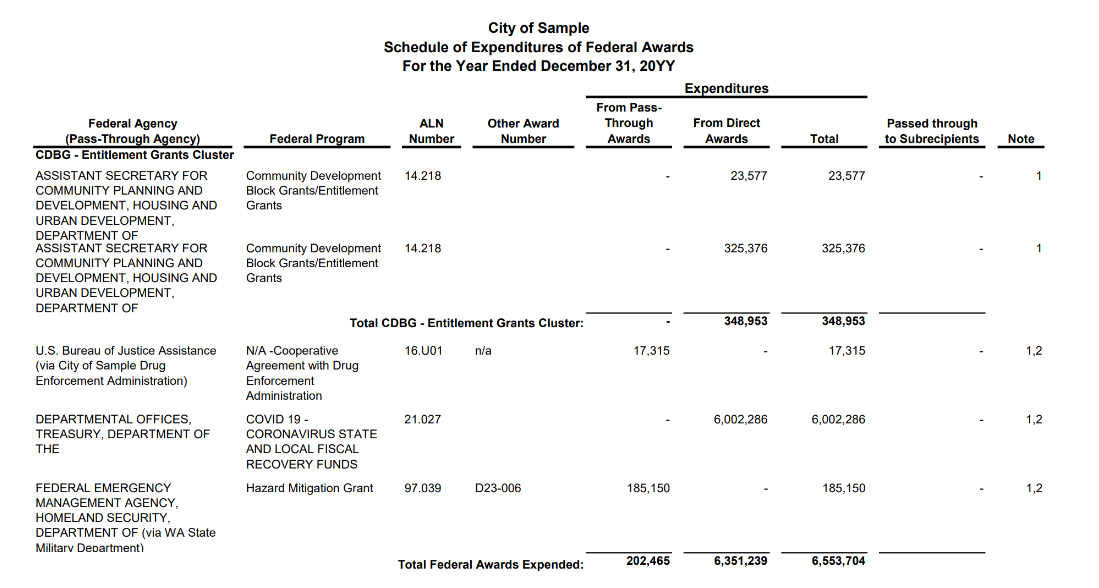
4.14.5.260 Template Notes to the Schedule of Expenditures of Federal Awards
________________________
(City/County/District)
Notes to the Schedule of Expenditures of Federal Awards
for the Year Ended December 31, 20XX
The order of the required notes corresponds to the Federal Audit Clearinghouse Data Collection Form (SF-SAC). Please follow the same order for the required Notes. After Notes 1-2, disclose other notes as applicable to the government circumstances in sequential order.
Note 1 – Basis of Accounting (Required)
BARS GAAP
This Schedule is prepared on the same modified accrual basis of accounting (describe if not the same basis) as the (city/county/district’s) financial statements and in accordance with the requirements contained in Uniform Guidance. (describe any exceptions to the basis of accounting, if applicable).
BARS Cash
This Schedule is prepared on the same cash basis of accounting (describe if not the same basis) as the (city/county/district’s) financial statements and in accordance with requirements contained in Uniform Guidance. (describe any exceptions to the basis of accounting, if applicable)
Note 2 – Federal Indirect Cost Rate (Required to state whether the de minis indirect cost rate was elected)
The (city/county/district) has elected to use the (10-percent/15-percent) de minimis indirect cost rate allowed under the Uniform Guidance .
Note 3 – Federal Loans (Required if applicable)
(a) The (city/county/district) was approved by the USDA Rural Utilities Service to receive a loan totaling $____ to build a sewer treatment plant. Interim loan financing was received for the construction period. The amount listed for this loan includes the beginning of the period loan balance plus proceeds used during the year. The balance owing at the end of the period is $______.
(b) The (city/county/district) was approved by the EPA and the PWB to receive a loan totaling $____ to improve its drinking water system. The amount listed for this loan includes the beginning of the period loan balance plus proceeds used during the year. The balance owing at the end of the period is $_____.
Both the current and prior year loans are reported on the (city/county/district’s) (Schedule of Liabilities [Cash governments] or Schedule of Changes in Long-Term Liabilities [GAAP governments – note disclosure].
Note # – Revolving Loan – Program Income (Recommended if applicable)
The (city/county/district) has a revolving loan program for low-income housing renovation. Under this federal program, repayments to the (city/county/district) are considered program revenues (income) and loans of such funds to eligible recipients are considered expenditures. The amount of loan funds disbursed to program participants for the year was $_____ and is presented in this Schedule. The amount of principal and interest received in loan repayments for the year was $____.
Note # – Noncash Awards (Recommended if applicable)
The amount of (vaccine/dental items/commodities/surplus property/etc.) reported on the Schedule is the value of (vaccine/dental items/commodities/surplus property/etc.) received by the (city/county/district) during current year and priced as prescribed by ________________.
Note # – Noncash Awards – Equipment (Recommended if applicable)
The (city/county/district) received equipment and supplies that were purchased with federal Homeland Security funds by the state of Washington. The amount reported on the Schedule is the value of the property on the date it was received by the (city/county/district) and priced by the state of Washington.
Note # – Program Costs (Recommended if applicable)
The amounts shown as current year expenditures represent only the federal award portion of the program costs. Entire program costs, including the (city/county/district’s) portion, are more than shown. Such expenditures are recognized following the cost principles contained in Title 2 U.S. Code of Federal Regulations Part 200, Uniform Administrative Requirements, Cost Principles, and Audit Requirements for Federal Awards, wherein certain types of expenditures are not allowable or are limited as to reimbursement.
4 Reporting
4.8 SAO Annual Report Schedules
4.8.1 Revenues/Expenditures/Expenses (Schedule 01)
4.8.1.10 The purpose of this schedule is to report the local government’s financial activity for the reporting year including beginning balances, revenues, expenditures and ending balances for all reportable funds and activities. These are reported using BARS accounts to identify the specific type of activity.
4.8.1.20 Local governments are required to update the incorrect financial data submitted on this schedule. The requirement applies to all errors found prior to or during an audit.
4.8.1.25 Local governments completing the Schedule 01 must ensure the data submitted is accurate. Each reported fund is required to balance within $1,000. If one or more reported fund(s) do not balance within $1,000, it will result in a required error. The annual report cannot be submitted until all required errors are resolved.
This schedule is submitted as part of the annual report via the filing system on the State Auditor’s website at: https://portal.sao.wa.gov/LGCS/. The filing system will only accept an Excel file formatted in the prescribed record layout (see BARS 4.8.1.50 below). The Amount column must be formatted as a number (the system will round to the nearest whole number); all other columns must be formatted as text.
4.8.1.30 The Schedule 01 templates can be found on the BARS Reporting Templates page. Templates are updated each year with changes to BARS account so it’s important for local governments to use the newest version of the template from the SAO’s website. There is no Schedule 01 template for cities/towns and counties because they have access to the majority of BARS accounts. A complete listing of BARS accounts by government type/accounting basis can be run from the BARS Account Export page.
For additional information on reporting requirements, please see:
4.8.1.50 The Schedule 01 should be formatted as follows for upload (also see example below):
Note: Blank rows may cause upload errors (the system interprets this as the end of the reported data). If using a template, unused rows should be deleted entirely; alternately, the Amount field may be entered as zero ($0). Hiding rows and/or clearing cells will result in upload errors.
Row 1: Column headers; this row may be populated but will not be included in the data import (i.e., financial data in the first row of the Excel will be deleted upon import).
Column 1: MCAG number; this column may be left blank, but must be included for data import.
Column 2: Fund number; provide the three-digit fund number as prescribed in the BARS 3.1.7, Fund Accounting and Fund Types. Make sure that the fund number correlates with the correct fund type. If using a template, the fund number is pre-filled out.
Column 3: Fund name; this should be the title of the fund, suitable for presentation on the financial statements. Normally, this would be the official title of the fund that matches the accounting system. However, in some circumstances the name may need to be changed to ensure it is sufficiently understandable for financial statement users. For example, acronyms or abbreviations should generally not be used since they would not be understandable for external financial statement users. For this reason, fund names with less than 4 characters are flagged as a warning error in the online filing system. Also, to fit properly on the financial statement, the fund name is limited to a maximum of 40 characters.
Only one fund name is allowed for each reported fund number. Multiple fund names for a given fund number will result in a required error, and the annual report cannot be submitted until the error is resolved (e.g., if a line reports the fund number “001” with a fund name “General” and another line reports the fund number “001” with a fund name “Current Expense”, a required error will occur. This validation check is identified based on the text, so clerical errors like transposed letters will generate a required error).
Column 4: BARS account; coding must be valid based on the government type and basis of accounting.
Column 5: BARS account title; the Account Title can be found in the chart of accounts export, see the BARS Account Export page. If using a template, this is pre-filled out.
Column 6: Amounts; please note:
4.8.1.60 The Schedule should exclude the following:
4.8.1.70 Cities/towns and counties are required to include all fiduciary funds on the Schedule 01. Counties should include data for all special purpose districts which would be reported in a custodial fund. The Statement C-5 will present the data by the fund type only and only include the beginning balances, increases, decreases and ending balances. Counties should not use functional BARS accounts for the special purpose districts. For more information on reporting fiduciary activity, see BARS 3.1.11, Determining Fiduciary Activities to be Reported in Custodial Funds. Detailed guidance on fund coding can be found in BARS 3.1.7, Fund Accounting and Fund Types.
For assistance, submit questions to the SAO HelpDesk through our Online Services.
If you need assistance resolving required or warning errors please see available filing system resources on the BARS & Annual Filing FAQ page specifically the Error Guide.
|
MCAG |
Fund Number |
Fund Name |
BARS Account |
Account Title |
Amount |
|
1234 |
001 |
General |
3083100 |
Restricted Beginning |
301,200 |
|
1234 |
001 |
General |
3084100 |
Committed Beginning |
125,000 |
|
1234 |
001 |
General |
3085100 |
Assigned Beginning |
78,250 |
|
1234 |
001 |
General |
3089100 |
Unassigned Beginning |
575,456 |
|
1234 |
001 |
General |
3111000 |
Property Tax |
250,056 |
|
1234 |
001 |
General |
3131000 |
Local Retail Sales and Use Tax |
54,123 |
|
1234 |
001 |
General |
3174000 |
Timber Excise Tax |
157 |
|
1234 |
001 |
General |
3698000 |
Cash Adjustments |
-15 |
|
1234 |
001 |
General |
5083100 |
Restricted Ending |
259,000 |
|
1234 |
001 |
General |
5084100 |
Committed Ending |
25,000 |
|
1234 |
001 |
General |
5085100 |
Assigned Ending |
35,212 |
|
1234 |
001 |
General |
5089100 |
Unassigned Ending |
120,000 |
|
1234 |
001 |
General |
5111010 |
Legislative - Salary |
56,000 |
|
1234 |
001 |
General |
5111020 |
Legislative - Benefits |
25,000 |
|
1234 |
001 |
General |
5111030 |
Legislative - Supplies |
62,000 |
|
1234 |
001 |
General |
5111040 |
Legislative - Services |
55,000 |
|
1234 |
101 |
Special Revenue |
3083100 |
Restricted Beginning |
12,501 |
|
1234 |
101 |
Special Revenue |
3111000 |
Property Tax |
15,555 |
|
1234 |
101 |
Special Revenue |
3611000 |
Investment Interest |
27 |
|
1234 |
401 |
Water |
3434000 |
Water Sales |
23,978 |
|
1234 |
401 |
Water |
3611000 |
Investment Interest |
576 |
|
1234 |
401 |
Water |
5340010 |
Water Operations - Salary |
250,000 |
|
1234 |
401 |
Water |
5340020 |
Water Operations - Benefits |
35,000 |
|
1234 |
401 |
Water |
5340030 |
Water Operations - Supplies |
45,000 |
|
1234 |
401 |
Water |
5340040 |
Water Operations - Services |
24,000 |
4 Reporting
4.8 SAO Annual Report Schedules
4.8.17 Summary of Bank Reconciliations (Schedule 06)
4.8.17.10 This schedule applies to all counties and cities. It does not apply to special purpose districts.
4.8.17.20 The purpose of this schedule is to summarize the government’s bank reconciliations. This demonstrates the accuracy and completeness of the Schedule 01 and the city or county’s controls over accounting records. It is also used to collect information on bank accounts, cash flows and certain reconciling items.
4.8.17.30 The Schedule Summary of Bank Reconciliations should match the city/county’s bank accounts, bank reconciliations, accounting records, and Statements C-4/C-5 or Schedule 01 (which represents the corresponding summary of accounting records).
A downloadable template of the schedule can be found here: Schedule 06 Template
Use the following instructions to complete the schedule:
Bank statement section
(1) Bank & Investment account name – List all accounts held by the city/county at any point during the year. The list should be inclusive of all bank and investment accounts, including zero-balance accounts. Accounts should be listed separately by row, however Certificate of Deposits or other groups of accounts may be consolidated into a single line on the schedule if it makes the schedule easier to complete. Account descriptions should be sufficient to positively identify the account (or group of accounts) to enable tracing of amounts on the schedule to underlying bank statements and reconciliations, but should not include the full account number.
(2) Beginning bank balance – Enter the balance of each account at the beginning of the city/county's fiscal year. This figure should come for the bank statement issued by that institution. This amount should be the same as the ending balance used in the prior year’s reconciliation.
(3) Receipts – Enter the total receipts deposited in the bank account throughout the year. Do not include transfers into the bank account from other city/county bank accounts, this will be reported in column 4.
(4) Inter-bank transfers in – Enter all transfers in from the city/county’s own bank accounts, such as investment maturities or movements between bank accounts. Do not include bank transfers from outside non-entity bank accounts, which would be a receipt reported in column 3. Columns 3 and 4 should equal the total deposits reported on the bank statements.
(5) Disbursements – Enter all the disbursements made from the bank account throughout the year, such as checks, electronic payments and fees. Do not include transfers out of the bank account to other city/county bank accounts, this will be reported in column 6.
(6) Inter-bank transfers out – Include all transfers out to the city/county’s own bank accounts, such as investment purchases or movement between bank accounts. Do not include EFT, ACH or bank transfers to outside non-entity bank accounts, which would be a disbursement reported in column 4. Columns 5 and 6 should equal the total withdrawals reported on the bank statements. Column 4 and Column 6 should also equal.
(7) Ending Bank Balance – Enter the balance of each account at the end of the city/county’s fiscal year. This should be taken from the bank statements issued from that financial institution.
Reconciling items
(8) Beginning Deposits in Transit – Include total amount of deposits in transit at the beginning of the city/county’s fiscal year. These adjustments should be a positive addition to beginning bank balance and a negative reduction to bank receipts in the same amount to reconcile to accounting records. This amount should be the same as the ending deposits outstanding used in the prior year’s reconciliation. Please enter the amount as a positive number in column B and as a negative number in column C.
(9) Year-end Deposits in Transit – Include total amount of deposits in transit at the end of the city/county’s fiscal year. These adjustments should be the same positive addition to both bank receipts and ending bank balance to reconcile to accounting records.
(10) Beginning Outstanding & Open Period Items – Include the total amount of outstanding and open period items at the beginning of the city/county’s fiscal year. These adjustments should be the same negative reduction to both beginning bank balance and bank disbursements to reconcile to accounting records. This amount should be the same as the ending outstanding and open period items used in the prior year’s reconciliation. Please enter the amount as a negative number.
(11) Year-end Outstanding & Open Period Items – Include the total amount of outstanding and open period items at the end of the city/county’s fiscal year. These adjustments should be a positive addition to bank disbursements and a negative reduction to ending bank balance in the same amount to reconcile to accounting records. Please enter the amount as a positive number in column E and as a negative number in column G.
(12) NSF Checks – Enter the total amount of NSF checks for the year. This would include any deposits that were subsequently withdrawn by the bank due to insufficient funds by the payor, whether a check or an electronic payment. These adjustments should be the same negative reduction to both bank receipts and disbursements to reconcile to accounting records. NSF check fees would not be included in this reconciling item, since these withdrawals would already be recorded as an expenditure in accounting records. Please enter the amount as a negative number.
(13) Cancellation of unredeemed checks/warrants – Include the total amount of cancelled unredeemed checks/warrants throughout the year. These adjustments should be a positive addition to bank receipts to reconcile to accounting records.
(14) Interfund Transactions – Enter the total amount of interfund transactions that are recorded in accounting records but did not correspond to bank deposits and withdrawals. This might include interfund transfers, interfund loans, internal service fund charges, and interfund taxes. These adjustments should be the same positive addition to both bank receipts and disbursements to reconcile to accounting records.
(15) Netted Transactions – Enter the total amount of netted transactions in both columns. This amount should be the total of those deposits and withdrawals in the bank statements that are reported as a net amount in accounting records. For example, this might include refunds and certain reimbursements such as for COBRA payments. These adjustments should be the same negative reduction to both bank receipts and disbursements to reconcile to accounting records. Please enter the amount as a negative number.
(16) Authorized balance of revolving, petty cash and change funds – Enter the total authorized balances of all revolving, petty cash, and change funds. The authorized balances should tie to accounting records as described in BARS 3.8.7, Redeemed Warrants/Cancelled Checks. These adjustments should be positive additions to both beginning and ending bank balances to reconcile to accounting records. Beginning and ending adjustments may be different if there was a net change in the authorized balances of revolving accounts during the year.
(17) Other Reconciling Items, net – Enter the net amounts of all other reconciling items included in the government’s year end bank reconciliation that are not already included on other lines. This might include prior period adjustments, correction of bank errors, offsetting agreements, fiscal agent balances, changes in authorized balances of revolving funds, and other items. List net amounts in each column as needed, based on the effect of other reconciling items. Please enter the amount as a negative or positive number.
General ledger section
(18) Statements C-4/C-5 or Trial Balance totals – Enter totals from the city/county’s C-4/C-5 report or Schedule 01 from the annual filing system or from the city/county's accounting records. For reporting purposes, only the total for all reportable funds is required. However, governments may add lines and report general ledger amounts by fund if this is helpful to align with bank reconciliations or to evaluate or explain any variances.
(19) Beginning Cash & Investment Balance - Enter the total cash & investment balances for all reported funds at the beginning of the city/county's fiscal year. This figure should come from the city/county’s general ledger and should match total beginning cash & investments (308) amounts reported on the C-4/C-5 or Schedule 01 for all funds. This amount should also be the same as the total ending balance used in the prior year’s reconciliation; any reported prior period adjustments (388 or 588) should be reported in columns 20 or 21, respectively.
(20) Revenues – Enter the total revenue and other resources reported for all funds for the year. This should match to your general ledger and to total revenues and other resources (31X – 39X) reported on the C-4/C-5 or Schedule 01 for all funds.
(21) Expenditures – Enter the total expenditures and other decreases reported for all funds for the year. This should match to your general ledger and to total expenditures and other decreases (51X – 59X) reported on the C-4/C-5 or Schedule 01 for all funds.
(22) Ending Cash & Investment Balance – Enter the total cash & investment balances for all reported funds at the end of the city/county’s fiscal year. This figure should come from the city/county’s general ledger and should match total ending cash & investments (508) reported on the C-4/C-5 or Schedule 01 for all funds.
(23) Unreconciled Variance – based on the above entries, the excel template will automatically calculate the variance. This should be zero, but if not, should match the total net unreconciled variance identified in the city/county’s bank reconciliations.

4 Reporting
4.8 SAO Annual Report Schedules
4.8.16 Expenditures of State Financial Assistance (Schedule 15)
The filing system template is available on SAO’s website page, BARS Reporting Templates. Local governments have the option to import the Schedule 15 data via the template or manually enter the data in the filing system.
4.8.16.10 List on this schedule expenditures from grants received directly or indirectly from state agencies (334 and the applicable 374). Expenditures from state shared revenues and entitlements (BARS resource codes 335 and 336) do not need to be included on this schedule. List together all expenditures from grants received from the same state agency.
4.8.16.20 If the government received state-funded equipment, supplies, or real property, report the fair value in the year received.
4.8.16.30 State-funded loans do not need to be reported on this schedule. Be sure that any loans received from state agencies are not actually federal in origin. In such a case, a federal loan passing through a state agency should be reported in the Schedule of Expenditures of Federal Awards (i.e., Schedule 16).
4.8.16.40 Any payments that the entity receives as a fee for services in a vendor capacity should not be included on the Schedule 15.
Instructions to preparer:
4.8.16.50 Often federal financial assistance received indirectly is a mix of federal or state money. If possible, identify the different sources and list them on appropriate schedules (i.e., the federal share on the Schedule of Expenditures of Federal Awards and the state portion on the Schedule Expenditures of State Financial Assistance. If the state portion cannot be identified, list the entire amount on the Schedule of Expenditures of Federal Awards and describe the commingled nature of the funds in the notes to the Schedule of Expenditures of Federal Awards.
4.8.16.60 Local governments are required to update the incorrect financial data submitted on this schedule. The requirement applies to all errors found prior or during an audit.
Column 1
Provide the name of the grantor agency. Please clearly distinguish between agencies with similar names or initials.
Column 2
Provide the name of the each program for that agency.
Column 3
Use this column to report the grant, contract or award numbers assigned by state agencies. If a number is not available, write NA.
Column 4
Use this column to report current year expenditures (determined on the same basis of accounting as the financial statements).
4.8.16.70 The following is an example of the system formatted schedule after the data is imported or manually entered.
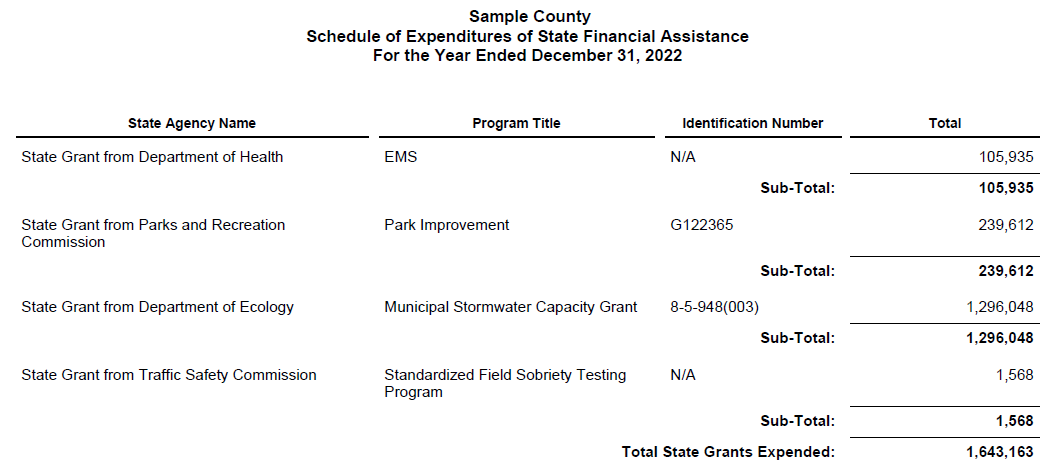
4 Reporting
4.8 SAO Annual Report Schedules
4.8.6 Public Works − Cities and Counties (Schedule 17)
| Quick Links |
| Instructions for cities |
| Instructions for counties |
Schedule instructions for cities
4.8.6.10 This Schedule applies to first class cities (RCW 35.01.010). The purpose of this Schedule is to document compliance with limitations on public works projects performed by public employees as described in RCW 35.22.620(2)(4).
Instructions for individual lines:
1. Record the total current public work construction budget, including any amendments.
2. This amount is 10 percent of line 1. RCW 35.22.620(2) sets this limitation on public works projects performed by public employees. The filing system will automatically calculate the amount for the limitation.
3. Subtract the amount, if any, that was in excess of the permitted amount in the prior budget period.
4. The filing system will automatically calculate the amount allowed by statute for public works performed by public employees for the current year (which calculates the difference in line 2 and line 3).
5. Record the total construction costs of public works performed by public employees for the year being reported. Be sure to include work performed for the city by a county.
6. This line is only pertinent to cities that budget on a biennial basis. For those municipalities, record on this line total construction costs of public works performed by public employees for the first year of biennium. If this line does not apply to you, enter “0” into the field.
7. This amount is the difference between the statutory limit computed on line 4 and the amount of public works performed by public employees recorded on lines 5 and 6. A negative number here indicates noncompliance with the limitations and must be carried forward to next budget period report. If this noncompliance is not corrected within two years, 20 percent of the motor vehicle fuel tax will be withheld (RCW 35.22.620(2)). This amount is automatically calculated in the filing system.
4.8.6.11 The Schedule should be prepared on the same basis of accounting, for the same period and reporting entity, and using the same underlying accounting records as the Schedule 01 and financial statements.
4.8.6.15 The Schedule must be completed within the annual filing system. The line items that require a calculation will automatically be calculated within the filing system. The following is an example of the fields required for this Schedule.
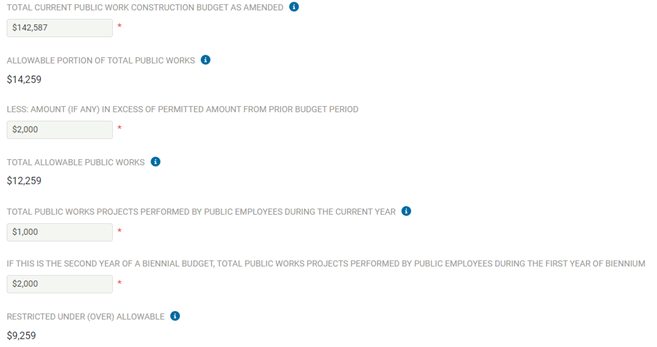
NOTE: If the restricted amount is over allowable, this amount must be carried forward to next budget period report.
Schedule instructions for counties
Part 1. Public Works Projects Performed by Public Employees
4.8.6.20 This part applies to counties that established purchasing departments and use public employees to perform public works projects (RCW 36.32.240(1), RCW 36.32.235).
4.8.6.30 The amount reported should include all public work, including county road construction. Public work is defined in RCW 39.04.010. For additional reporting requirements for county road construction projects, see Part 3 below.
4.8.6.40 Note: For counties with a purchasing department, due to changes removing the population requirement in RCW 36.32.235 effective in fiscal 2019 and possible conflicts with RCW 36.32.240, we would expect the county to consult with their legal counsel regarding the use of day labor and applicable limits. ALL counties are subject to limits for the county roads construction projects (RCW 36.77.065). See Part 3 of this Schedule for reporting requirements.
The template for the annual filing system to upload the information required for Part 1 is available on the SAO’s website at BARS Reporting Templates. The following is an example of the template.
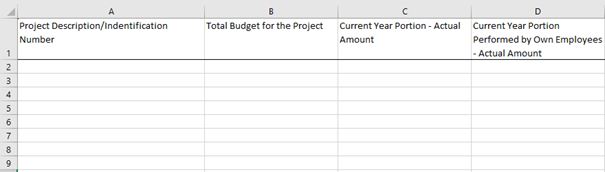
Part 2. Limitations on Public Works Projects Performed by Public Employees
4.8.6.50 This part applies only to counties which by resolution established a county purchasing department (RCW 36.32.240(1), RCW 36.32.235(8)).
Part 2 of the Schedule must be completed within the annual filing system. You will need to check the box in the filing system if Part 2 is applicable to your county. The line items that require a calculation will automatically be calculated within the filing system.
Instructions for individual lines:
1. Record the total current public work construction budget, including any amendments, from Part 1.
2. The filing system will automatically calculate the amount for the allowable portion of public projects performed by public employees. RCW 36.32.235(8) sets this limitation at 10 percent of line 1.
3. Subtract the amount, if any, that was in excess of the permitted amount in the prior budget period.
4. The filing system will automatically calculate the amount for the limitation on public works performed by public employees for the current year (line 2 less line 3).
5. Record the total construction costs of public works performed by public employees for the year being reported, from Part 1.
6. This line is only pertinent to counties that budget on a biennial basis. For those counties, record on this line total construction costs of public works performed by public employees for the first year of biennium. If this line does not apply to you, enter “0” into the field.
7. The filing system will automatically calculate the difference between the statutory limit computed on line 4 and the amount of public works performed by public employees recorded on lines 5 and 6. A negative number here indicates noncompliance with the limitations and must be carried forward to next budget period report. If this noncompliance is not corrected within two years, 10 percent of the motor vehicle fuel tax will be withheld (RCW 36.32.235(10)).
The following is an example of the fields required for this Schedule that is completed within the filing system.
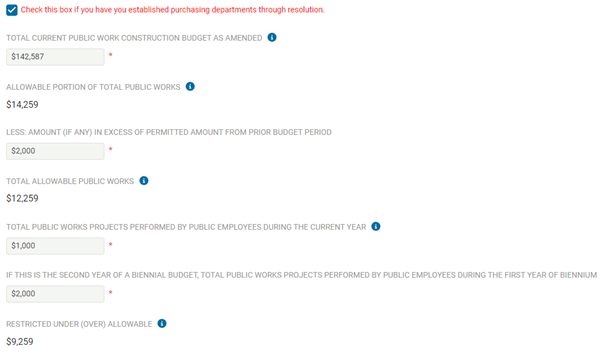
NOTE: If the amount of public works performed by public employees is over allowable, this amount must be carried forward to next budget period report.
Part 3. Limitations on County Roads Construction Projects Performed by Public Employees
4.8.6.60 This part applies to ALL counties (RCW 36.77.065). Counties are required to prepare and have available for an audit the Annual Construction Program and the Annual Construction Report forms, required by the County Road Administration Board, pertaining to the same calendar year.
Access to blank forms is at www.crab.wa.gov.
4 Reporting
4.8 SAO Annual Report Schedules
4.8.8 Sales and Use Tax for Public Facilities – Rural Counties (Schedule 20)
4.8.8.10 RCW 82.14.370 authorizes rural counties to impose sales and use tax of no more than 0.09 percent. This tax is credited against the 6.5 percent state sales tax and use tax and is paid by the Department of Revenue to eligible rural counties [1]. RCW 82.14.370(3)(b), requires the State Auditor’s Office to collect annual information on the use of these tax proceeds. The purpose of this schedule is to summarize use of these funds and demonstrate compliance.
4.8.8.20 The proceeds of this tax are restricted to financing public facilities [2] serving economic development purposes [3] in rural counties and finance personnel in economic development offices. The public facilities must be listed as an item in the officially adopted county overall economic development plan, or the economic development section of the county’s comprehensive plan, or the comprehensive plan of a city or town located within the county for those counties planning under RCW 36.70A.040, or provide affordable workforce housing infrastructure or facilities. For those counties that do not have an adopted overall economic development plan and do not plan under the Growth Management Act, the public facilities must be listed in the county’s public facilities plan or the capital facilities plan of a city or town located within the county, or provide affordable workforce housing infrastructure or facilities. No new projects funded with this money may be for justice system facilities.
The county must consult with cities, towns, and port districts located within the county and the associate development organization serving the county to ensure that the expenditure of money collected under the sales and use tax for public facilities RCW meets the goals of creating, attracting, expanding, and retaining businesses, providing family wage jobs, and providing affordable workforce housing infrastructure or facilities and the use of money collected under this section meets the requirements of the law.
4.8.8.30 The counties collecting this tax must file an annual schedule with the State Auditor’s Office 150 days after close of their fiscal year, listing the projects funded by this tax revenue in the previous fiscal year.
4.8.8.40 The schedule should be prepared on the same basis of accounting, for the same period and reporting entity, and using the same underlying accounting records as the Schedule 01 and financial statements.
4.8.8.50 The template for the filing system is available on SAO’s website page at BARS Reporting Templates.
Preparing the preformatted Schedule 20 template to upload into the filing system
Column A: List the name of the public facilities project. The name listed here should be the same as the project name listed in the government’s plan containing the project.
Note: Users (legislature, audit, etc.) of the Schedule 20 report information may review the plan document for additional information therefore use of the same project name is important.
Column B: Select from the drop down in the excel template the name of the government’s plan where the project is listed (e.g., Capital Facilities Plan, Comprehensive Plan, Economic Development Plan, etc.).
Column C: Name the lead agency for the project (e.g., City of Sample, Port of Sample, Sample County, etc.)
Column D: Provide a brief detailed description of the following: (1) purpose of the project, (2) of what the project expenditures entail (3) how the project meets the requirements of the RCW. This is limited to 500 characters.
Example 1: Construct ~20,000 sq. ft. Light industrial building at the Port of Example, costs include payment to construction company and project manager. This project will increase consumer product storage, bringing new shipping and receiving businesses to the area and increased access to consumer goods, increasing economic development and job growth.
Example 2: City of Sample is improving the recreation center, paying expenses for the construction company. This project will increase capacity in the theater area of the community center to bring in new entertainment to the area, increasing and promoting tourism and economic growth.
Example 3: Hired an economic development staff member to focus on increasing tourism to the area over the next three years. Expenses include staff wages, benefits, and required supplies for the employee to start work.
Column E: Select from the dropdown in the excel template the category of the project (e.g., Public Facilities, Economic Development Purposes, Economic Development Office, etc.) which is defined by RCW 82.14.370(C).
Column F: Input the year the project started. Must be inputted as the 4-digit fiscal year to avoid any upload errors.
Column G: Input the year the project is expected to be completed. Must be inputted as the 4-digit fiscal year to avoid any upload errors.
Column H: Input the specific amount of sales and use tax spent on the project in the fiscal year. Example: Project A spent $10,000 in sales and use tax in FY2022, therefore the total in column H would be $10,000 when reporting to SAO in 2023.
Column I: Input the accumulative total sales and use tax proceeds expended on the project from prior years up through the current fiscal year for which the government is reporting for. Example: Project A spent $10,000 in sales and use tax starting FY 2022, therefore the total in column I would be $10,000. Additionally, Project B has spent $25,000 in prior years and spent $25,000 in the current fiscal year, therefore column I would report $50,000.
Column J: Input the estimated number of businesses created and retained by the project. This number should carry over from year to year and only change if additional businesses are created/retained due to the project. Must be inputted as a number and no alpha characters will be accepted for the upload into the filing system. A number is required in this field and if left blank will result in an error after uploading into the filing system.
Column K: Input the estimated number of jobs created and retained by the project. This number should carry over from year to year and only change when jobs are either removed or added due to the project. Must be inputted as a number and no alpha characters will be accepted for the upload into the filing system. A number is required in this field and if left blank will result in an error after uploading into the filing system.
Sample Template of Schedule of Sales and Use Tax for Public Facilities
| (A) | (B) | (C) | (D) | (E) | (F) | (G) | (H) | (I) | (J) | (K) |
| Public Facilities Project Name | Plan Containing the Project | Lead Agency for Project | Project Description | Project Category | Project Start Year (YYYY) | Est. Project Completion Year (YYYY) | Amount of Sales & Use Tax Spent on the Project this Fiscal Year | County’s Cumulative Total of Sales & Use Tax Spent through this Fiscal Year | Est. # of Businesses Created/Retained by the Project | Est. # of Jobs Created/Retained by the Project |
| $ | $ | |||||||||
| $ | $ | |||||||||
| $ | $ | |||||||||
| $ | $ | |||||||||
| $ | $ | |||||||||
| $ | $ |
Footnotes
[1] Rural County means a county with a population density of less than one hundred persons per square mile or a county smaller than two hundred twenty-five square miles as determined by the Office of Financial Management.
Return to Reference 1
[2] Public Facilities means bridges, roads, domestic and industrial water facilities, sanitary sewer facilities, earth stabilization, storm sewer facilities, railroads, electricity, natural gas, buildings, structures, telecommunication infrastructure, transportation infrastructure, or commercial infrastructure and port facilities.
Return to Reference 2
[3] The legislative goal for RCW 82.14.370 is to promote the creation, attraction, expansion, and retention of businesses and provide for family wage jobs. Economic development means those purposes which facilitate the creation or retention of businesses and jobs in a county.
Return to Reference 3
4 Reporting
4.8 SAO Annual Report Schedules
4.8.9 Risk Management (Schedule 21)
Applicability of schedule
4.8.9.20 Schedule 21 is required for all local governments. The purpose of this schedule is to report information on how the government responds to risks/payments in the following categories: liability, property, health and welfare, unemployment compensation, workers’ compensation and Washington Paid Family & Medical leave. Local governments may assume the risk, purchase insurance, become a member of a risk pool, self-insure their own risks only (an individual self-insurance program) or self-insure jointly with other governments pursuant to Chapter 48.62 RCW or another enabling statute.
4.8.9.30 Local governments occasionally maintain or assume risk for one or more risks without setting resources aside as part of a self-insurance program. This activity does not constitute a self-insurance program under RCW 43.09.260(1).
4.8.9.40 Instructions to preparer:
Self-insurance / Risk Management Contact: This is generally the person responsible for designing and implementing an overall risk management process for the entity or the appropriate person to contact with questions about the entity's self-insurance programs.
Use the following definitions and information when preparing responses in the schedule for the method used by the entity to address risks related to property, liability, health and welfare, unemployment compensation, workers’ compensation and any other insurable risk.
Self-insurance: Risk management approach in which an entity accumulates financial resources and sets them aside to pay or fund future claims and probable losses, instead of transferring the risk by purchasing an insurance policy. Setting resources aside to fund a deductible as part of an insurance policy is not considered self-insurance. Budgeting for claims expenses does not constitute setting aside financial resources for purposes of self-insurance determination.
Risk assumption: Risk management approach in which an entity has an insurable risk of loss but neither purchases an insurance policy nor has a program to set aside funds to cover those obligations should they arise. In other words, the entity will simply pay the claims or losses as they arise without creating a program and setting money aside.
Public entity risk pool: A cooperative group of governmental entities joining together through a written agreement to finance an exposure, liability or risk. A pool may be a stand-alone entity or be included as part of a larger governmental entity that acts as the pool’s sponsor.
There are two basic types of public entity risk pools:
1. Risk is retained by members: Some public entity risk pools do not involve any transfer or pooling of risk among pool participants. Each participant is completely responsible for (and only responsible for) its own claims liabilities. In other cases, members pay a required contribution to a pool based on the individual member's claims/loss experience. If the member’s actual losses exceed the initial charge, the member will be assessed an additional amount to fully reimburse the pool. If the premium exceeds the losses, the entity will receive a refund. In all the above situations, risk has been retained by the member and it is considered to be self-insurance for the member. There are two main categories of these types of arrangements:
a) Banking: an arrangement by which monies are made available for pool members in the event of a loss on a loan basis.
b) Claims-servicing: an arrangement by which a pool manages separate accounts for each pool member from which the losses of that member are paid. Members contribute their funds to these accounts.
2. Risk is transferred to the pool: This is often referred to as a risk-sharing pool. In this case, the pool collects premiums that it estimates will cover the costs of all claims for which the pool is obligated. If a member's losses are different than its premiums, there is no regular, supplemental assessment or refund. The insurer (pool) views its activities in the aggregate, rather than on an individual insured member basis, which is the case for pools where risk is retained by members. In this situation, risk is shared by members, with the pool acting as the insurer. Although risk is transferred by members to the pool, it is not the same as purchasing an insurance policy since the pool is organized as a cooperative – the members remain liable for unpaid claims in excess of pool resources. Many risk pools have a “retroactive assessment” provision in their agreements whereby the risk pool will charge members in the event losses exceed available assets. Alternatively, pools may declare supplemental assessments or refunds depending on the loss experience of members or may increase or decrease premiums for future coverage. This type of arrangement is not considered self-insurance.
Unemployment compensation – taxable: The entity is assigned a rate that is applied to applicable wages and makes payments quarterly. Rates are reassessed annually by the Employment Security Department (ESD). The taxable basis is not considered self-insurance.
Unemployment compensation – reimbursable: The reimbursable status is considered self-insurance if funds are accumulated in advance and set aside to pay future claims. If no funds are accumulated in advance and set aside to pay future claims, then the entity is simply assuming risk and is not operating a self-insurance program. Entities must be approved for reimbursable status by the ESD. Entities report quarterly wages to the ESD. Unemployment claims are still managed, approved and paid by the ESD, but the ESD submits a quarterly claim for reimbursement to the entity for all claims paid on the entity’s behalf.
Workers’ compensation – premiums: The entity is assigned a rate that is applied to applicable wages and makes payments quarterly. Rates are reassessed annually by the Department of Labor and Industries (L&I). The taxable basis is not considered self-insurance.
Workers’ compensation – self-insured employer: Entities must submit for formal approval via an application to the L&I to operate as a self-insured employer. As a self-insured employer, the entity sets funds aside to pay for workers’ compensation claims, but L&I still reviews and approves all claims, and sends approved claims to the entity to pay.
Washington Paid Family & Medical Leave (PFML) – State Program: The entity pays assigned rates to ESD based on applicable gross wages. Claims are managed, approved and paid by the ESD. This is not considered self-insurance.
Washington Paid Family & Medical Leave (PFML) – Voluntary Plan: A PFML Voluntary Plan administered internally by an employer may be considered self-insurance. An employer must obtain approval from the ESD to offer a Voluntary Plan for one or both benefits, manage funds set aside from employer resources or withheld from employee pay, and maintain overall financial responsibility for paying claims for eligible events under program guidelines. When employer financial resources or employee withholdings are accumulated and set aside to pay claims, that employer is operating its Voluntary Plan as a self-insurance program. If the Voluntary Plan does not involve accumulating and setting aside funds, then the employer is not self-insuring and is instead engaging in risk assumption.
Use the following definitions and information to help complete the schedule if the entity self-insures for one or more class of risk.
Individual self-insurance program: A program established by an entity to accumulate financial resources and set them aside to pay or fund future claims and probable losses. This is in contrast to risk assumption, which is a decision to absorb the entity's financial exposure to a risk of loss without the creation of a program of advance funding of anticipated losses (i.e. just pay the claims/losses as they arise).
Joint self-insurance program: Any two or more local government entities which have entered into a cooperative risk sharing agreement subject to regulation under Chapter 48.62 RCW.
Third party administrator: An organization that processes claims and performs other administrative services in accordance with a service contract.
Claims audit: An audit conducted by an independent qualified claims auditor not affiliated with the program, its insurers, its broker of record, or its third-party administrator. The services performed generally include an in-depth, written evaluation of the claims handling activities, identifying strengths, areas of improvement, findings, conclusions and recommendations to improve quality of claims management and processing. These reviews are required to be performed every three years by state regulation for joint self-insurance programs covering property and liability risks (WAC 200-100-050) and individual and joint health and welfare programs offering medical coverage (WAC 200-110-120).
Actuarially determined liabilities: Joint property and liability programs are required to obtain estimates of unpaid claims measured at eighty percent confidence level by an actuary (WAC 200-100-03001). Joint and individual health and welfare programs are not subject to this requirement.
Number of claims paid during the period: The number of individual claims that were paid (in any amount) during the reporting period. In the case of unemployment compensation, this would be the claims paid by the government to ESD during the period.
Total amount of claims paid during the period: The total dollar amount of claims paid during the reporting period. In the case of unemployment compensation, this would be the claims paid by the government to ESD during the period.
Total amount of recoveries during the period: The total dollar amount of gross recoveries or subrogation received during the reporting period.
4.8.9.50 The schedule should be prepared on the same basis of accounting, for the same period and reporting entity, and using the same underlying accounting records as the Schedule 01 and financial statements.
4.8.9.60 The template for filing system is available on the SAO’s website page, BARS Reporting Templates. When using the filing system, the system will require completion of all questions and, based on the answers, indicate the need for completion of the schedule template. If required, this template will need to be attached in the filing system.
4 Reporting
4.8 SAO Annual Report Schedules
4.8.14 Assessment Questionnaire (Schedule 22)
Applicability
4.8.14.10 This Schedule is required for all of the following government types:
| Government Types |
| Fire districts |
| Local/regional EMS and trauma care councils |
| Conservation districts |
| Transportation benefit districts |
| Economic and industrial development corporations |
| Cemetery districts |
| Diking/drainage districts |
| Mosquito/pest/weed districts |
| TV reception districts |
| Water conservancy boards |
| No Activity governments* |
Revenue criteria
Additionally, governments with annual resource inflows usually less than $300,000 and some governments with annual resource inflows between $300,000 and $500,000 who will not receive an onsite audit are required to complete this schedule. For purposes of this threshold, annual inflows include tax collections, grants, loans and other receipts. A current year increase in resource inflows above the $300,000 threshold from a grant or bond does not preclude the government for completing the Schedule.
*Governments who file a no activity report will not be required to submit a Schedule 22. However, no activity reports are still required to submit supporting documents to verify no activity, such as meeting minutes, county reports and/or bank statements in the filing system.
4.8.14.20 If you are unsure whether or not your government should complete the Schedule 22, please contact the SAO by submitting your question through the SAO HelpDesk. You can also check a government’s requirement to submit a Schedule 22 by accessing the SAO Online Services and logging in using your credentials.
Frequency of small local government accountability audits
4.8.14.30 Current audit policy requires the Office to conduct certain audits, including assessment audits, every two years. This does not limit our ability to initiate or conduct special investigations and also would not prevent clients from requesting more frequent audits due to need or preference. If you want the SAO to audit your government on an annual basis instead of every two years, please contact us through the SAO HelpDesk.
The government’s Annual Report including the Schedule 22 must be submitted on an annual basis as required by RCW 43.09.230. The preferred method of submitting the annual report is through the SAO Online Services using the filing system. Most filers find the filing system to be easier and less work than mailing paper copies of the annual filing.
4.8.14.40 Instructions for preparer:
All questions must be answered with the most appropriate response for the government’s operations and all required attachments must be attached to the annual report, using the filing system or received via mail for the annual report to be considered complete.
Beginning with the fiscal year 2023 annual filing, local governments will have the ability to import their prior year responses for select Schedule 22 questions. Each question in the filing system will have a blue information icon that local governments can use to read additional guidance on what type of response SAO is looking for. These features are only available if using the filing system to complete the annual report.
4.8.14.50 Attachments
Questions that require an attachment will have an option to select the “attached” response and provide a button to attach the required document. If needed, you can attach multiple files individually or attach a compressed zip folder. If a local government chooses to mail copies of the required attachments, the annual report will not be considered complete until those are received at SAO and attached in the filing system.
Required information when applicable:
4.8.14.60 Minutes – All governments
Provide copies of the official minutes, all resolutions and/or ordinances for all regular and special meetings of the governing body held during the reporting year. You can attach your Word files to meet this requirement as we do not require PDFs of signed minutes. If minutes, resolutions, and ordinances are available on the government’s website, no minutes or resolution attachments are needed; just indicate the web address where the minutes can be found. Provide an explanation of any circumstances where minutes were not taken or are otherwise not available.
4.8.14.70 Detailed Revenue by Source – All governments
Attach a copy of a year-end County Treasurer’s Report that shows all receipts for the year by revenue source. The report should include all receipts for the year separated by type. Local governments that do not use a county as its treasurer will need to attach comparable accounting records to substantiate revenue activity and/or all bank statements for the year that compromise the government’s financial activity.
4.8.14.75 Cash Balance Summary – All governments
Attach a copy of the year-end County Treasurer (or other fiscal agent) report(s) inclusive of all year-end cash and investment balances. If the government holds funds outside of the County, please upload the first and last months bank statements of the years, inclusive of all cash and investment balances.
4.8.14.80 Detailed Expenditure List – All governments
Attach a detailed list of all expenditures for the year. The report should include all expenditures made during the fiscal year and include the following minimum information:
If the County Treasurer is used, a warrant register or expenditure listing can usually be obtained from the county showing this information. Governments that do not use the County Treasurer can provide copies of the check register. Governments should also submit copies of imprest checking account activities and petty cash logs.
4.8.14.90 Cash Receipting policy – All governments
Every government that receives cash or checks (other than through the County Treasurer) should have a written policy or procedure that directs staff how to process receipts when received either over the counter, through the mail or in a drop box. The policy should address receipting, securing receipts, depositing, reconciliations and accounting for receipts. If the district does not have a written policy, attach a detailed description of the process used by the government including the names of the positions participating in the process, and any reconciliations or reviews performed.
4.8.14.100 Board members – All governments
In the annual filing system, add the applicable number of rows that correlates with the number of governing body members and complete the table with the required information. It is required to provide the full names of each member, each board member’s spouse (if applicable), any businesses owned or operated by the member or a household member (e.g. spouse, children, etc.) and the board member’s contact information (phone number, email, and mailing address). This information is needed to evaluate conflict of interest statutes.
4.8.14.140 Preparer information – All governments
Auditors often have questions about information and attachments included in the annual report. In order to resolve questions quickly, we require governments to provide contact information for the person completing the Schedule 22. Because of their small size, many government offices are not manned daily and it requires us to contact the preparer or approving governing board member at their home or on their cell phone. If your office is not manned daily, please provide contact information where we can expect to contact the preparer.
4.8.14.150 Template
The Schedule 22 is a web-based form and is best completed using the filing system. If a local government wants to complete a paper version of the questionnaire, please email LGCSfeedback@sao.wa.gov to request that.
| BARS Manual PDF | PDF of the Cash BARS 2022 |
| 02/07/2023 | Opioid Settlement Update |
| 12/17/2022 | Annual update, see changes in table below |
Overview of Changes – Applicable to the Reporting Year 2022
| Topic | Reference | Description of Changes |
| Chart of Account | ||
| BARS Account Export | 512.50 (Municipal Court Expenses) | 512.50 (Municipal Court Expense) – Retired see 512.51 and 512.52 |
| 512.51 (Non-Contracted Court) | 512.51 New Code – This code is to be used for municipal governments that provide their own court services. | |
| BARS Account Export | 512.52 (Contracted Courts) | 512.52 New Code – This code is to be used when a municipal government contracts out their court services and should also be used by governments providing the court services to another municipality. |
| BARS Account Export | 54P (Transportation) | Transportation codes are restricted to governmental funds (Exceptions are codes 542.65, 547.10, 546.00, 547.20) |
| BARS Account Export | 341.81 (Data/Word Processing, Printing, Duplication & IT services) | 341.81 (Data/Word Processing, Printing, Duplication & IT services) Allowed for Fire Districts that provide IT services to other Fire Districts. |
| BARS Account Export | 518.61 (Judgments & Settlements) | 518.61 (Judgments & Settlements) Restricted to fund types 100, 200, 300, 500, 700. Only to be used by general purpose governments. |
| BARS Account Export | 333.45.30 (Federal Indirect Award from Institute of Museum and Library Services (IMLS)) | 333.45.30 New Code – This code is to be used for federal indirect awards from the Institute of Museum and Library Services (IMLS). |
| BARS Account Export | 331.45.30 (Federal Direct Award from Institute of Museum and Library Services (IMLS)) | 331.45.30 New Code – This code is to be used for federal direct awards from the Institute of Museum and Library Services (IMLS). |
| BARS Account Export | Added instructions and a new resource "Codes to Funds" | Added instructions for chart of accounts export. All codes from the Chart of Accounts as of November 30th are included in the resource with the allowable fund types indicated. |
|
Budgeting |
||
| Budget Adoption and Amendments | 2.4.3 | 2.4.3 Removed statement that this guidance applies only to cities and counties since it applies to all government types. |
|
Accounting |
||
| Original Supporting Documentation | 3.1.4 | 3.1.4 Clarified guidance on electronic documentation and digital signatures. |
| Fund Types & Accounting Principles | 3.1.7 | 3.1.7.40 – Clarified how to account for non-cash transactions and receipting by a third party for the benefit of the government. 3.1.7.50 – Clarified which transactions can be reported in Permanent Funds. |
| Leases and Installment Purchases | 3.4.1 | 3.4.1 Leases – New section for the leases standard |
| Intergovernmental and Forgivable Loans | 3.4.7 | 3.4.7 Intergovernmental and Forgivable Loans – Moved accounting for forgivable loans out of the Schedule 09 instructions and added information on intergovernmental loans. |
| Accounting for LOCAL Program Financing Activities | 3.4.11 | 3.4.11.30 – Added that deposits of LOCAL program resources into bank accounts besides LGIP still must be reported. |
| Pension Liabilities | 3.4.13 | 3.4.13 Updates, changes, and clarifications for reporting pensions made throughout. |
| Other Postemployment Benefits (OPEB) | 3.4.16 | 3.4.16 Updates, changes, and clarifications for reporting other postemployment benefits made throughout. |
| Federal Awards - Accounting | 3.7.1 | 3.7.1 Updates, changes, and clarifications for reporting federal awards made throughout (annual updates). |
| Use of Payroll and Claims Funds | 3.8.6 | 3.8.6.30 – Added information on registered warrants issued by counties. |
| Imprest, Petty Cash and Other Revolving Funds | 3.8.8 | 3.8.8.20 – Added a new section, bullet 6, for debit and ATM card use. |
| Interfund Loans | 3.9.1 | 3.9.1.10 – Added when interfund loans could be used and requirements for interfund loans from the General Fund. 3.9.1.31 – Added information on negative fund balances and the accounting for those balances. 3.9.1.32 – Added information on when interfund payments become interfund loans. |
| Limitation of Indebtedness | 3.10.5 | 3.10.5.60 – Changed capital leases to installment purchases 3.10.5.70 – Added leases to the obligations that do not constitute debt for debt limitation. |
| Promotional Hosting | 3.10.7 | Added public facility districts to governments that can participate in promotional hosting. |
| Reporting | ||
| Reporting Requirements and Filing Instructions for Cities and Counties | 4.1.5 | Removed Schedule 19 from the list of required schedules. |
| Reporting Requirements and Filing Instructions for Special Purpose Districts | 4.1.6 | Removed Schedule 19 from the list of required schedules. |
| Determining Fiduciary Activities to be Reported in Custodial Funds | 4.3.14 | 4.3.14 Added determinations for Flexible Savings (FSAs) and Health Savings Accounts (HSAs), both when a government controls the asset and when the government does not. |
| Sales and Use Tax for Public Facilities – Rural Counties (Schedule 20) | 4.8.8 | 4.8.8 Added an example of the new online filing template for Schedule 20. |
| Expenditures of Federal Awards (Schedule 16) | 4.14.5 | 4.14.5 Updates, changes, and clarifications for reporting federal awards made throughout (annual updates). |
| Schedule of Long-term Liabilities (Schedule 09) | 4.14.13 | 4.14.13 Removed information on forgivable loans. It was moved to the new Intergovernmental and Forgivable Loans section. Added Schedule 09 lease reporting ID#s. |
| Note X – Budget Compliance | Note X – Budget Compliance | Added information for reporting biennial budgets. |
| Note X – COVID-19 | Note X – COVID-19 | Removed the requirements for all governments to report this note. |
| Note X – Fiduciary Activities | Note X – Fiduciary Activities | Removed. |
| Note X – Going Concern | Note X – Going Concern | Added instructions for when to use each part of the note. |
| Note X – Leases (Lessees) | Note X – Leases (Lessees) | New note for disclosing lease liabilities. |
| Note X – Long-term Debt | Note X – Long-term Debt | Added information for conduit debt. |
| Note X – Pension Plans | Note X – Pension Plans | Updates, changes, and clarifications for reporting pensions made throughout. |
| Note X – Telecommunications | Note X – Telecommunications | New note for governments that are providing telecommunications services (wholesale and retail broadband). |
| Online Filing | ||
| Schedule 01 Templates | BARS Reporting Templates | Schedule 01 templates for online filing schedules have been updated. |
| Pension and OPEB Templates | BARS Reporting Templates | Fiscal year 2022 Pension Calculation Worksheet template is available for download. |
| Schedule 19 – Labor Relations | BARS Reporting Templates | Removed due to change in state law. |
| BARS Manual PDF | PDF of the Cash BARS 2021 |
| 12/17/2021 | Leases accounting is effective for fiscal year 2022 reporting in 2023. See the Leases project page for more information. |
| 12/17/2021 | Annual update, see changes in table below |
Overview of Changes – Applicable to the Reporting Year 2021
| Topic | Reference | Description of Changes |
| Chart of Account | ||
| BARS Account Export | All BARS Codes | Remember to download the most current version of the BARS Chart of Accounts. |
| 344.70 (Transits, Railroads and Other Transportation Systems Services) | 344.70 (Transits, Railroads and Other Transportation Systems Services) - Retired code, please see 344.71 and 344.72 | |
| BARS Account Export | 344.71 (Transits, Railroads and Other Transportation Systems Services) | 344.71 New Code - Include private vanpool charges, streetcar and monorail fares, disabled/aging transportation fees, etc. For cities/counties: this code is not reported on the road/street report to WSDOT. |
| BARS Account Export | 344.72 (Ferry and Water Taxi Services) | 344.72 New Code - Include the proceeds of ferries and water taxis. Include a vessel replacement surcharge fee (RCW 36.54.200) |
| BARS Account Export | 369.70 (Pension/OPEB Contributions) | 369.70 (Pension/OPEB Contributions) Should only be used for contributions made to a pension/OPEB plan administered by the reporting government. Not for use in the fiduciary funds. |
| BARS Account Export | 518.61 (Judgments and Settlements) | 518.61 (Judgments and Settlement) Updated description to include proprietary funds |
| BARS Account Export | 544.70 (Miscellaneous) | 544.70 (Miscellaneous) - Retired, use appropriate 544XX codes |
| BARS Account Export | 547.00 (Transits, Railroads and Other Transportation Systems Services) | 547.00 (Transits, Railroads and Other Transportation Systems Services) - Retired, please see 547.10 and 547.20 |
| BARS Account Export | 547.10 (Transits, Railroads and Other Transportation Systems Services) | 547.10 New Code - This account should be used only if the local government operates its own, or with other governments, transit, railroad or other transportation system. These expenditures are related to public transportation. For cities/counties: this code is not reported on the road/street report to WSDOT. |
| BARS Account Export | 547.20 (Ferry and Water Taxi Services) | 547.20 New Code - This account should only be used if the local government operates its own, or with other governments, ferries and/or water taxis. |
|
Accounting |
||
| Fund Types & Accounting Principles | 3.1.7 | Internal Service Funds - Added guidance on accounting for internal service funds providing services to fiduciary funds and the use of internal service funds at special purpose districts. |
| County External Investment Pools | 3.2.9 | Updated and clarified this section. Applicable to all counties. |
| Capital Asset Management | 3.3.8 | 3.3.8.10 Added the definition of impairment and the coding of impairment transactions. |
| Refunding Debt | 3.4.14 | 3.4.14.100 Updated the journal entry examples for refunding debt. |
| Environmental and Certain Assets Retirement Liabilities | 3.4.18 | 3.4.18.30, 3.4.18.45, 3.4.18.50 Added clarifications on reporting non-environmental asset retirement obligations and what can cause an asset retirement obligation |
| Criminal Justice Funding | 3.6.4 | 3.6.4.10 Added how to code the sale of confiscated and forfeited items. |
| Impact Fees | 3.6.14 | New section - Added the accounting for impact fees under RCW 82.02 and 39.92.040 |
| Federal Awards - Accounting (Formerly Grants - Accounting) | 3.7.1 | 3.7.1 Changed title to Federal Awards to include all items that must be reported on the Expenditures of Federal Awards (Schedule 16). Updates, changes, and clarifications for reporting awards made throughout. |
| Certain Grants and Other Financial Assistance (Formerly Pass-Through Grants) | 3.7.2 | 3.7.2 Changed title to Certain Grants and Other Financial Assistance to match national standard titles. |
| Purchase Cards | 3.8.4 | 3.8.4.10 Removed references to debit cards Added Additional Reference Section |
|
Reporting |
||
| Reporting Requirements and Filing Instructions for Cities and Counties | 4.1.5 | 4.1.5.30 Clarified instances where cities/towns and counties do not need to prepare financial statements. |
| Reporting Requirements and Filing Instructions for Special Purpose Districts | 4.1.6 | Added Footnote 2 for no activity governments reporting, no formal Schedule 22, but the government must attach bank statements and any meeting minutes for the fiscal year. 4.1.6.20 Clarified instances where special purpose districts do not need to prepare financial statements. 4.1.6.25 Updated the definition for no financial activity to include small automatic bank fees and SAO audit billings. |
| Revenues/Expenditures/Expenses (Schedule 01) | 4.8.1 | Rewrote the section to provide additional links and instructions. |
| Public Works (Schedule 17) | 4.8.6 | 4.8.6.30 Clarified that the amount reported on the Schedule 17 should include all public works, including county road construction. |
| Risk Management (Schedule 21) | 4.8.9 | 4.8.9.40 Clarified definitions in the instructions to preparer. |
| Annual Questionnaire for Accountability Audit (Schedule 22) | 4.8.14 | 4.8.14.10 Added clarification that governments who file a no activity report will not be required to submit a formal Schedule 22, but will need to submit supporting documents. |
| Expenditures of Federal Awards (Schedule 16) | 4.14.5 | Added Quick Links to specific guidance 4.14.5.70 Added additional information on COVID-19 Expenditures including donated personal protective equipment purchased with COVID-19 federal financial assistance, COVID 19 Vaccines - Immunization Cooperative Agreements CFDA #93.268, Provider Relief Fund (PRF) CFDA #93.498 4.14.5.155 Moved and retitled 4.14.5.230 to Preparing the preformatted SEFA template for upload to Online Filing 4.14.5.180 Added yellow flag caution under column 4 instructions. 4.14.5.230 Changed to example of finalized Schedule of Expenditures of Federal Awards. |
| Note 1 – Summary of Significant Accounting Policies | Note 1 – Summary of Significant Accounting Policies | Corrected ending classifications that are different from GAAP bullet. |
| Note X – Joint Ventures, Component Unit(s), and Related Parties | Note X – Joint Ventures, Component Unit(s), and Related Parties | Clarified when a joint venture, component unit and foundation should be reported. Separated related party from the other items. |
| Note X – COVID-19 | Note X – COVID-19 | All local governments must include this note. Provided examples for when there has been no substantial impacts. |
| Note X – Environmental and Certain Asset Retirement Liabilities | Note X – Environmental and Certain Asset Retirement Liabilities | Removed section from Note X - Other Disclosures and provided more examples for different situations. |
| Note X – Other Disclosures | Note X – Other Disclosures | Removed the Environmental and Certain Asset Retirement Liabilities section. |
| Online Filing | ||
| Schedule 01 | Schedule 01 | Schedule 01 templates for online filing schedules have been updated. |
| Pension and OPEB Templates | Pension and OPEB Templates | Fiscal year 2021 Pension and OPEB templates are available for download |
| Online Filing Flag Descriptions | Online Filing Flag Descriptions | Updated the Guide to Online Filing Flag Descriptions to include new red flags. |